
Rione X Campitelli in Roma in Città metropolitana di Roma Capitale, Latium, Rome, Italy — Central Italy (Tyrrhenian Coast)
Il Vittoriano: Monumento della Celebrazione
⎯⎯⎯
The Vittoriano: Monument of Celebration

Photographed by James Hulse, June 24, 2023
1. Il Vittoriano: Monumento della Celebrazione / The Vittoriano: Monument of Celebration Marker

Nel 1878 la memoria di Vittorio Emanuele II, morto nel gennaio, è quella del padre della nuova Italia unita. Il governo decide di glorificare la sua figura con un monumento che fosse contemporaneamente "l'affermazione bronzea e marmorea della creazione della nuova nazione, dopo la stagione del Risorgimento. Alla proposta di realizzazione di un Arco trionfale che restituisse il re nelle vesti di un antico imperatore, segue un concorso internazionale per individuare l'architetto capace di rappresentare non solo attraverso l'architettura grandiosa ma anche con la mediazione di tutte le arti e gli artifici della tecnica, la rinascita degli ideali della storia e dell'impegno civile della novella patria, dopo le lotte del Risorgimento.
La scelta del luogo cade presso le pendici del monte Capitolino, in asse con la Via del Corso nel cuore della Roma antica, costretta a sacrificare fasi della sua storia: spariscono con la realizzazione del grandioso monumento, i quartieri medievali e rinascimentali, ove è anche la casa di Michelangelo, viene spostato il Palazzetto Venezia (scomposto e ricostruito poi nel 1899 a fianco della basilica paleocristiana di S. Marco), viene interrotto il viadotto che congiunge il palazzo Venezia con la torre di Paolo III, quindi, è distrutto il tessuto connettivo della piazza. Queste antiche testimonianze vengono tutte sacrificate e oggi questa distruzione, a distanza di oltre un secolo, è ormai giustificata dal momento storico e sovrastata dal messaggio celebrativo e magniloquente dell’"Unità nazionale" che il monumento esprime "ad alta voce".
A seguito del concorso vinto da G. Sacconi nel 1880, inizia la realizzazione del monumento nel 1885 che si protrarrà fino al 1911, anno dell'inaugurazione in occasione dell'Esposizione universale. Alla morte dell'architetto marchigiano (1905), la direzione architettonica dei lavori è affidata a G. Koch, P. Piacentini e M. Manfredi. Il complesso programma decorativo, ispirato a soluzioni del mondo classico come già l'architettura esemplificata sui santuari ellenistici e laziali come quello di Palestrina, costituisce un "museo all'aperto" della scultura in marmo e bronzo tra fine Ottocento e inizi Novecento, con una rassegna di opere eseguite da oltre settanta scultori di varia provenienza.
Figure simboliche si alternano ad allegorie in riferimento ai principi etici dell'Italia e del suo popolo, distinto in Regioni, Città e Mari. I gruppi statuari denunciano le virtù e la tenacia tesi all'acquisizione della pace e della libertà, in un contesto dominato dalle Arti e dalle Scienze umane. Si snoda per tutta la superficie del monumento, una narrazione che ha il suo fulcro tematico nelle due iscrizioni latine sulle testate dei due propilei, in quello di sinistra è scritto: "PATRIAE UNITATI", ossia "all’Unità della patria", e in quello di destra: "CIVIUM LIBERTATIS", ossia "alla Libertà del cittadini Entrambe sono sormontate in alto ad 81 metri di altezza da Quadrighe bronzee di C. Fontana e P. Bartolini (1927). Nella parte destra del monumento, si trovano i soggetti ispirati al tema della Liberta con le statue della Guerra e della Rivoluzione (sulla porta del museo sottostante), i grandi gruppi della Forza e della Concordia (sulla balustra del primo livello) e il gruppo bronzeo del Pensiero (al lato della scala d'accesso). Nella parte sinistra, invece, si svolgono le tematiche allusive all'Unità con le statue della Politica e della Filosofia (sulla porta del museo sottostante), i gruppi del Sacrificio e del Diritto (sulla prima terrazza) e il gruppo bronzeo dell'Azione (al lato). Un fregio continuo con le statue delle sedici Regioni dell'Italia di fine Ottocento corre al centro tra i due propilei, ognuna con i suoi attributi, opere di N. Cantalamessa. A. Apolloni, M. Rutelli e A. Zocchi. Coppie di allegorie simboleggianti le Arti dell'Architettura, della Musica, a sinistra, della Pittura e della Scultura, a destra, decorano gli ingressi. Sull'ampia fascia, sottostante la statua equestre, si dispongono quattordici statue di figure femminili classicheggianti, rappresentanti le Città italiane che rinunciarono ai privilegi in favore di Roma Diverse Vittorie alate in bronzo, dorate, si ergono alla fine della prima scalinata, davanti alle entrate dei propilei e sulle colonne trionfali, con i simboli della palma (la statua equestre, si dispongono quattordici statue di figure femminili classicheggianti, rappresentanti le Città italiane che rinunciarono ai privilegi in favore di Roma. Diverse Vittorie alate in bronzo, dorate, si ergono alla fine della prima scalinata, davanti alle entrate dei propilei e sulle colonne trionfali, con i simboli della palma (la vittoria), dell'alloro (il valore), dell'ulivo (la pace) e della corona di quercia (la forza).
Controversa la statua del re Vittorio Emanuele, per la cui realizzazione vennero banditi tre concorsi, a seguito della proposta di Sacconi ormai malato, di un re in vesti civili. La statua equestre, in linea con gli autorevoli modelli romani e rinascimentali, progettata poi da E. Chiaradia viene eseguita da Gallori solo tra il 1907 e il 1910, con la fusione di cinquanta tonnellate di bronzo. Alla base di questa, successivamente è realizzato l'Altare della Patria con il fregio di A. Zanelli (1909-10) che, al posto dei momenti delle lotte risorgimentali pensati da Sacconi, scolpisce le teorie del Lavoro e dell'Amor patrio, convergenti verso la statua della Dea Roma, al centro entro una nicchia.
La volontà di commemorare i caduti della prima guerra mondiale si trasforma nella soluzione di una tomba di un "Ignoto Milite" (1921), in corrispondenza della statua del re, sotto l'edicola della dea Roma.
Anche negli interni regna l'allegoria civile e l'esaltazione dei canoni classici: il portico curvilineo esteso per 72 metri ospita un soffitto a lacunari, ideato da Koch, con elementi del Pantheon e della Basilica di Massenzio, e bassorilievi eseguiti da G. Tonnini (1911); anche i pavimenti sono d'ispirazione pompeiana, La tradizione classica trionfa nei 9 Trofei d'Arme, insiemi di corazze, scudi, bandiere e lance, tra cui figurano anche gli emblemi di Casa Savoia ed ancora nelle figure femminili delle Scienze. Un gusto più avanzato, ormai pienamente liberty, si ravvisa, invece, nelle lunette a mosaico eseguite da G. Bargellini e A. Rizzo che esprimono, nel gusto orientaleggiante e nell'accesa cromia delle composizioni, una distanza non solo temporale (1885-1911) ma un evidente divario tra l'ossequio celebrative dell'architettura iniziale e dei suoi primi artefici e la libertà delle scelte artistiche del primo Novecento, in assoluta autonomia e originalità rispetto ai temi indicati dalla cultura ufficiale.
Didascalie
(Foto #1) E. Chiaradia, E. Galleri, Statua equestre di Vittorio Emanuele II
(Foto #2) G. Sacconi, Progetto vincitore per il secondo concorso
(Foto #3) A. Zanelli, Dea Roma (al di sotto la Tomba del Milite Ignoto)
(Foto #4) A. Zanelli, Quadriga de La Libertà
Arch portraying the king as an emperor of the ancient world was followed by an international competition held to find an architect with the capability to represent, not only through great architecture but also by means of all the arts and the artifices of technology, the rebirth of the ideals of the history and civil commitment of the young nation after the risings of the Risorgimento. The choice of site fell on a spot near the slopes of the Capitoline Hill, facing Via del Corso in the very heart of Ancient Rome, which meant sacrificing whole phases of the city's history with the construction of the grandiose monument, medieval and Renaissance neighbourhoods disappeared, including the house of Michelangelo: Palazzo Venezia was moved (dismantled to be later rebuilt next to the early Christian basilica of St. Mark in 1899), the viaduct joining Palazzo Venezia to the Paul III tower was partially demolished and so the very "connective tissue” of the square was destroyed. Today, after more than a century, the destruction of all that bore witness to the city's past is justified by the historical events of the time and diminished by the commemorative and magniloquent message of "national unity" that the monument expresses "loud and clear". After G. Sacconi winning the competition in 1880, the building of the monument commenced in 1885 and continued until 1911. when it was inaugurated on the occasion of the Universal Exhibition. When the architect, native of the Marches region, died in 1905, the supervision of the architectonic works was entrusted to G. Koch, P. Piacentini and M. Manfredi. The decorative complex is inspired by Classic styles examples of which can be found in the architecture of Hellenistic and Latium sanctuaries such as that of Palestrina and amounts to an "open air museum” of marble and bronze sculptures from the late 19th and early 20th century that are the work of over seventy sculptors of diverse provenance.
Symbolic and allegoric figures alternate and refer to the ethical principles of Italy and her people, divided into Regions, Cities and Seas. The sculptural groups express the endeavour to gain peace and liberty through virtue and tenacity in a context dominated by the Arts and the Human Sciences. A story unfolds over the whole surface of the monument the central theme of which is found in the Latin inscriptions on the headpieces of the two propylaea: in the left-hand one the words "PATRIAE UNITATI" to the Unity of the Fatherland) are written and in the right-hand one "CIVIUM LIBERTATI (to the Liberty of the Citizens). Both are surmounted at a height of 81 metres by bronze Quadrigas, the work of C. Fontana and P. Bartolini (1927). On the right of the monument the subjects inspired by the theme of Liberty are found in the statues of War and Revolution (on the door of the museum housed in the base of the structure), in the large groups of Strength and Concord (on the balustrade on the first level) and in the bronze group Thought (beside the flight of steps). On the left the themes with allusions to Unity are developed in the statues representing Politics and Philosophy (on the door of the museum housed in the base of the structure), in the groups portraying Sacrifice and Rights (on the first terrace) and in the bronze group portraying Action (to one side). A continuous frieze with the statues of the sixteen Regions of Italy that existed in the late 1800s runs along the centre of the monument between the two propylaea, each with its own symbol, the work of N. Cantalamessa, A. Apolloni, M. Rutelli and A Zocchi. Pairs of allegoric figures symbolising the Arts adorn the entrances: Architecture and Music on the left, Painting and Sculpture on the right. On the ample frieze beneath the equestrian statue stand fourteen female figures of a classical style representing the Cities of Italy that forwent privileges in Rome's favour. Winged Victories in gold-plated bronze stand at the top of the first flight of steps, in front of the entrances of the propylaea and on the triumphal columns with symbols of palm (victory), laurel (valour), olive (peace) and a wreath of oak (strength). For the controversial statue of King Victor Emmanuel three competitions were held following the proposal advanced by Sacconi, by now in a poor state of health, for a king in civilian clothing. The equestrian statue, in the authoritative Roman and Renaissance tradition, designed in the end by E. Chiaradia, was to be carried out by Gallori only between 1907 and 1910, and required the fusion of fifty tons of bronze. At the base of this statue the Altar to the Fatherland was subsequently added with the frieze by A. Zanelli (1909-10) who, in place of scenes from the Risorgimento risings, wanted by Sacconi, sculpted the Procession of Work and Love for the Fatherland that converge on the central statue of the Goddess Rome standing in a niche. The wish to commemorate the fallen of the First World War found a solution in the tomb of the "Unknown Soldier" (1921) that is found directly beneath the aedicule of the goddess Rome above which rises the statue of the king. Civil allegory and the exaltation of the canons of classicism also reign inside the monument: the curvilinear portico that extends for 72 metres has a lacunary ceiling created by Koch, with elements from both the Pantheon and the Basilica of Maxentius, and bas-reliefs, the work of G. Tonnini (1911); the floors take their inspiration from Pompeian architecture. The classical tradition prevails in the 9 Trophies of Arms, arrays of armour shields, flags and lances, among which the emblems of the House of Savoy are to be seen and also in the female figures of the Sciences. A later style, decidedly Art Nouveau, can be clearly recognized la the mosaic lunettes, the work of G. Bargellini and A. Rizzo, Both their oriental style and the vivid tones of the compositions reveal not only a certain time span (1885-1911) but also an obvious difference between the commemorative homage of the early architecture and its artists and the freedom of artistic expression of the early 20th century, absolutely autonomous and original compared to the themes suggested by the official culture.
Captions
(Photo #1) E. Chiaradia, E. Galleri, Equestrian Stratham of Vittorio Emanuele II
(Photo #2) G. Winning project for the second competition
(Photo #3) A. Zanelli, Dea Roma (underneath the Tomb of the Unknown Soldier)
(Photo #4) A. Zanelli, Quadriga de La Liberta
Erected by Ministry
this page online
Topics. This historical marker is listed in this topic list: Architecture. A significant historical year for this entry is 1878.
Location. 41° 53.685′ N, 12° 29.029′ E. Marker is in Roma, Lazio (Latium, Rome), in Città metropolitana di Roma Capitale. It is in Rione X Campitelli. It is at the intersection of Via dei Fori Imperiali and Via di S. Pietro in Carcere, on the left when traveling north on Via dei Fori Imperiali. The marker is located directly at the base of the monument. Touch for map. Marker is in this post office area: Roma, Lazio 00186, Italy. Touch for directions.

Regionally, it is in Europe, the European Union, the Schengen Area, a coastal Mediterranean country, and the Western World. Historically, it finds itself in what was once the Byzantine Empire and specifically also the Roman Empire.
Other nearby markers. At least 8 other markers are within walking distance of this marker: A Cinquant'anni dalla Liberazione di Roma / Fifty Years After the Liberation of Rome

Photographed by James Hulse, June 24, 2023
2. The view of the marker along the wall of the Victor Emmanuel II monument
More about this marker. There are duplicates of this marker.
Photographed by James Hulse, June 24, 2023
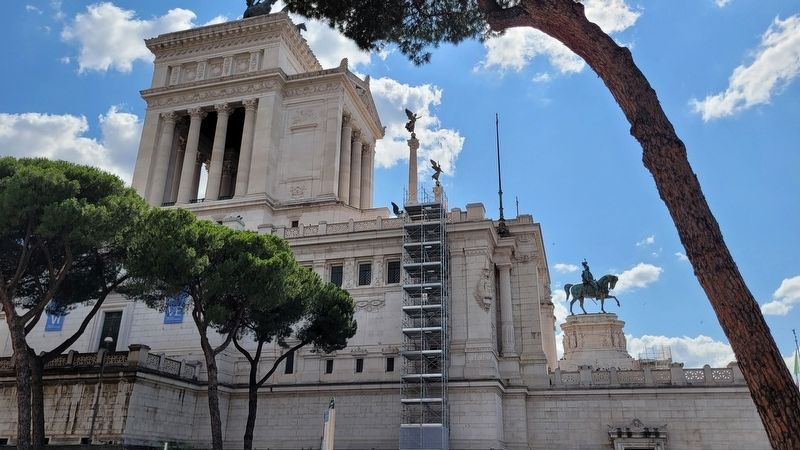
3. The view of the east side of the Victor Emmanuel II monument
The marker is located directly at the base of the monument just off camera.

Photographed by James Hulse, June 24, 2023
4. Victor Emmanuel II

Photographed by James Hulse, February 28, 2024
5. The reverse view of the Victor Emmanuel II statue
Credits. This page was last revised on March 13, 2025. It was originally submitted on March 11, 2025, by James Hulse of Medina, Texas. This page has been viewed 105 times since then and 17 times this year. Photos: 1, 2, 3, 4, 5. submitted on March 13, 2025, by James Hulse of Medina, Texas.
