Durango in La Plata County, Colorado — The American Mountains (Southwest)
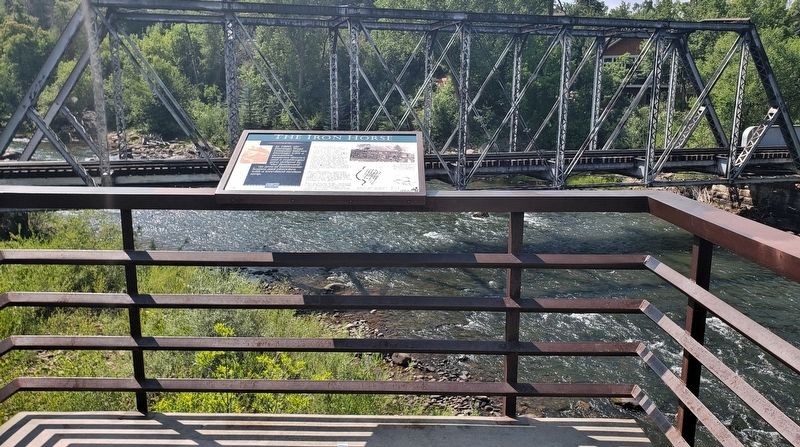
The Iron Horse
Photographed by Cosmos Mariner, July 25, 2024
1. The Iron Horse Marker
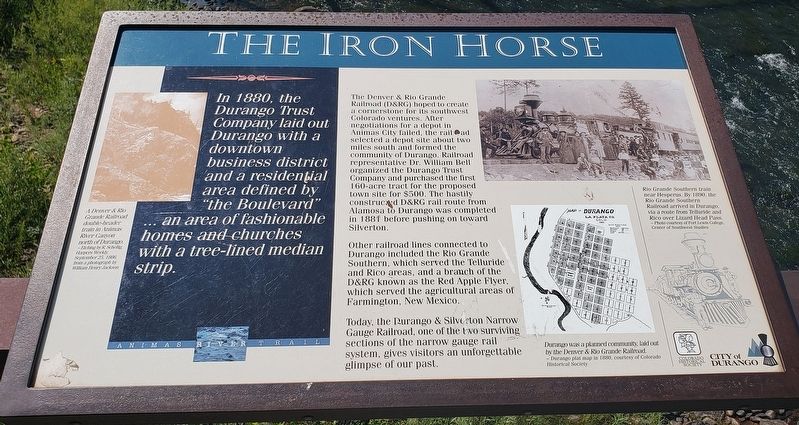
In 1880, the Durango Trust Company laid out Durango with a downtown business district and a residential area defined by “the Boulevard” …an area of fashionable homes and churches with a tree-lined median strip.
The Denver & Rio Grande Railroad (D&RG) hoped to create a cornerstone for its southwest Colorado ventures. After negotiations for a depot in Animas City failed, the railroad selected a depot site about two miles south and formed the community of Durango. Railroad representative Dr. William Bell organized the Durango Trust Company and purchased the first 160-acre tract for the proposed town site for $500. The hastily constructed D&RG rail route from Alamosa to Durango was completed in 1881 before pushing on toward Silverton.
Other railroad lines connected to Durango included the Rio Grande Southern, which served the Telluride and Rico areas, and a branch of the D&RG known as the Red Apple Flyer, which served the agricultural areas of Farmington, New Mexico.
Today, the Durango & Silverton Narrow Gauge Railroad, one of the two surviving sections of the narrow gauge rail system, gives visitors an unforgettable glimpse
this page online
Erected by City of Durango and Colorado Historical Society.
Topics. This historical marker is listed in these topic lists: Industry & Commerce • Railroads & Streetcars • Settlements & Settlers. A significant historical year for this entry is 1880.
Location. 37° 16.825′ N, 107° 52.568′ W. Marker is in Durango, Colorado, in La Plata County. It can be reached from East 2nd Avenue north of East 15th Street, on the right when traveling north. The marker is located on the Animas River Trail, at the midpoint of the footbridge across the river, overlooking the adjacent train trestle that also crosses the river. Touch for map. Marker is in this post office area: Durango CO 81301, United States of America. Touch for directions.

Regionally, this marker is in the American Mountain West and at the Four Corners. Globally, it is in North America, the Rocky Mountains, the Western Hemisphere, the Western World, and the Anglosphere. Historically, it finds itself in what was once the territory of the Ancestral Puebloans.
Other nearby markers. At least 8 other markers are within walking distance of this marker: Fassbinder's Legacy
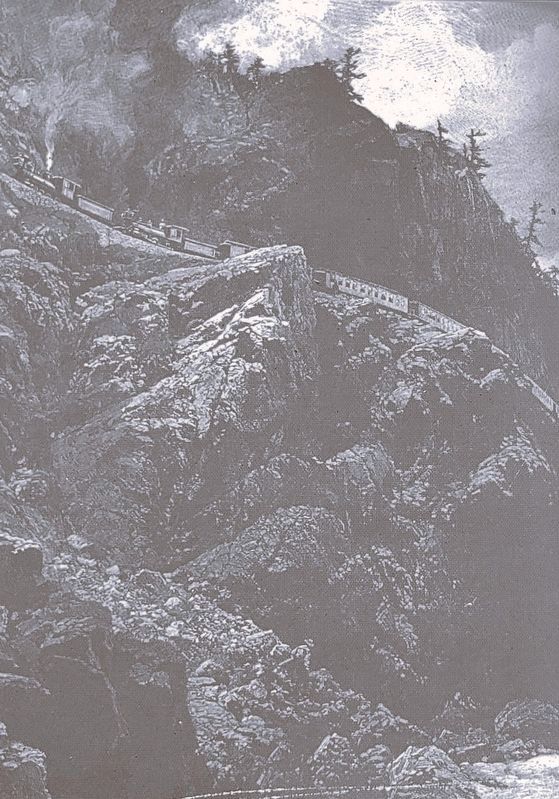
2. Marker detail: Denver & Rio Grande Railroad double-header train
In Animas River Canyon north of Durango. Etching by R. Schellig, Harpers Weekly, September 25, 1886, from a photograph by William Henry Jackson.
Also see . . . History of the City of Durango (City of Durango).
Excerpt: The Denver and Rio Grande Railroad Company formed Durango along the banks of the Animas River in September 1880 to serve the San Juan mining district. Lots of silver (and later, even more gold) was being discovered in the mountains ever since gold fever struck in 1872 and resulted in the settlement of mining towns like Silverton, 50 miles north. Durango had a more tolerable climate and a good supply of water and coal for operating the smelters to pull precious metals out of the ore.(Submitted on March 17, 2025, by Cosmos Mariner of Cape Canaveral, Florida.)The railroad company chose a site south of the town of Animas City for its
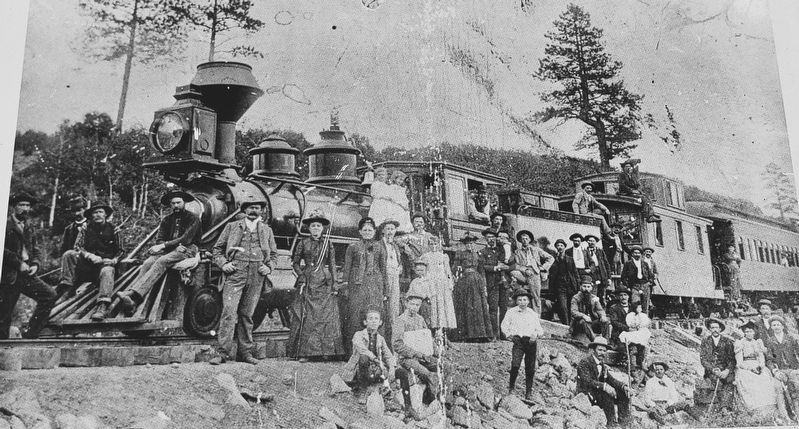
depot. It bought up the land in the eventual downtown Durango area using various different names to conceal what it was doing. The land was purchased for less money this way. Hundreds of gold miners had camped out in this area in 1860, but within a year of its founding in 1880, Durango had a population of 2,400 and really began to grow. People arrived from many countries to work in the smelters and mines and on the railroad.Courtesy Fort Lewis College, Center of Southwest Studies3. Marker detail: Rio Grande Southern train near HesperusBy 1890, the Rio Grande Southern Railroad arrived in Durango, via a route from Telluride and Rico over Lizard Head Pass.
Colorado Historical Society
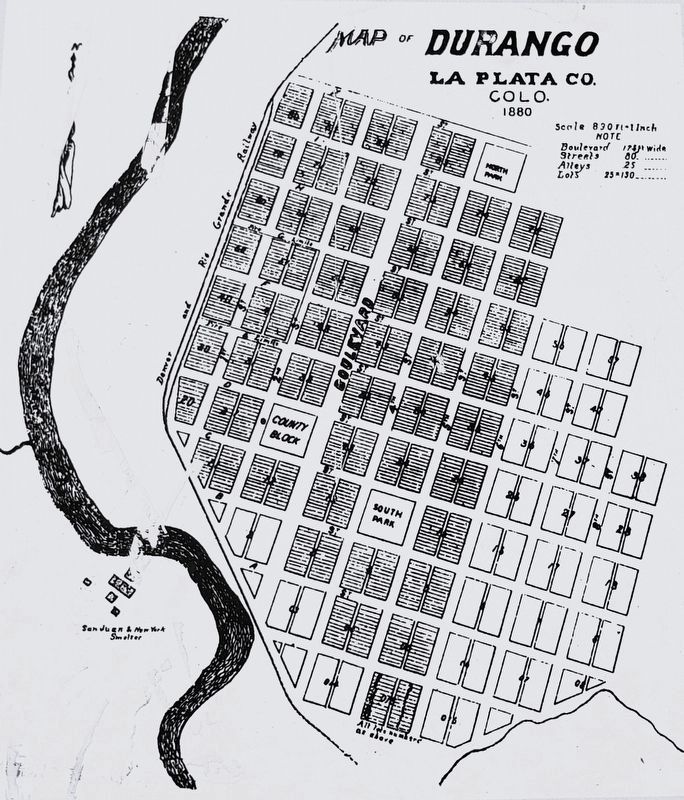
4. Marker detail: Durango plot map, 1880
Durango was a planned community, laid out by the Denver & Rio Grande Railroad.
Photographed by Cosmos Mariner, July 25, 2024
5. The Iron Horse Marker
The marker is located on the Animas River trail at the midpoint of the footbridge across the river, overlooking the adjacent train trestle.
Credits. This page was last revised on March 17, 2025. It was originally submitted on March 11, 2025, by Cosmos Mariner of Cape Canaveral, Florida. This page has been viewed 356 times since then and 193 times this year. Photos: 1, 2, 3. submitted on March 16, 2025, by Cosmos Mariner of Cape Canaveral, Florida. 4, 5. submitted on March 17, 2025, by Cosmos Mariner of Cape Canaveral, Florida.
