Ville-Haute in Luxembourg, — Western Europe
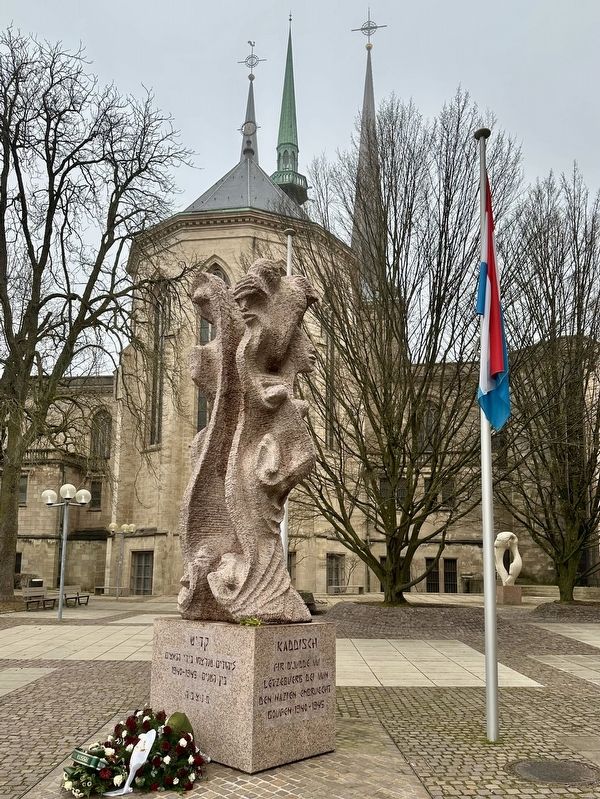
Kaddish Monument
Memorial to the Victims of the Shoah

Photographed by Andrew Ruppenstein, February 5, 2025
1. Kaddish Monument Marker (English panel)

The National Monument in Memory of the Victims of the Shoah in Luxembourg (1940-1945) was erected on the initiative of the Jewish community of Luxembourg, the government of the Grand Duchy of Luxembourg, and the City of Luxembourg. The monument was inaugurated on 17 June 2018. It is named after the Kaddish, one of the most famous Jewish prayers recited as part of mourning rituals in Judaism.
Given below are an interpretation of the monument and a biography as suggested by the artist.
[1] Facing the monument, the onlooker discovers two upturned heads at the bottom, whose hair turns into devouring flames, flames of memory which, as they rise, surround a large hollow narrowing before transforming into a channel of light. The upturned heads symbolize death.
The flames on the right rise towards the man who is covering his eyes with his hand in order to recite the Shema, the prayer said by Jews in the face of death, a gesture symbolical for the world turning away its gaze so as not to witness the enormous crime being perpetrated.
To the left, a flame rises towards the shape of a head with a large eye, the eye of the world that sees everything. The hand. below symbolizes the indifference and inaction of the world.
From the flames moving to the left [2] emerges a hand holding a child and the Hebrew letter "lamed" which winds from the bottom to the top.
[3] At the back of the sculpture, at the bottom, the onlooker discovers the head of a martyred man. His beard transforms into flames that rise towards a woman's upturned head, turning into a vortex of fire.
To the left of the channel of light, which rises in the center, appears the Hebrew letter "vav". [4] Under the "vav" looms the head of a woman with a swaying body and another tilted
this page online
In Hebrew, the two letters "lamed" and "vav" which emerge from the flames have the numerical value 30 for the "lamed" and 6 for the "vav", thus equaling a total of 36. According to cabalistic tradition, the constant existence on Earth of 36 hidden righteous people is a guarantee for the survival of our world.
Artist's Biography
Shelomo Selinger, the artist who sculpted the Kaddish Monument, is born on 31 May 1928 in Szczakowa, a small Polish town near Jaworzno, not far from Auschwitz.
After the invasion of the country by the Nazis on 1 September 1939, a regime of terror is established in Poland.
In 1942, Shelomo, aged 14, is deported to Germany with his father who is murdered three months later. After having experienced nine successive camps and two death marches, he is in Theresienstadt. In 1945, when the camp is liberated, a Soviet officer, and Jewish military doctor, notices a body still moving on a pile of corpses. It's Shelomo, whom this officer saves by having him admitted to a military hospital.
However, the

Photographed by Andrew Ruppenstein, February 5, 2025
2. Kaddish Monument (French panel)
In 1946, he reaches Palestine with 700 other survivors and joins the kibbutz of Beit ha Arava, near the Dead Sea. This kibbutz is destroyed during Israel's War of Independence and Shelomo helps establish the kibbutz Kabri in Galilee.
After seven years of amnesia, his memory returns to him at the same time as his artistic creation manifests itself following his meeting with Ruth Shapirovsky, a music student, whom he marries in 1954. At the end of 1955, he leaves Israel with his wife and moves to Paris. Thanks to a scholarship that he received as the winner of a contest, he enrolls at the École des Beaux-Arts and becomes the pupil of sculptor Marcel Gimond. An extraordinary career as a sculptor follows. His works of art win multiple international awards. Notably, Shelomo Selinger created the memorial monument of the Drancy camp in France.
Le monument national à la Mémoire des victimes de la Shoah à Luxembourg (1940-1945) a été érigé à l'initiative de la Communauté juive du Luxembourg, du gouvernement du Grand-Duché

Photographed by Andrew Ruppenstein, February 5, 2025
3. Marker details: Lamed, Vav, and three sculptural details
Ci-après suivent une interprétation du monument et une biographie proposées par l'artiste.
[1] En regardant le monument de face, le passant découvre en bas deux têtes renversées dont les cheveux se transforment en flammes dévorantes, flammes du souvenir qui, en montant, entourent un large creux se rétrécissant jusqu'à devenir un canal de lumière. Les têtes renversées symbolisent la mort.
Les flammes de droite montent vers l'homme qui couvre ses yeux avec sa main afin de réciter le Shema, la prière dite par les Juifs face à la mort, geste qui symbolise également le monde cachant son regard afin de ne pas voir perpétrer le crime immense.
Une flamme monte à gauche vers la forme d'une tête à grand ceil, celui du monde qui voit tout. La main, en dessous, symbolise l'indifférence et l'inaction du monde. Des flammes qui partent vers la gauche [2] sort une main qui tient un enfant et la lettre hébraïque « lamed

Photographed by Andrew Ruppenstein, February 5, 2025
4. Kaddish Marker and Monument
[3] À l'arrière de la sculpture, dans le bas, le passant découvre la tête d'un homme martyr. Sa barbe se transforme en flammes qui montent vers la tête renversée d'une femme, se muant en un tourbillon de feu.
À gauche du canal de lumière qui monte au centre apparaît la lettre hébraïque «vav». [4] Sous le «vav» surgissent la tête d'une femme au corps déhanché puis une autre tête renversée, ainsi qu'une main qui tient un bébé, tentant de le sauver alors que les flammes jaillissent de partout.
Les deux lettres «lamed» et «vav» qui émergent des flammes ont en hébreu la valeur numérique 30 pour le «lamed» et 6 pour le «vav», soit 36.
Selon la tradition cabalistique, la présence permanente sur terre de 36 Justes cachés est une garantie de survie de notre monde.
Biographie de l'artiste
Shelomo Selinger, l'artiste qui a sculpté le monument Kaddish, est né le 31 mai 1928 à Szczakowa, petite ville de Pologne proche de Jaworzno, non loin d'Auschwitz.
Un régime de terreur est instauré en Pologne après l'invasion du pays par les nazis, le 1er septembre 1939.
En 1942, Shelomo,

Photographed by Andrew Ruppenstein, February 5, 2025
5. Kaddish Monument - French and Hebrew sides
The inscription reads: “Kaddish for the Jews of Luxembourg killed by the Nazis, 1940-1945”. A “Kaddish” (קדיש) is, per Wikipedia, “… is a hymn praising God that is recited during Jewish prayer services. The central theme of the Kaddish is the magnification and sanctification of God's name.… The term Kaddish is often used to refer specifically to the Mourner's Kaddish, which is chanted as part of the mourning rituals in Judaism in all prayer services, as well as at funerals (other than at the gravesite) and memorials…”
Cependant, le traumatisme est si important que Shelomo perd complètement la mémoire.
En 1946, il gagne la Palestine en compagnie de 700 autres rescapés et rejoint le kibboutz de Beit ha Arava, proche de la mer Morte. Ce kibboutz est détruit lors de la guerre d'indépendance d'Israël et Shelomo contribue à la création du kibboutz Kabri en Galilée.
Après sept ans d'amnésie, la mémoire lui revient en même temps que se révèle sa création artistique après sa rencontre avec Ruth Shapirovsky, étudiante en musique, qu'il épouse en 1954. Fin 1955, il quitte Israël avec sa femme et s'installe à Paris où, inscrit à l'École des Beaux-Arts, grâce à une bourse reçue comme lauréat d'un concours,
Photographed by Andrew Ruppenstein, February 5, 2025
6. Kaddish Monument - Hebrew and Luxembourgish sides
Erected 2018 by AEPJ Jewish Heritage, Ville de Luxembourg, Government of the Grand Duchy of Luxembourg.
Topics and series. This monument and memorial is listed in these topic lists: Arts, Letters, Music • War, World II. In addition, it is included in the The Holocaust series list. A significant historical date for this entry is June 17, 1943.
Location. 49° 36.542′ N, 6° 7.898′ E. Monument is in Luxembourg. It is in Ville-Haute. It is on Boulevard Franklin Delano Roosevelt, on the right when traveling west. Touch for map. Monument is in this post office area: Luxembourg 1143, Luxembourg. Touch for directions.

Regionally, it is in Europe, the European Union, the Benelux Low Countries, the Schengen Area, Western Europe, and the Western World. Historically, it finds itself in what was once the Roman Empire and specifically also the Holy Roman Empire.
Other nearby markers. At least 8

Photographed by Andrew Ruppenstein, February 5, 2025
7. Kaddish Marker and Monument - wide view
Also see . . .
1. The Holocaust in Luxembourg (Wikipedia). Overview:
Jews in Luxembourg were systematically persecuted, expelled and murdered in the Holocaust after Luxembourg's occupation and later annexation by Nazi Germany. It is generally believed that the Jewish population of Luxembourg had numbered around 3,500 before the war although many fled into France at the time of the German invasion of 10 May 1940 or in the early months of the occupation. Around 1,000 to 2,500 were murdered during the Holocaust after being deported to ghettos and extermination camps in Eastern Europe, under the Civil Administration of Gustav Simon.(Submitted on March 13, 2025.)
2. Memorial to the victims of the Shoah (Wikipedia). Overview:
The Memorial to the Victims of the Shoah was inaugurated on 17 June 2018 in the city of Luxembourg. The monument commemorates the persecution, deportation and murder of native Jews and those who fled to Luxembourg during the National Socialist dictatorship. The 17th of June 2018 was chosen for the inauguration because 75 years earlier, on the 17th of June 1943, the last deportation train with Jews had left Luxembourg, and the location, Boulevard Roosevelt, because the first synagogue of Luxembourg existed nearby.(Submitted on March 13, 2025.)
Additional keywords. קדיש Kaddisch Holocaust Shoah
Credits. This page was last revised on March 13, 2025. It was originally submitted on March 13, 2025, by Andrew Ruppenstein of Lamorinda, California. This page has been viewed 232 times since then and 76 times this year. Photos: 1, 2, 3, 4, 5, 6, 7. submitted on March 13, 2025, by Andrew Ruppenstein of Lamorinda, California.
