Weiden in der Oberpfalz in Weiden i.d. OPf., Bavaria, Germany — Central Europe
Das 15. Jahrhundert - Wohlstand überall
⎯⎯⎯
The 15th Century - Prosperity Everywhere

Photographed by James Hulse, February 17, 2024
1. Das 15. Jahrhundert - Wohlstand überall / The 15th Century - Prosperity Everywhere Marker

Nach dem Ende Neuböhmens folgten wechselnde Verpfändungen Weidens, unter anderem an die Landgrafen von Leuchtenberg und die bayerischen Herzöge, mit denen oft kriegerische Auseinandersetzungen einhergingen. 1414 kommt der Reformator Jan Hus auf seinem Weg zum Konzil nach Konstanz durch Weiden.
Aus dem Jahr 1416 gibt es eine Aufschreibung des Weidener Stadtrechts: es nennt die Rechte und Strafen, das Halsgericht, den Stadtrichter, die Stadtsteuer, die Judensteuer, den Deichselzoll, beschreibt die vier Jahrmärkte (an Pfingsten, St. Jakob, St. Michael und St. Katharina), nennt das Kaufhaus (= Rathaus), die Weihern und Gräben der Stadt, die Mühlen und das Fischwasser, die Abgaben, die Kirchen und die Zeidelweid (= Bienenzucht).
Im Jahr 1421 einigten sich Marktgraf Friedrich von Brandenburg und Pfalzgraf Johann von Neumarkt nach der Einnahme von Parkstein und Weiden die Herrschaft Weiden-Parkstein "gemeinschaftlich zu gleichen Teilen inne zu haben". Dies war die Gründung des Gemeinschaftsamtes Parkstein-Weiden, eines eigenarti-gen staatsrechtlichen Gebildes, das bewirkte, dass die Weidener stets zwei Landesherren hatten. Es bestand bis 1777. Im selben Jahr bestätigen die beiden neuen Herren der Stadt auch ihre alten Privilegien und erweiterten sie noch. Außerdem erhalten die Bürger Steuerfreiheit auf sechs Jahre "wegen erlittener Brunst". 1422, 1427, 1428 und 1431 ist Weiden Sammelpunkt für das Reichsheer, das gegen die Hussiten zieht.
1425 wird die Bruderschaft der Bäcker und Müller erwähnt, sie ist somit die älteste Zunft in Weiden. Am 6.12.1436 werden erstmals namentlich genannt: Bürgermeister und Rat, genannt die "Zwölfer" und die Geschworenen der Gemeinde, die "Achter". Kaiser Sigismund verleiht der Stadt am 24.09.1436 das Privilegium "de non evocando".
1439 wird das Altalmosen,
this page online
Am 11.12.1456 erhält die Stadt Weiden eine neue Ratsverfassung von ihren Landesherren Otto I. von Moosbach und Ludwig von Bayern-Landhut. Es gibt nun einen Inneren Rat (die vier Bürgermeister und neun Stadträte) und einen Äußeren Rat mit 16 Mitgliedern.
1473 gibt die Stadt dem Handwerk der Schmiede und Wagner eine Zunftordnung. Weiden hatte einst zwei Badstuben. 1482 wird die "Niedere Badstube" in der heutigen Unteren Bachgasse (früher "Badgasse") genannt, 1488 ein Bader. 1485 wird ein Schulmeister erwähnt.
Während des 15. Und 16. Jahrhunderts mehrte sich der Wohlstand der Stadt Weiden. Reiche Handelsfamilien wie die Sand, die Ermweig und die Heuring betrieben vor allem den Eisenhandel und bescherten der Stadt großen Reichtum.
Touristinformation
Ein kleiner Stadtführer durch Weiden
Stadt Weiden in der Oberpfalz
©2011 Verantwortlich fur den Inhalt Stadt Weiden i d Oberplatz, Amt für Kulfur, Stadtgeschichte und Tourismus / Hoch- und Tiefbauamt
After
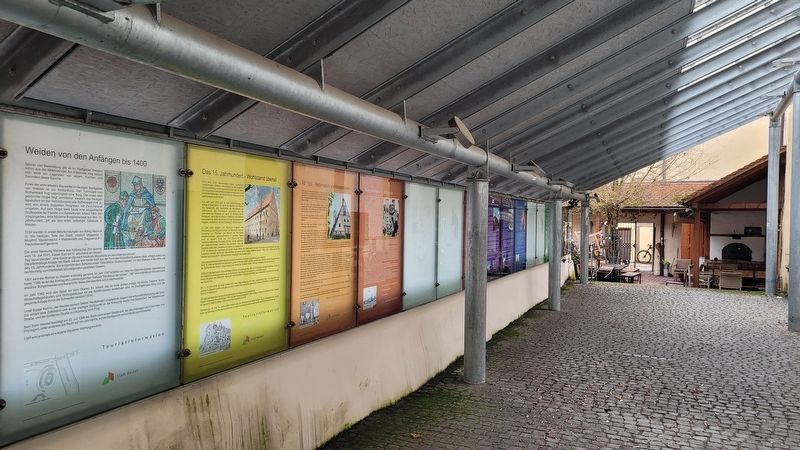
Photographed by James Hulse, February 17, 2024
2. The marker is the second marker from the left
A record from 1416 contains the Weiden town law: it names the rights and punishments, the capital punishment court, the city judge, the city tax, the Jewish tax, the axle toll, describes the four annual fairs (at Pentecost, St. James, St. Michael, and St. Catherine), names the marketplace (= town hall), the ponds and ditches of the town, the mills and fishwaters, the dues, the churches, and the Zeidelweid (= beekeeping).
In 1421, Margrave Friedrich of Brandenburg and Count Palatine Johann of Neumarkt agreed, after the capture of Parkstein and Weiden, to jointly hold the lordship of Weiden-Parkstein in equal shares. This led to the creation of the Gemeinschaftsamt Parkstein-Weiden, a peculiar legal entity, meaning that Weiden always had two rulers. This arrangement lasted until 1777. In the same year, the new rulers of the town confirmed its old privileges and even extended them. Furthermore, the citizens were granted a six-year tax exemption "due to the suffering from the epidemic." In 1422, 1427, 1428, and 1431, Weiden served as a rallying point for the Imperial army that was marching against the Hussites.
In 1425, the Brotherhood of Bakers and Millers is mentioned, making it the oldest guild in Weiden. On December 6, 1436, the mayor and council, called the "Twelve," and the town's jurors, known as the "Eighth," were first named. Emperor Sigismund granted the town the privilege "de non evocando" on September 24, 1436.
In 1439, the Almosen Foundation, a charitable organization, was established. The large building constructed by this foundation next to the Michael Church now houses the Hans Bauer Cultural Center, including the city archive and museum. King Christopher of Denmark, Norway, and Sweden granted the town two mills on the Naab River and allowed it to build the city mill.
On December 11, 1456, the town of Weiden received a new town council constitution from its rulers Otto I of Moosbach and Ludwig of Bavaria-Landshut. This established an Inner Council (the four mayors and nine city councilors) and an Outer Council with 16 members.
In 1473, the town issued a guild ordinance for the craft of blacksmiths and wagon makers. Weiden once had two bathhouses. In 1482, the "Lower Bathhouse" is mentioned in today's Untere Bachgasse (formerly "Badgasse"), and in 1488, a bathkeeper is mentioned. In 1485, a schoolmaster is mentioned.
During the 15th and 16th centuries, the wealth of the town of Weiden increased. Wealthy trading families such as the Sands, Ermweigs, and Heurings, who mainly dealt in iron trade, brought great wealth to the town.
Tourist Information
A Small City Guide through Weiden
City of Weiden in the Upper Palatinate
©2011 Responsible for the content City of Weiden in the Upper Palatinate, Department of Culture, Local History and Tourism / Department of Civil and Structural Engineering
Erected by Stadt Weiden.
Topics. This historical marker is listed in these topic lists: Industry & Commerce • Religion & Religious Structures • Settlements & Settlers. A significant historical date for this entry is September 24, 1436.
Location. 49° 40.622′ N, 12° 9.925′ E. Marker is in Weiden in der Oberpfalz, Bayern (Bavaria), in Weiden i.d. OPf.. It is on Hinter der Mauer just north of Unterer Markt. The marker is located in a small alleyway under an open air patio with several other markers. Touch for map. Marker is at or near this postal address: Hinter d Mauer 21, Weiden in der Oberpfalz BY 92637, Germany. Touch for directions.

Regionally, it is in Europe, the European Union, Atlantic Europe, Central Europe, the Schengen Area, Western Europe, and the Western World. Historically, it finds itself in what was once the Holy Roman Empire.
Other nearby markers. At least 8 other markers are within walking distance of this marker: Weiden von den Anfängen bis 1400 / Weiden from the beginnings to 1400 (here, next to this marker); Ab 1500 - Reformation und Katastrophen / From 1500 - Reformation and catastrophes (here, next to this marker); Das 18. Jahrhundert - Goethe in Weiden / The 18th Century - Goethe in Weiden (here, next to this marker); Krieg und Pest im 17. Jahrhundert / War and Plague in the 17th Century (here, next to this marker); Der History-Point / The History Point (here, next to this marker); Ab 1900 - Weiden's Weg in die Moderne / From 1900 - Weiden's Path to Modernity (here, next to this marker); Ab 1800 - Weiden wird Industriestandort / From 1800 - Weiden becomes an industrial location (here, next to this marker); Die Kirchengeschichte Weidens / The Church History of Weiden (here, next to this marker). Touch for a list and map of all markers in Weiden in der Oberpfalz.
Credits. This page was last revised on March 14, 2025. It was originally submitted on March 13, 2025, by James Hulse of Medina, Texas. This page has been viewed 166 times since then and 24 times this year. Photos: 1. submitted on March 13, 2025, by James Hulse of Medina, Texas. 2. submitted on March 14, 2025, by James Hulse of Medina, Texas.
