
Weiden in der Oberpfalz in Weiden i.d. OPf., Bavaria, Germany — Central Europe
Ab 1500 - Reformation und Katastrophen
⎯⎯⎯
From 1500 - Reformation and catastrophes

Photographed by James Hulse, February 17, 2024
1. Ab 1500 - Reformation und Katastrophen / From 1500 - Reformation and catastrophes Marker

1505, nach dem Ende des Landshuter Erbfolgekriegs, wird das Fürstentum der Jungen Pfalz für die jungen Pfalzgrafen Ottheinrich und Philipp geschaffen. Auch eine Halbscheid des Gemeinschaftsamtes Parkstein-Weiden gehörte zu diesem Gebiet.
Am 25. Januar 1510 verleiht Kurfürst Ludwig V., der Friedfertige, der Stadt ein vermehrtes Wappen, Weiden hat nun zusätzlich zum Weidenbaum den Pfälzer Löwen und die bayerischen Rauten in seinem Wappen.
Im Jahr 1515 hat Weiden hat 2140 Einwohner in 362 Bürgerfamilien, 148 Inwohnerfamilien und 63 Witwen und Waisen.
1527 hört man vom Goldenen Brunnen, der nach Nürnberger Vorbild errichtet wurde.
Selbst die verheerenden Stadtbrände von 1536 und 1540 konnten die wohlhabende Bürgerschaft nicht entmutigen. Die Stadt erholte sich verhältnismäßig schnell von den materiellen Verlusten und entstand größer und prächtiger neu. Eine monumentale Inschrift an der Westwand der Michaelskirche gibt über die Brandschäden Auskunft: „Im sin Weiden Jahre des Herrn 1536 den 11. August ist die Stadt Weiden zum ersten hernach im 1540. Jahr zum zweiten Mal ausgebrannt. Und es ist das mittlere Gewölbe, welches der Giebel beim ersten Brand eingeschlagen hatte, wiederum im 1564. Jahr den 12. Juni zu bauen angefangen und den 11. August des selbigen 1564. Jahrs des Herrn glückseliglich Gott sei Lob und Ehr fertiggestellt worden."
Bis 1522, fünf Jahre nachdem der Thesenanschlag Luthers die Reformation eingeläutet hatte, war St. Michael rein katholisch, dann erstmals hören wir von reformiertem Gedankengut in der Stadt, vertreten von Johann Weber in der Nikolauskapelle und von Magister Johannes Freisleben, Verfasser der Elbogischen Kirchenordnung, der wohl ältesten lutherischen Gottesdienstordnung. Viele Weidener Bürger waren, trotz Verboten des Landesherrn und des Regensburger Bischofs, sehr angetan von der neuen Lehre und den Predigten Freislebens und es kam zu offener Parteienbildung. Eine landesherrliche Kommission wurde nach Weiden geschickt, aber Bürgermeister und Rat drehten den Spieß um und klagten gegen Bürger, die nicht zur Predigt Freislebens gingen. Diese siebzehn wurden verhört, die allerdings nicht alle Gegner waren, sondern aus Gleichgültigkeit fernblieben. Einer gab sogar an, er bekomme daheim genug Predigt zu hören. Nun mischte sich aber die geistliche Obrigkeit ein, der die weltliche viel zu milde war, und zitierte Freisleben nach Regensburg. Dieser aber zog vor, Weiden zu verlassen. 1542 führt Pfalzgraf Ottheinrich von Neuburg die Reformation endgültig im Gemeinschaftsamt ein.
1556 fällt die pfalzgräfliche Halbscheid des Amtes Parkstein-Weiden an Kurfürst Ottheinrich von der Pfalz. Für wenige Jahre waren die beiden Halbscheiden in einer Hand.
Für das 16. Jahrhundert sind immer wieder hohe Darlehen der Stadt an ihre Landesherren überliefert Zeichen der Wohlhabenheit Weidens und seiner Bürger.
Von 1585 bis 1593 ist Weiden Residenzstadt. Friedrich von Parkstein und seine Familie bewohnen das Veste Haus. Seine Schwägerinnen, die Fürstinnen von Liegnitz, sind unter dem Hochaltar in St. Michael beigesetzt.
Touristinformation
Ein kleiner Stadtführer durch Weiden
Stadt Weiden in der Oberpfalz
©2011 Verantwortlich fur den Inhalt Stadt Weiden i d Oberplatz, Amt für Kulfur, Stadtgeschichte und Tourismus / Hoch- und Tiefbauamt
1505, after the end of the Landshut War of Succession, the principality of the Young Palatinate was created for the young Palatine princes Ottheinrich and Philipp. A half-share of the joint office Parkstein-Weiden also belonged to this area.
On January 25, 1510, Elector Ludwig V, the Peaceful, granted the city an enhanced coat of arms. Weiden now has the Palatine lion and the Bavarian lozenges in addition to the Weiden tree in its coat of arms.
In 1515, Weiden had 2,140 inhabitants in 362 citizen families, 148 resident families, and 63 widows and orphans.
In 1527, there was talk of the Golden Fountain, which was built after the model of the one in Nuremberg.
Even the devastating city fires of 1536 and 1540 could not discourage the wealthy citizenry. The city recovered relatively quickly from the material losses and was rebuilt larger and more magnificent. A monumental inscription on the west wall of the Michaelskirche gives information about the fire damage: "In the year of our Lord 1536, on the 11th of August, the city of Weiden was burned down for the first time, and in the year 1540, on the 11th of August, for the second time. And the middle vault, which had collapsed in the first fire due to the gable, was rebuilt in 1564, on June 12th, and completed on August 11th of the same year. Blessed be God, to whom all praise and honor is due."
Until 1522, five years after Luther’s posting of the 95 Theses had initiated the Reformation, St. Michael was purely Catholic. It was only then that we first hear of Reformation ideas in the city, represented by Johann Weber in the Nikolauskapelle and by Magister Johannes Freisleben, author of the Elbogische Church Order, possibly the oldest Lutheran order of service. Despite the prohibitions of the ruler and the Bishop of Regensburg, many citizens of Weiden were very attracted to the new teachings and the sermons of Freisleben, leading to the formation of open parties. A royal commission was sent to Weiden, but the mayor and council turned the tables and filed complaints against citizens who did not attend Freisleben's sermons. Seventeen of them were interrogated, although not all were opponents, as some had stayed away out of indifference. One even claimed that he heard enough preaching at home. However, the spiritual authorities, who were much stricter than the secular ones, intervened and summoned Freisleben to Regensburg. He, however, chose to leave Weiden. In 1542, Palatinate Prince Ottheinrich of Neuburg definitively introduced the Reformation in the joint office.
In 1556, the Palatine half-share of the Parkstein-Weiden office fell to Elector Ottheinrich of the Palatinate. For a few years, both half-shares were in one hand.
For the 16th century, there are recurring high loans from the city to its rulers, evidence of Weiden’s wealth and its citizens.
From 1585 to 1593, Weiden was the residence city. Friedrich of Parkstein and his family lived in the Veste Haus. His sisters-in-law, the princesses of Liegnitz, are buried under the high altar in St. Michael.
Tourist Information
A Small City Guide through Weiden
City of Weiden in the Upper Palatinate
©2011 Responsible for the content City of Weiden in the Upper Palatinate, Department of Culture, Local History and Tourism / Department of Civil and Structural Engineering
Erected by Stadt
this page online
Topics. This historical marker is listed in these topic lists: Disasters • Industry & Commerce • Religion & Religious Structures • Settlements & Settlers. A significant historical date for this entry is January 25, 1510.
Location. 49° 40.621′ N, 12° 9.926′ E. Marker is in Weiden in der Oberpfalz, Bayern (Bavaria), in Weiden i.d. OPf.. It is on Hinter der Mauer just north of Unterer Markt. The marker is located in a small alleyway under an open air patio with several other markers. Touch for map. Marker is at or near this postal address: Hinter d Mauer 21, Weiden in der Oberpfalz BY 92637, Germany. Touch for directions.

Regionally, it is in Europe, the European Union, Atlantic Europe, Central Europe, the Schengen Area, Western Europe, and the Western World. Historically, it finds itself in what was once the Roman Empire and specifically also the Holy Roman Empire.
Other nearby markers. At least 8 other markers are within walking distance of this marker: Das 18. Jahrhundert - Goethe in Weiden / The 18th Century - Goethe in Weiden (here, next to this marker); Krieg und Pest im 17. Jahrhundert / War and Plague in the 17th Century
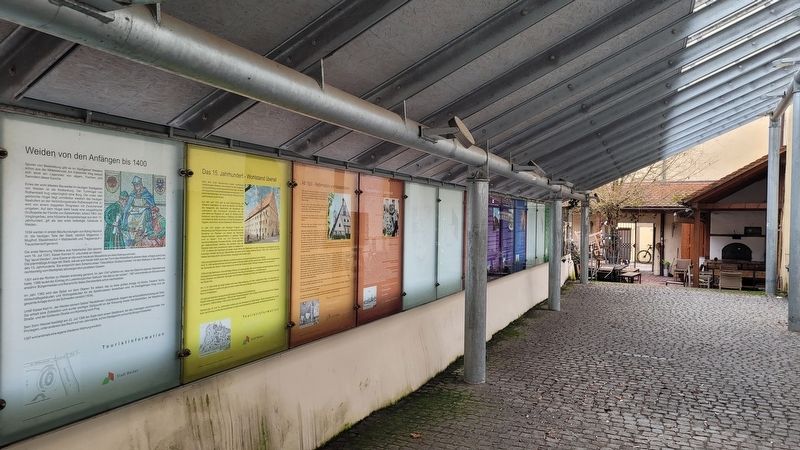
Photographed by James Hulse, February 17, 2024
2. The marker is the third marker from the left
Credits. This page was last revised on March 14, 2025. It was originally submitted on March 13, 2025, by James Hulse of Medina, Texas. This page has been viewed 118 times since then and 18 times this year. Photos: 1, 2. submitted on March 14, 2025, by James Hulse of Medina, Texas.
