Weiden in der Oberpfalz in Weiden i.d. OPf., Bavaria, Germany — Central Europe
Ab 1900 - Weiden's Weg in die Moderne
⎯⎯⎯
From 1900 - Weiden's Path to Modernity
Photographed by James Hulse, February 17, 2024
1. Ab 1900 - Weiden's Weg in die Moderne / From 1900 - Weiden's Path to Modernity Marker

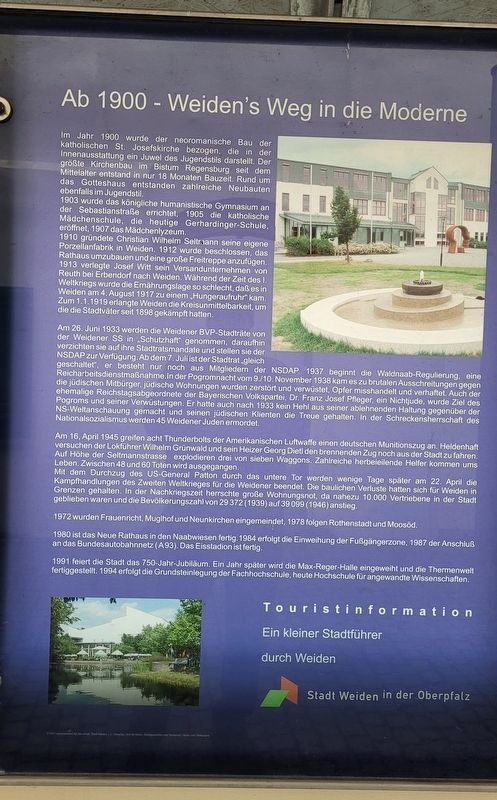
Im Jahr 1900 wurde der neoromanische Bau der katholischen St. Josefskirche bezogen, die in der Innenausstattung ein Juwel des Jugendstils darstellt. Der größte Kirchenbau im Bistum Regensburg seit dem Mittelalter entstand in nur 18 Monaten Bauzeit. Rund um das Gotteshaus entstanden zahlreiche Neubauten ebenfalls im Jugendstil.
1903 wurde das königliche humanistische Gymnasium an der Sebastianstraße errichtet, 1905 die katholische Mädchenschule, die heutige Gerhardinger-Schule, eröffnet, 1907 das Mädchenlyzeum.
1910 gründete Christian Wilhelm Seltraann seine eigene Porzellanfabrik in Weiden. 1912 wurde beschlossen, das Rathaus umzubauen und eine große Freitreppe anzufügen. 1913 verlegte Josef Witt sein Versandunternehmen von Reuth bei Erbendorf nach Weiden. Während der Zeit des I. Weltkriegs wurde die Ernährungslage so schlecht, daß es in Weiden am 4. August 1917 zu einem „Hungeraufruhr" kam. Zum 1.1.1919 erlangte Weiden die Kreisunmittelbarkeit, um die die Stadtväter seit 1898 gekämpft hatten.
Am 26. Juni 1933 werden die Weidener BVP-Stadträte von der Weidener SS in „Schutzhaft" genommen, daraufhin verzichten sie auf ihre Stadtratsmandate und stellen sie der NSDAP zur Verfügung. Ab dem 7. Juli ist der Stadtrat,gleich geschaltet", er besteht nur noch aus Mitgliedern der NSDAP. 1937 beginnt die Waldnaab-Regulierung, eine Reicharbeitsdienstmaßnahme.In der Pogromnacht vom 9./10. November 1938 kam es zu brutalen Ausschreitungen gegen die jüdischen Mitbürger, jüdische Wohnungen wurden zerstört und verwüstet, Opfer misshandelt und verhaftet. Auch der ehemalige Reichstagsabgeordnete der Bayerischen Volkspartei, Dr. Franz Josef Pfleger, ein Nichtjude, wurde Ziel des Pogroms und seiner Verwüstungen. Er hatte auch nach 1933 kein Hehl aus seiner ablehnenden Haltung gegenüber der NS-Weltanschauung
this page online
Am 16, April 1945 greifen acht Thunderbolts der Amerikanischen Luftwaffe einen deutschen Munitionszug an. Heldenhaft versuchen der Lokführer Wilhelm Grünwald und sein Heizer Georg Dietl den brennenden Zug noch aus der Stadt zu fahren. Auf Höhe der Seltmannstrasse explodieren drei von sieben Waggons. Zahlreiche herbeieilende Helfer kommen ums Leben. Zwischen 48 und 60 Toten wird ausgegangen.
Mit dem Durchzug des US-General Patton durch das untere Tor werden wenige Tage später am 22. April die Kampfhandlungen des Zweiten Weltkrieges für die Weidener beendet. Die baulichen Verluste hatten sich für Weiden in Grenzen gehalten. In der Nachkriegszeit herrschte große Wohnungsnot, da nahezu 10.000 Vertriebene in der Stadt geblieben waren und die Bevölkerungszahl von 29 372 (1939) auf 39 099 (1946) anstieg.
1972 wurden Frauenricht, Muglhof und Neunkirchen eingemeindet, 1978 folgen Rothenstadt und Moosöd.
1980 ist das Neue Rathaus in den Naabwiesen fertig. 1984 erfolgt die Einweihung der Fußgängerzone,
Photographed by James Hulse, February 17, 2024
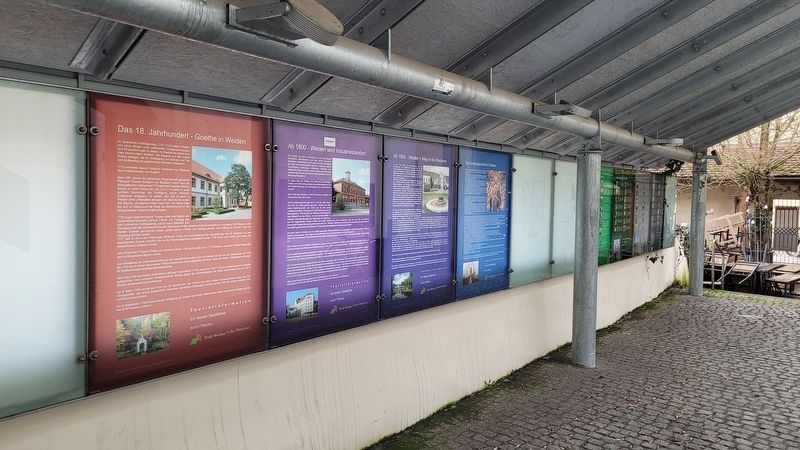
2. The marker is the third marker from the left
1991 feiert die Stadt das 750-Jahr-Jubiläum. Ein Jahr später wird die Max-Reger-Halle eingeweiht und die Thermenwelt fertiggestellt. 1994 erfolgt die Grundsteinlegung der Fachhochschule, heute Hochschule für angewandte Wissenschaften.
Touristinformation
Ein kleiner Stadtführer durch Weiden
Stadt Weiden in der Oberpfalz
©2011 Verantwortlich fur den Inhalt Stadt Weiden i d Oberplatz, Amt für Kulfur, Stadtgeschichte und Tourismus / Hoch- und Tiefbauamt
In 1900, the neo-Romanesque building of the Catholic St. Joseph Church was inaugurated, which, in terms of interior design, is a jewel of Art Nouveau. The largest church building in the Diocese of Regensburg since the Middle Ages was completed in just 18 months of construction time. Numerous new buildings, also in the Art Nouveau style, were built around the church.
In 1903, the Royal Humanistic Gymnasium was established on Sebastianstraße, and in 1905, the Catholic Girls' School, the current Gerhardinger School, was opened, followed by the Girls' Lyceum in 1907.
In 1910, Christian Wilhelm Seltraann founded his own porcelain factory in Weiden. In 1912, it was decided to remodel the town hall and add a large staircase. In 1913, Josef Witt moved his shipping company from Reuth near Erbendorf to Weiden. During World War I, the food situation became so bad that on August 4, 1917, a "hunger riot" occurred in Weiden. On January 1, 1919, Weiden achieved district independence, a goal the city fathers had been fighting for since 1898.
On June 26, 1933, the Weiden BVP city councilors were taken into "protective custody" by the Weiden SS. They then resigned from their city council mandates and made them available to the NSDAP. From July 7, the city council became "aligned," consisting only of members of the NSDAP. In 1937, the Waldnaab regulation began as a Reich Labor Service measure. During the Night of the Pogrom on November 9/10, 1938, brutal riots took place against Jewish citizens. Jewish homes were destroyed and looted, victims were abused and arrested. Even former Reichstag member of the Bavarian People's Party, Dr. Franz Josef Pfleger, a non-Jew, became a target of the pogrom and its devastation. He had continued to oppose the Nazi ideology after 1933 and remained loyal to his Jewish clients. During the reign of terror of National Socialism, 45 Jews from Weiden were murdered.
On April 16, 1945, eight Thunderbolt planes of the American Air Force attacked a German ammunition train. Heroically, the train driver Wilhelm Grünwald and his stoker Georg Dietl tried to drive the burning train out of the city. At the height of Seltmannstrasse, three of the seven carriages exploded. Numerous helpers rushing to the scene lost their lives. Between 48 and 60 deaths were reported.
With the passage of US General Patton through the Lower Gate, the fighting of World War II for Weiden ended a few days later on April 22. The structural losses for Weiden were limited. After the war, there was a severe housing shortage, as nearly 10,000 refugees remained in the city, and the population grew from 29,372 in 1939 to 39,099 in 1946.
In 1972, Frauenricht, Muglhof, and Neunkirchen were incorporated, followed by Rothenstadt and Moosöd in 1978.
In 1980, the New Town Hall was completed in the Naabwiesen. In 1984, the pedestrian zone was inaugurated, and in 1987, the city was connected to the federal highway network (A93). The ice stadium was also completed.
In 1991, the city celebrated its 750th anniversary. A year later, the Max Reger Hall was inaugurated, and the thermal world was completed. In 1994, the groundbreaking ceremony for the University of Applied Sciences took place.
Tourist Information
A Small City Guide through Weiden
City of Weiden in the Upper Palatinate
©2011 Responsible for the content City of Weiden in the Upper Palatinate, Department of Culture, Local History and Tourism / Department of Civil and Structural Engineering
Erected by Stadt Weiden.
Topics. This historical marker is listed in these topic lists: Architecture • Religion & Religious Structures • Sports • War, World II. A significant historical date for this entry is January 1, 1919.
Location. 49° 40.62′ N, 12° 9.928′ E. Marker is in Weiden in der Oberpfalz, Bayern (Bavaria), in Weiden i.d. OPf.. It is on Hinter der Mauer just north of Unterer Markt. The marker is located in a small alleyway under an open air patio with several other markers. Touch for map. Marker is at or near this postal address: Hinter d Mauer 21, Weiden in der Oberpfalz BY 92637, Germany. Touch for directions.

Regionally, it is in Europe, the European Union, Atlantic Europe, Central Europe, the Schengen Area, Western Europe, and the Western World. Historically, it finds itself in what was once the Holy Roman Empire.
Other nearby markers. At least 8 other markers are within walking distance of this marker: Ab 1800 - Weiden wird Industriestandort / From 1800 - Weiden becomes an industrial location (here, next to this marker); Die Kirchengeschichte Weidens / The Church History of Weiden (here, next to this marker); Krieg und Pest im 17. Jahrhundert / War and Plague in the 17th Century (here, next to this marker); Das 18. Jahrhundert - Goethe in Weiden / The 18th Century - Goethe in Weiden (here, next to this marker); Ab 1500 - Reformation und Katastrophen / From 1500 - Reformation and catastrophes (here, next to this marker); Der History-Point / The History Point (here, next to this marker); Das 15. Jahrhundert - Wohlstand überall / The 15th Century - Prosperity Everywhere (here, next to this marker); Weiden von den Anfängen bis 1400 / Weiden from the beginnings to 1400 (here, next to this marker). Touch for a list and map of all markers in Weiden in der Oberpfalz.
Credits. This page was last revised on March 14, 2025. It was originally submitted on March 13, 2025, by James Hulse of Medina, Texas. This page has been viewed 112 times since then and 9 times this year. Photos: 1, 2. submitted on March 14, 2025, by James Hulse of Medina, Texas.
