
Weiden in der Oberpfalz in Weiden i.d. OPf., Bavaria, Germany — Central Europe
Die Kirchengeschichte Weidens
⎯⎯⎯
The Church History of Weiden
Photographed by James Hulse, February 17, 2024
1. Die Kirchengeschichte Weidens / The Church History of Weiden Marker

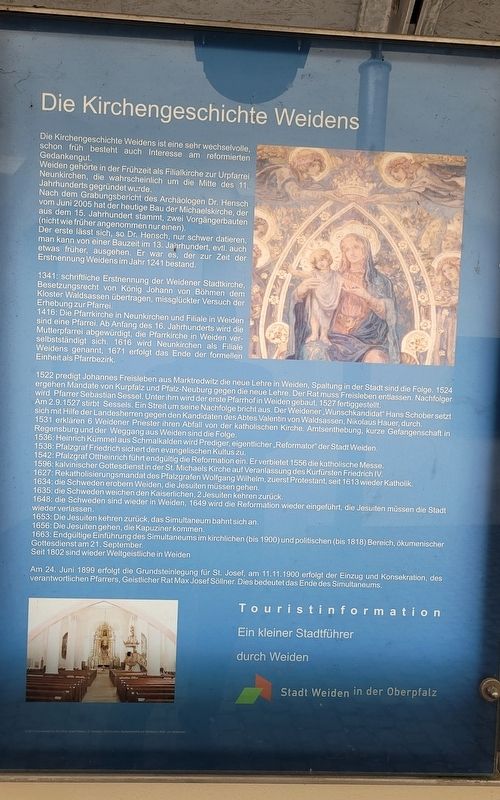
Die Kirchengeschichte Weidens ist eine sehr wechselvolle, schon früh besteht auch Interesse am reformierten Gedankengut.
Weiden gehörte in der Frühzeit als Filialkirche zur Urpfarrei Neunkirchen, die wahrscheinlich um die Mitte des 11. Jahrhunderts gegründet wurde.
Nach dem Grabungsbericht des Archäologen Dr. Hensch vom Juni 2005 hat der heutige Bau der Michaelskirche, der aus dem 15. Jahrhundert stammt, zwei Vorgängerbauten (nicht wie früher angenommen nur einen).
Der erste lässt sich, so Dr. Hensch, nur schwer datieren, man kann von einer Bauzeit im 13. Jahrhundert, evtl. auch etwas früher, ausgehen. Er war es, der zur Zeit der Erstnennung Weidens im Jahr 1241 bestand.
1341: schriftliche Erstnennung der Weidener Stadtkirche, Besetzungsrecht von König Johann von Böhmen dem Kloster Waldsassen übertragen, missglückter Versuch der Erhebung zur Pfarrei.
1416: Die Pfarrkirche in Neunkirchen und Filiale in Weiden sind eine Pfarrei. Ab Anfang des 16. Jahrhunderts wird die Mutterpfarrei abgewürdigt, die Pfarrkirche in Weiden verselbstständigt sich. 1616 wird Neunkirchen als Filiale Weidens genannt, 1671 erfolgt das Ende der formellen Einheit als Pfarrbezirk.
1522 predigt Johannes Freisleben aus Marktredwitz die neue Lehre in Weiden, Spaltung in der Stadt sind die Folge. 1524 ergehen Mandate von Kurpfalz und Pfalz-Neuburg gegen die neue Lehre. Der Rat muss Freisleben entlassen. Nachfolger wird Pfarrer Sebastian Sessel. Unter ihm wird der erste Pfarrhof in Weiden gebaut, 1527 fertiggestellt.
Am 2.9.1527 stirbt Sessels. Ein Streit um seine Nachfolge bricht aus. Der Weidener „Wunschkandidat" Hans Schober setzt sich mit Hilfe der Landesherren gegen den Kandidaten des Abtes Valentin von Waldsassen, Nikolaus Hauer, durch. 1531 erklären 6 Weidener Priester ihren Abfall von der katholischen
this page online
1536: Heinrich Kümmel aus Schmalkalden wird Prediger, eigentlicher „Reformator" der Stadt Weiden.
1538: Pfalzgraf Friedrich sichert den evangelischen Kultus zu.
1542: Pfalzgraf Ottheinrich führt endgültig die Reformation ein. Er verbietet 1556 die katholische Messe.
1596: kalvinischer Gottesdienst in der St. Michaels Kirche auf Veranlassung des Kurfürsten Friedrich IV.
1627: Rekatholisierungsmandat des Pfalzgrafen Wolfgang Wilhelm, zuerst Protestant, seit 1613 wieder Katholik.
1634: die Schweden erobern Weiden, die Jesuiten müssen gehen.
1635: die Schweden weichen den Kaiserlichen, 2 Jesuiten kehren zurück.
1648: die Schweden sind wieder in Weiden, 1649 wird die Reformation wieder eingeführt, die Jesuiten müssen die Stadt wieder verlassen.
1653: Die Jesuiten kehren zurück, das Simultaneum bahnt sich an. 1656: Die Jesuiten gehen, die Kapuziner kommen.
1663: Endgültige Einführung des Simultaneums im kirchlichen (bis 1900) und politischen (bis 1818) Bereich, ökumenischer Gottesdienst am 21. September.
Seit 1802 sind

Photographed by James Hulse, February 17, 2024
2. The marker is the fourth marker from the left
Am 24. Juni 1899 erfolgt die Grundsteinlegung für St. Josef, am 11.11.1900 erfolgt der Einzug und Konsekration, des verantwortlichen Pfarrers, Geistlicher Rat Max Josef Söllner. Dies bedeutet das Ende des Simultaneums.
Touristinformation
Ein kleiner Stadtführer durch Weiden
Stadt Weiden in der Oberpfalz
©2011 Verantwortlich fur den Inhalt Stadt Weiden i d Oberplatz, Amt für Kulfur, Stadtgeschichte und Tourismus / Hoch- und Tiefbauamt
The Church History of Weiden is a very eventful one, with early interest in Reformed thought.
In its early history, Weiden belonged as a daughter church to the original parish of Neunkirchen, which was likely founded around the middle of the 11th century.
According to the excavation report by the archaeologist Dr. Hensch from June 2005, the current construction of St. Michael's Church, dating from the 15th century, had two predecessor buildings (not just one as previously assumed).
The first one, according to Dr. Hensch, is difficult to date but can be assumed to have been built in the 13th century, possibly even earlier. It was

Photographed by James Hulse, February 17, 2024
3. St. Joseph's Church
1341: First written mention of Weiden's town church, with King John of Bohemia transferring the right of appointment to the Waldsassen Monastery. An unsuccessful attempt was made to elevate it to a parish.
1416: The parish church in Neunkirchen and the daughter church in Weiden formed one parish. From the early 16th century, the mother parish began to decline, and the parish church in Weiden became independent. In 1616, Neunkirchen was listed as a daughter church of Weiden, and in 1671, the formal unity as a parish district ended.
1522: Johannes Freisleben from Marktredwitz preached the new doctrine in Weiden, leading to a split in the city. In 1524, mandates were issued by the Palatinate and Palatinate-Neuburg against the new doctrine. The city council had to dismiss Freisleben. His successor was Pastor Sebastian Sessel. Under his leadership, the first rectory in Weiden was built and completed in 1527.
On September 2, 1527, Sessel died, and a dispute broke out over his succession. Weiden's "preferred candidate," Hans Schober, prevailed with the help of the local rulers against the candidate of Abbot Valentin of Waldsassen, Nikolaus Hauer. In 1531, six priests from Weiden declared their defection from the Catholic Church. As a result, they were deposed, briefly imprisoned in Regensburg, and left Weiden.
1536: Heinrich Kümmel from Schmalkalden became the preacher and the actual "reformer" of Weiden.
1538: Elector Friedrich secured the rights to the Evangelical cult.
1542: Elector Ottheinrich fully introduced the Reformation. In 1556, he banned the Catholic Mass.
1596: A Calvinist service was held in St. Michael's Church at the initiative of Elector Frederick IV.
1627: The Palatine Elector Wolfgang Wilhelm, originally Protestant but reconverted to Catholicism in 1613, issued a mandate for the re-Catholicization of the area.
1634: The Swedes captured Weiden, and the Jesuits were forced to leave.
1635: The Swedes retreated from the Imperial forces, and two Jesuits returned.
1648: The Swedes returned to Weiden, and in 1649, the Reformation was reinstated. The Jesuits were forced to leave again.
1653: The Jesuits returned, and the simultaneous use of the church was beginning to take shape.
1656: The Jesuits left, and the Capuchins arrived.
1663: The final introduction of the Simultaneum in both the ecclesiastical (until 1900) and political (until 1818) realms, with an ecumenical service on September 21.
Since 1802, secular clergy have been present in Weiden.
On June 24, 1899, the foundation stone for St. Joseph's Church was laid, and on November 11, 1900, the church was consecrated by the responsible pastor, Ecclesiastical Councilor Max Josef Söllner. This marked the end of the Simultaneum.
Tourist Information
A Small City Guide through Weiden
City of Weiden in the Upper Palatinate
©2011 Responsible for the content City of Weiden in the Upper Palatinate, Department of Culture, Local History and Tourism / Department of Civil and Structural Engineering
Erected by Stadt Weiden.
Topics. This historical marker is listed in this topic list: Religion & Religious Structures. A significant historical month for this entry is June 2005.
Location. 49° 40.619′ N, 12° 9.928′ E. Marker is in Weiden in der Oberpfalz, Bayern (Bavaria), in Weiden i.d. OPf.. It is on Hinter der Mauer just north of Unterer Markt. The marker is located in a small alleyway under an open air patio with several other markers. Touch for map. Marker is at or near this postal address: Hinter d Mauer 21, Weiden in der Oberpfalz BY 92637, Germany. Touch for directions.

Regionally, it is in Europe, the European Union, Atlantic Europe, Central Europe, the Schengen Area, Western Europe, and the Western World. Historically, it finds itself in what was once the Holy Roman Empire.
Other nearby markers. At least 8 other markers are within walking distance of this marker: Ab 1800 - Weiden wird Industriestandort / From 1800 - Weiden becomes an industrial location (here, next to this marker); Ab 1900 - Weiden's Weg in die Moderne / From 1900 - Weiden's Path to Modernity (here, next to this marker); Krieg und Pest im 17. Jahrhundert / War and Plague in the 17th Century (here, next to this marker); Das 18. Jahrhundert - Goethe in Weiden / The 18th Century - Goethe in Weiden (here, next to this marker); Ab 1500 - Reformation und Katastrophen / From 1500 - Reformation and catastrophes (here, next to this marker); Der History-Point / The History Point (here, next to this marker); Das 15. Jahrhundert - Wohlstand überall / The 15th Century - Prosperity Everywhere (here, next to this marker); Weiden von den Anfängen bis 1400 / Weiden from the beginnings to 1400 (here, next to this marker). Touch for a list and map of all markers in Weiden in der Oberpfalz.
Credits. This page was last revised on March 14, 2025. It was originally submitted on March 13, 2025, by James Hulse of Medina, Texas. This page has been viewed 103 times since then and 8 times this year. Photos: 1, 2, 3. submitted on March 14, 2025, by James Hulse of Medina, Texas.
