
Westerpark in Amsterdam, North Holland, Netherlands — Northwestern Europe
Molen De Otter (The Otter Windmill)

Photographed by Andrew Ruppenstein, March 15, 2025
1. Molen De Otter (The Otter Windmill) Marker
Note that the QR code on the marker does not work.

Architect onbekend
Bouwjaar 1638
De strook ten oosten van de Kostverlorenvaart stond in de 17e eeuw bekend als molenbuurt. Er stonden voornamelijk houtzaagmolens, maar liefst 49. De Otter is als enige bewaard gebleven; het is de oudste paltrokmolen van Nederland. Hij dankt zijn naam aan een wijdvallende herenjas: de paltrok. De beide vaarten voor aan- en afvoer van hout zijn nog aanwezig.
Molen De Otter (The Otter windmill)
Architect unknown
Year of construction 1638
In the 17th century, the area to the east of the Kostverlorenvaart was known for its many windmills. The mills here, at least 49 of them, were mainly sawmills. Only De Otter remains; it is the oldest paltrokmolen (post-mill) in the Netherlands. Its name comes from a gentlemen's jacket, the paltrok. Both of the waterways for transporting timber are still present.
Erected by IAmsterdam.
Topics and series. This historical marker is listed in this topic list: Industry & Commerce. In addition, it is included in the IAmsterdam, and the Windmills series lists. A significant historical year for this entry is 1638.
Location. 52° 22.573′ N, 4° 52.307′ E. Marker is in Amsterdam, Noord-Holland (North Holland). It is in Westerpark. It is on Gillis van Ledenberchstraat, on the left when traveling north. Touch for map.
this page online

Regionally, it is in Europe, the European Union, Atlantic Europe, the Benelux Low Countries, the Schengen Area, Western Europe, and the Western World. Historically, it finds itself in what was once the Holy Roman Empire.
Other nearby markers. At least 8 other markers are within walking distance of this marker: Gillis van Ledenberch (within shouting distance of this marker); Hugo de Groot (about 90 meters away, measured in a direct line); Frederik Hendrik van Oranje (about 180 meters away); a different marker also named Hugo de Groot (about 210 meters away); a different marker also named Hugo de Groot (about 240 meters away); Zaagmolens / Sawmills (about 240 meters away); Rombout Hogerbeets (approx. 0.3 kilometers away); Johan van Oldenbarneveldt (approx. 0.3 kilometers away). Touch for a list and map of all markers in Amsterdam.
Also see . . . De Otter, Amsterdam (Wikipedia). Overview:
De Otter is a paltrok mill in Amsterdam, Netherlands which has been restored to working order. As all Dutch paltrok mills it is a wind-powered sawmill. The mill is listed as a Rijksmonument, number 1198.(Submitted on March 15, 2025.)
Photographed by Andrew Ruppenstein, March 15, 2025
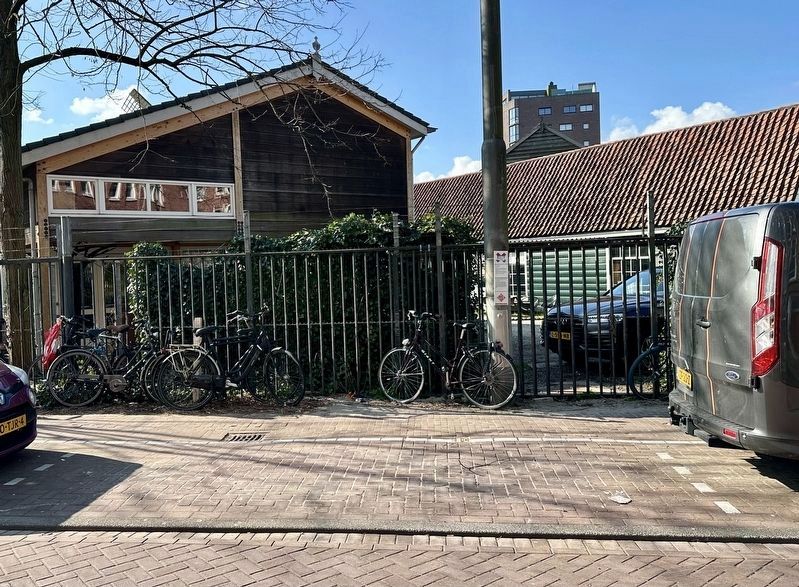
2. Molen De Otter (The Otter Windmill) Marker - wide view
Although not particularly difficult to see, the marker is mounted to a utility pole and not as close to the entrance gate as one might expect.

Photographed by Andrew Ruppenstein, March 15, 2025
3. Molen De Otter (The Otter Windmill) - rear view
The windmill is within a gated complex and is seemingly (currently?) not open to the public.

courtesy Rijksdienst voor het Cultureel Erfgoed (via Wikimedia Commons under CC 4.0 license)
4. Molen De Otter (The Otter Windmill)

Photographed by Andrew Ruppenstein, March 15, 2025
5. Molen De Otter (The Otter Windmill) - front view
De Otter, probably earlier known as De Kleine Otter (The Small Otter) was built in or shortly after 1631. It is the only one left over from a group of sawmills built in the area between the Kostverlorenvaart canal and the Singelgracht… The last operational wind powered sawmill, De Eenhoorn (The Unicorn), located north of De Otter, shut down in 1929 and was dismantled in 1931, leaving De Otter as the only remainder of this local industry. De Otter was placed on the list of monuments in 1977. The mill was restored to working order after a two-year restoration project started in 1994 after which it was regularly running….- Wikipedia
Credits. This page was last revised on March 15, 2025. It was originally submitted on March 15, 2025, by Andrew Ruppenstein of Lamorinda, California. This page has been viewed 147 times since then and 36 times this year. Photos: 1, 2, 3, 4, 5. submitted on March 15, 2025, by Andrew Ruppenstein of Lamorinda, California.
