Scottsboro in Jackson County, Alabama — The American South (East South Central)
Admiralty Pattern Wrought Iron Anchor
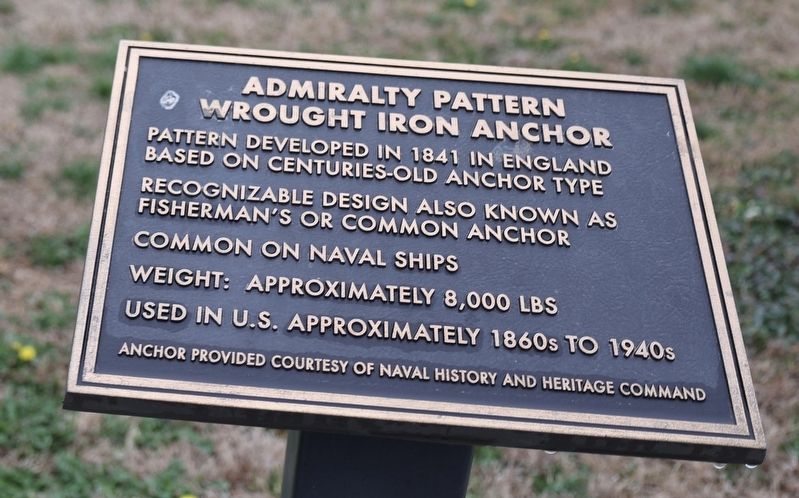
Photographed by Sandra Hughes Tidwell, March 14, 2025
1. Admirality Pattern Wrought Iron Anchor Marker
Topics. This historical marker is listed in this topic list: Military. A significant historical year for this entry is 1841.
Location. 34° 39.185′ N, 86° 2.505′ W. Marker is in Scottsboro, Alabama, in Jackson County. It is on Heroes Drive. Touch for map. Marker is at or near this postal address: 1616 Heroes Dr, Scottsboro AL 35768, United States of America. Touch for directions.

Regionally, this marker is in North Alabama. It is also in the American South, specifically in the Deep South, in Appalachia, and specifically in Southern Appalachia. Globally, it is in North America, a Gulf of Mexico state, the Western Hemisphere, the Western World, and the Anglosphere. Historically, it finds itself in what was once the original Cherokee Nation, the territory of the Mississippian Culture, one of the Confederate States of
this page online
Other nearby markers. At least 8 other markers are within walking distance of this marker: Kanone 18 Heavy Field Gun (a few steps from this marker); M 1918 "Schneider" Howitzer (within shouting distance of this marker); The Changing Faces of War (within shouting distance of this marker); Iraq (2nd Persian Gulf) War (within shouting distance of this marker); UH-1H "Huey" Helicopter (within shouting distance of this marker); Monument to the Fallen Soldier Battlefield Cross (within shouting distance of this marker); American - Indian Wars (within shouting distance of this marker); Commissioned Military Officers (within shouting distance of this marker). Touch for a list and map of all markers in Scottsboro.
Also see . . . Admiralty Anchor. The genesis of the Admiralty Anchor can be traced back to the late 19th century, a period marked by rapid advancements in naval technology. Its precursor, the Admiralty Pattern anchor, had been the standard issue for the British Royal Navy since the 1840s. However, the need for a more efficient and versatile anchor became increasingly apparent as ships
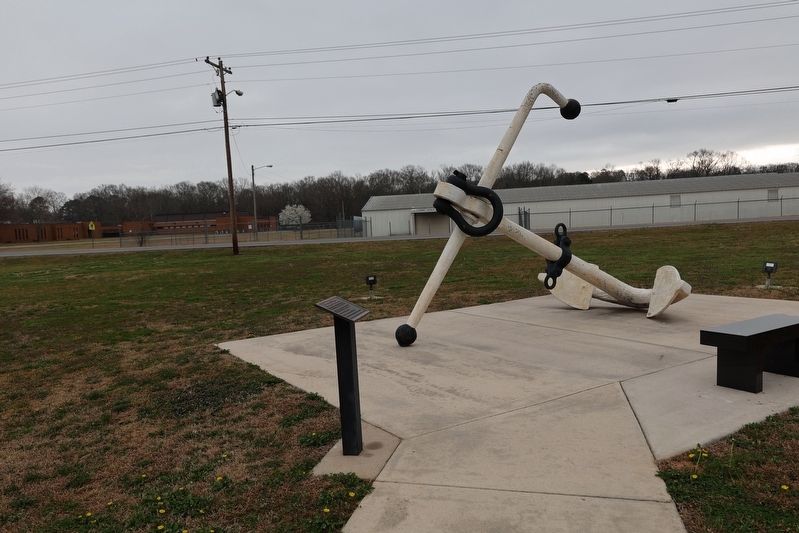
Photographed by Sandra Hughes Tidwell, March 14, 2025
2. Admirality Pattern Wrought Iron Anchor Marker
Credits. This page was last revised on March 19, 2025. It was originally submitted on March 15, 2025, by Sandra Hughes Tidwell of Killen, Alabama, USA. This page has been viewed 362 times since then and 100 times this year. Photos: 1, 2. submitted on March 15, 2025, by Sandra Hughes Tidwell of Killen, Alabama, USA. • James Hulse was the editor who published this page.
