Downtown Montreal in Montréal, Québec — Central Canada (French-Canadian)
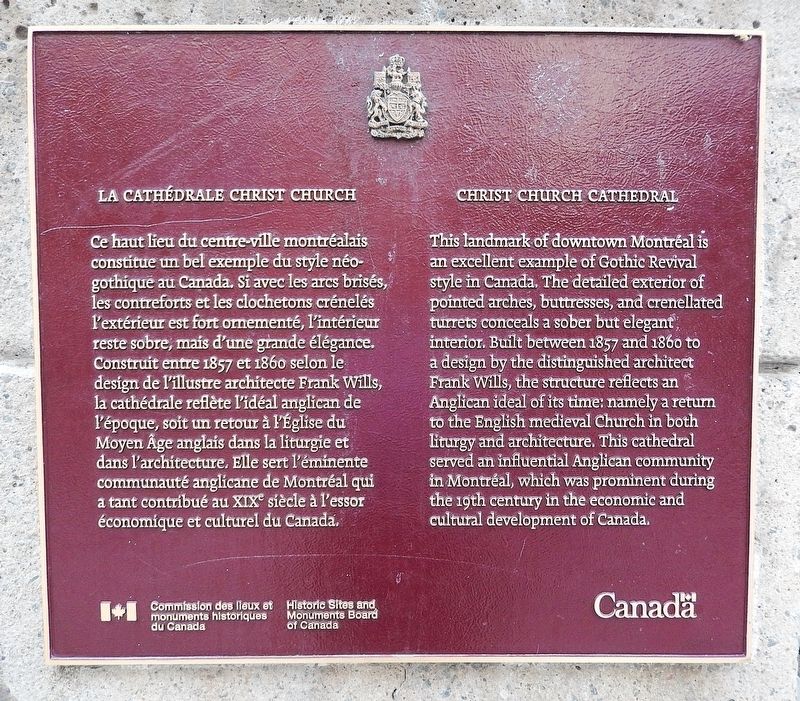
La Cathédrale Christ Church
⎯⎯⎯
Christ Church Cathedral
Photographed by Cosmos Mariner, May 19, 2024
1. La Cathédrale Christ Church / Christ Church Cathedral Marker

this page online
Erected by Commission des lieux et monuments historiques du Canada/Historic Sites and Monuments Board of Canada.
Topics and series. This historical marker is listed in these topic lists: Architecture • Religion & Religious Structures. In addition, it is included in the Canada, Historic Sites and Monuments Board series list. A significant historical year for this entry is 1857.
Location. 45° 30.209′ N, 73° 34.185′ W. Marker is in Montréal, Québec. It is in Downtown Montreal. It is on Saint-Catherine Street West just north of Boulevard Robert-Bourassa, on the left when traveling north. The marker is mounted on the left-front gate post, directly in front of the subject Cathedral. Touch for map. Marker is at or near this postal address: 635 Saint-Catherine Street West, Montréal QC H3B 1B8, Canada. Touch for directions.

Regionally, this marker is in Central Canada. Globally, it is in North America, the Western Hemisphere, and the Western World. Historically, it finds itself in what was once a British colony, the Viceroyalty

Photographed by Cosmos Mariner, May 19, 2024
2. La Cathédrale Christ Church / Christ Church Cathedral Marker
The marker is mounted on the left/south gate post, directly in front of the cathedral.
Other nearby markers. At least 8 other markers are within walking distance of this marker: Raoul Wallenberg (within shouting distance of this marker); The Canada Cement Company Building / L'édifice de la compagnie Canada Cement (about 120 meters away, measured in a direct line); L'église St. James United / St. James United Church (about 240 meters away); Frère André (approx. 0.2 kilometers away); The Olympic Symbol (approx. 0.3 kilometers away); Musée McCord (approx. 0.3 kilometers away); Percy Erskine Nobbs (approx. 0.3 kilometers away); La Basilique Saint-Patrick / Saint Patrick's Basilica (approx. 0.3 kilometers away). Touch for a list and map of all markers in Montréal.
Regarding La Cathédrale Christ Church / Christ Church Cathedral. Classified as historical monument by the government of Quebec on May 12, 1988. In 1999, it was designated a National Historic Site of Canada. Key elements which relate to the heritage value of the site include:
• its prominent location, facing Ste. Catherine Street, in the commercial centre of Montréal;
• the cruciform,geometric massing set under a steep gabled roof, and tower with spire over the crossing;Photographed by Cosmos Mariner, May 19, 20243. La Cathédrale Christ Church / Christ Church Cathedral (southeast elevation)
• the exterior facing of stone and carved stone elaboration;
• the relatively large scale of the building (61.87m by 33.22m and 69.80m in height);
• the hierarchical interior plan with high nave, lower side-aisles, short transept arms (now chapels), and raised chancel;
• the stained glass, pointed arch windows and large east window;
• interior materials and finishes consistent with the Gothic Revival style, including open timber ceiling, limestone supports including piers and crossing arches, and brick and plaster upper walls.

Also see . . .
1. Christ Church Cathedral (Wikipedia).
Excerpt: The present cathedral, a neo-Gothic structure, was designed by architect Frank Wills (1822–1856). Before construction began, Willis died, and Montreal architect Thomas Seaton Scott (1826–1895) was commissioned to carry out his design. The structure was completed in 1859 and consecrated in 1867. Modeled after the 14th century Gothic-style churches of the English countryside, the cathedral features a square crossing tower.(Submitted on March 21, 2025, by Cosmos Mariner of Cape Canaveral, Florida.)
The design, though acclaimedfor its architecture, suffered from important engineering flaws. The soft ground could not support the heavy central stone tower and steeple, which began to subside and lean. By 1920, the tower leaned 1.2 m to the south. George Allan Ross designed alterations in 1923 and reconstructed the tower from 1939 to 1940. In 1927, the stone steeple, weighing 1,600,000 kg was removed. New foundations were poured in 1939, and in 1940, an anonymous donation permitted the construction of a much lighter steeple made of aluminum, molded to simulate the former stone spire. It is 38 m high, attaining a height of 70 m from the ground.Photographed by Cosmos Mariner, May 19, 20244. La Cathédrale Christ Church / Christ Church Cathedral (south elevation)

2. Christ Church Cathedral. (with interior and exterior photos)
Excerpt: Nestled between modern buildings, Christ Church Cathedral figures prominently in the downtown core overtop an underground shopping centre. Designated a National Historic Site of Canada and a Historical Monument by the Government of Québec, Christ Church Cathedral is a rare example of Anglican Gothic Revival architecture designed by British architect Frank Wills.(Submitted on March 21, 2025, by Cosmos Mariner of Cape Canaveral, Florida.)Built between 1857 and 1859, it was one of the first of its kind in Canada. Inside and out, the Cathedral features magnificent details reminiscent of the medieval style of church architecture in England.Photographed by Cosmos Mariner, May 19, 20245. La Cathédrale Christ Church / Christ Church Cathedral (northwest elevation)

3. Christ Church Cathedral National Historic Site of Canada.
Excerpt: Christ Church Cathedral National Historic Site of Canada is a picturesque Gothic Revival building prominently located in the busy commercial district of Montréal, Quebec. With its cruciform plan, the building is composed of simple geometric volumes set beneath a steep gable roof with central tower and tall elegant spire.(Submitted on March 21, 2025, by Cosmos Mariner of Cape Canaveral, Florida.)The relatively elaborate design and decoration of the cathedral is, in part, a reflection of its congregation, who, in the past, were often high profile members of the Montréal’s anglophone business establishment. They included investor George Moffat, David Kinnear senior partner and editor of the (Montreal) Herald, and Thomas Brown Anderson, who became president of the Bank of Montréal.

Photographed by Cosmos Mariner, May 19, 2024
6. La Cathédrale Christ Church / Christ Church Cathedral (east/front elevation)
Credits. This page was last revised on April 5, 2025. It was originally submitted on March 16, 2025, by Cosmos Mariner of Cape Canaveral, Florida. This page has been viewed 171 times since then and 44 times this year. Photos: 1, 2, 3, 4, 5, 6. submitted on March 21, 2025, by Cosmos Mariner of Cape Canaveral, Florida.
