Speyer, Rhineland-Palatinate, Germany — Central Europe
Domnapf
Cathedral Bowl
Photographed by Steve Stoessel, December 17, 2024
1. Domnapf Marker

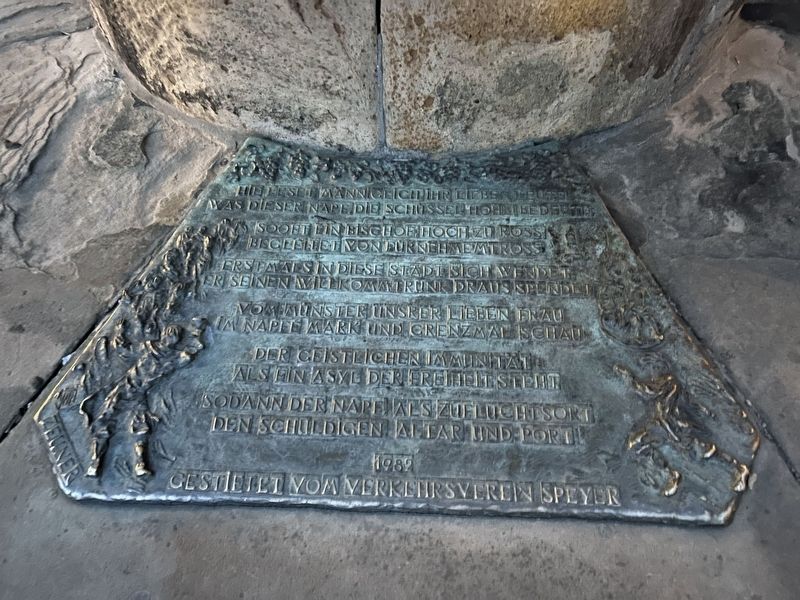
Hie leset Mannigelich ihr lieben Leuten was dieser Napf, die Schüssel hohl Bedeute
Sooft ein Bishop hohl zu Ross begleitet von für nehmemtross
Erstmals in diese Stadt sich wendet er seinen Willkomm trunk draus spendet vom Münster unsrer lieben Frau im Napfe mark und Grenzmal schau.
Der geistlichen Immunität als ein Asyl der Freiheit steht Sodann der Napf. Als Zuflucht sort den Schuldigen Altar und Port.
1982
Gesteilt vom Verkehrsverein Speyer
Here, dear people, you can read what this bowl, the hollow bowl, means.
Whenever a bishop, accompanied by his retinue, rides into the city for the first time, he pours his welcome drink from the Cathedral of Our Lady in the bowl, ceremoniously marking the border.
The bowl then stands as an sanctuary of spiritual immunity, an sanctuary of freedom. The altar and port are a refuge for the guilty.
1982
Provided by the Speyer Tourist Association
Erected 1982 by Verkehrsverein Speyer.
Topics. This historical marker is listed in these topic lists: Religion & Religious Structures • Settlements & Settlers. A significant historical year for this entry is 1982.
Location. 49° 19.035′ N,
this page online

Regionally, it is in Europe, the European Union, Atlantic Europe, Central Europe, the Schengen Area, Western Europe, and the Western World. Historically, it finds itself in what was once the Roman Empire and specifically also the Holy Roman Empire.
Other nearby markers. At least 8 other markers are within walking distance of this marker: Kaiserdom / Imperial Cathedral (a few steps from this marker); Domnapf / Cathedral Bowl (within shouting distance of this marker); Rathhof (within shouting distance of this marker); Ölberg / Mount of Olives (within shouting distance of this marker); Ehemalige Domherrenkurie / Former Canon’s Residence (about 120 meters away, measured in a direct line); Wiedervereinigung Deutschlands / Reunification of Germany (about 120 meters away); Hohenfeldtischer Hof / Court of Hohenfeldt (about 120 meters away); a different
Photographed by Steve Stoessel, December 17, 2024
2. Domnapf Marker
Also see . . .
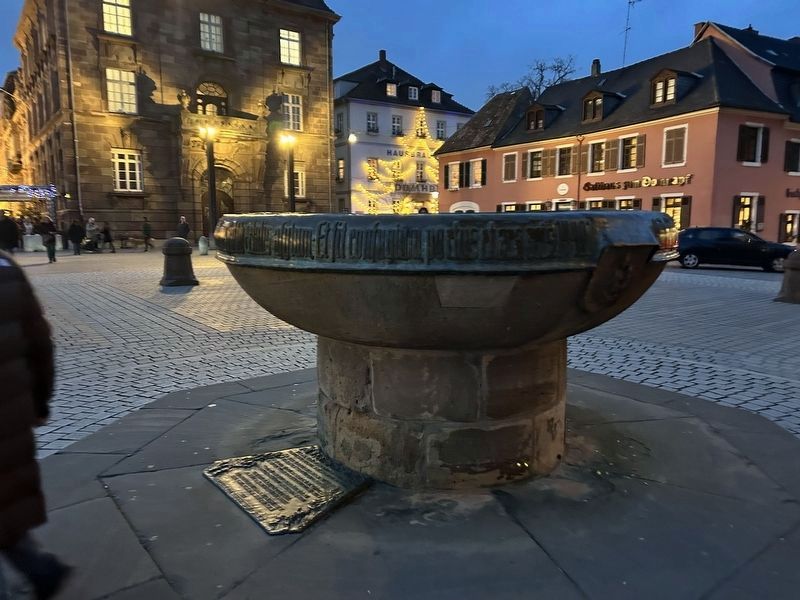
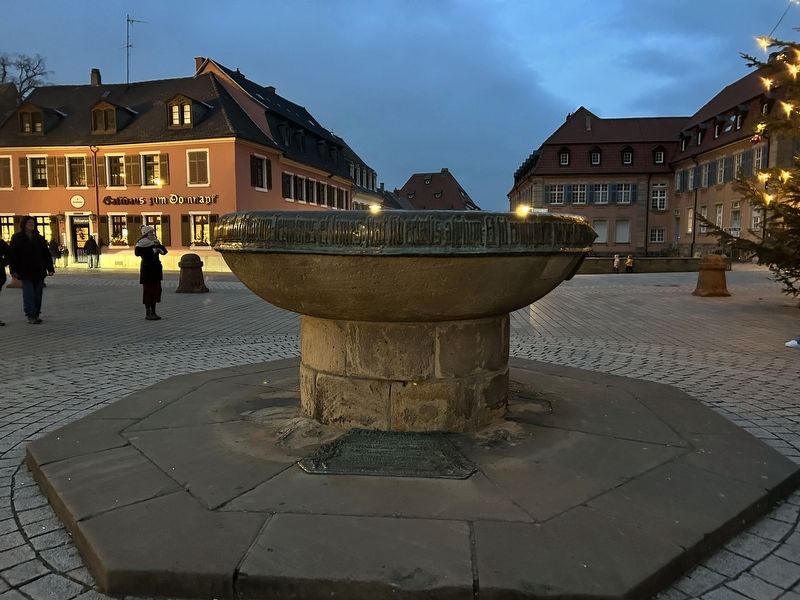
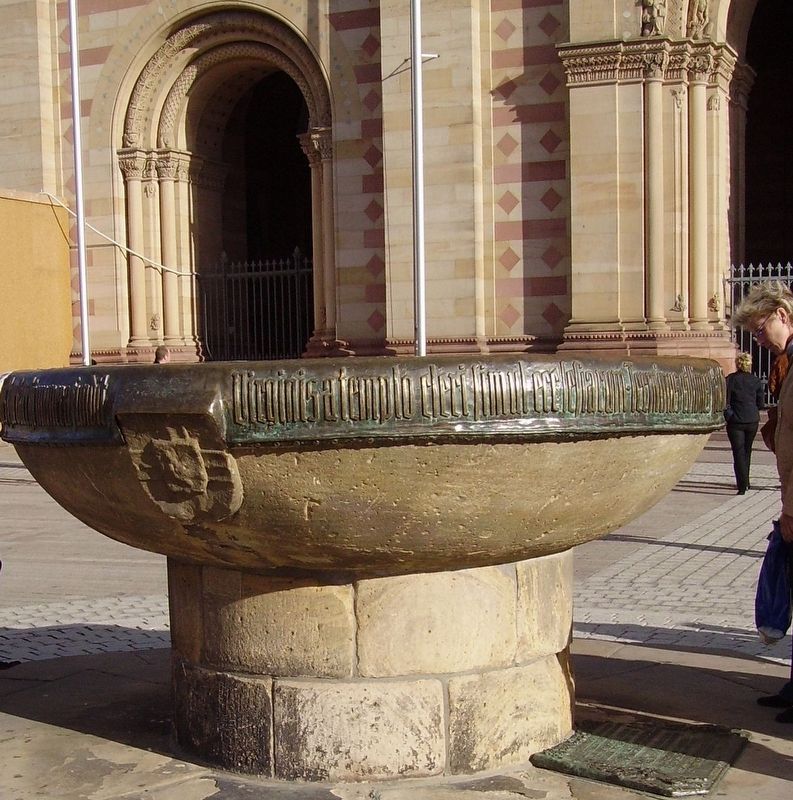
1. Domnapf (Wikipeida). "The cathedral bowl was built in the Middle Ages , probably in 1294; it was first mentioned in documents in 1314. In 1490 it was given its current form and was framed with the Latin inscription. It marked the border between the Free Imperial City of Speyer and the Bishopric, where episcopal law applied. Convicts in the Imperial City therefore sometimes sought refuge in the bishop's domain, hoping for his mercy. Thus, the cathedral bowl also became a kind of symbol of freedom." (Submitted on March 20, 2025, by Steve Stoessel of Niskayuna, New York.)
2. History of Speyer (Wikipedia).
The history of Speyer begins with the establishment of a Roman camp in 10 BCE, making it one of Germany's oldest cities. Its name evolved from Spira, first mentioned in 614. As of 1294 a Free Imperial City, the town became renowned for its Romanesque cathedral, its vibrant Jewish community, its seat of the Imperial Chamber Court, for 50 diets that(Submitted on March 20, 2025, by Steve Stoessel of Niskayuna, New York.)took place within its walls, most notably 1526 and 1529, and last but not least, for the Protestation at Speyer. For several centuries from the Middle Ages into the early modern period, Speyer was one of the main centres of gravity of the Holy Roman Empire.Photographed by Steve Stoessel, December 17, 20243. Domnapf Marker
3. Cathedral Bowl. Nice pictures of Speyer. (Submitted on March 20, 2025, by Steve Stoessel of Niskayuna, New York.)
Photographed by Wikimedia, November 5, 2005
4. Domnapf Marker
Credits. This page was last revised on March 20, 2025. It was originally submitted on March 20, 2025, by Steve Stoessel of Niskayuna, New York. This page has been viewed 145 times since then and 11 times this year. Photos: 1, 2, 3, 4. submitted on March 20, 2025, by Steve Stoessel of Niskayuna, New York.
