Scottsboro in Jackson County, Alabama — The American South (East South Central)
Barbary Wars
(1801-1816)
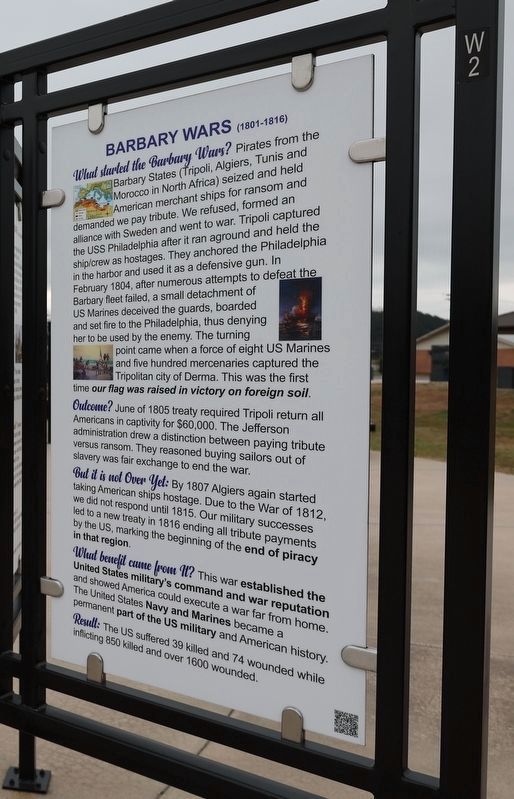
Photographed by Sandra Hughes Tidwell, March 14, 2025
1. Barbary Wars Marker
Outcome? June of 1805 treaty required Tripoli to return all Americans in captivity for $60,000. The Jefferson administration drew a distinction between paying tribute versus ransom. They reasoned buying sailors out of slavery was a fair exchange to end the war.
But it is not Over Yet: By 1807 Algiers again started taking American ships hostage. Due to the War of 1812, we did not respond until 1815. Our military successes led to a new treaty in 1816 ending all tribute payments by the US, marking the beginning of the end of piracy in that region.
What benefit came from it? This war established the United States military's command and war reputation and showed America could execute a war far from home. The United States Navy and Marines became a permanent part of the US Military and American history.
Result: The US suffered 39 killed and 74 wounded while inflating 850 killed and over 1600 wounded. (Marker Number W2.)
Topics. This historical marker is listed in this
this page online
Location. 34° 39.172′ N, 86° 2.546′ W. Marker is in Scottsboro, Alabama, in Jackson County. It is on Heroes Drive west of Jefferson Dr. Touch for map. Marker is at or near this postal address: 1616 Heroes Dr, Scottsboro AL 35768, United States of America. Touch for directions.

Regionally, this marker is in North Alabama. It is also in the American South, specifically in the Deep South, in Appalachia, and specifically in Southern Appalachia. Globally, it is in North America, a Gulf of Mexico state, the Western Hemisphere, the Western World, and the Anglosphere. Historically, it finds itself in what was once the original Cherokee Nation, the territory of the Mississippian Culture, one of the Confederate States of America, and the Antebellum South.
Other nearby markers. At least 8 other markers are within walking distance of this marker: World War II Pacific (here, next to this marker); United States Armed Forces (here, next to this marker); World War II (Europe) (here, next to this marker); Enlisted Service Members (here, next to this marker); Revolutionary War
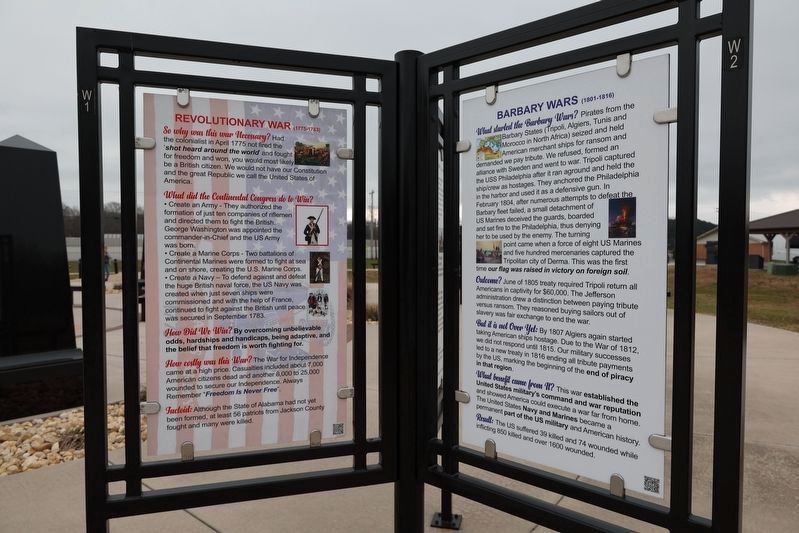
Photographed by Sandra Hughes Tidwell, March 14, 2025
2. Barbary Wars Marker
Regarding Barbary Wars. W2 is one of W1-W18 that chronicles the wars & conflicts fought by the United States
Also see . . . Barbary Wars. The wars were largely a reaction to piracy by the Barbary states. Since the 16th century, North African pirates had captured ships and even raided European coastal areas across the Mediterranean Sea. Originally starting out with the goal of capturing individuals for the domestic North African slave trade, the focus later shifted to kidnapping for ransom. By the 19th century, pirate activity had declined, but Barbary pirates continued to demand tribute from American merchant vessels in the Mediterranean. Refusal to pay would result in the capture of American ships and goods, and often the enslavement or ransoming of crew members. (Submitted on March 20, 2025, by Sandra Hughes Tidwell of Killen, Alabama, USA.)
Credits. This page was last revised on March 21, 2025. It was originally submitted on March 20, 2025, by Sandra Hughes Tidwell of Killen, Alabama, USA. This page has been viewed 164 times since then and 23 times this year. Photos: 1, 2. submitted on March 20, 2025, by Sandra Hughes Tidwell of Killen, Alabama, USA. • James Hulse was the editor who published this page.
