Old Montreal in Montréal, Québec — Central Canada (French-Canadian)
First Transcontinental Train
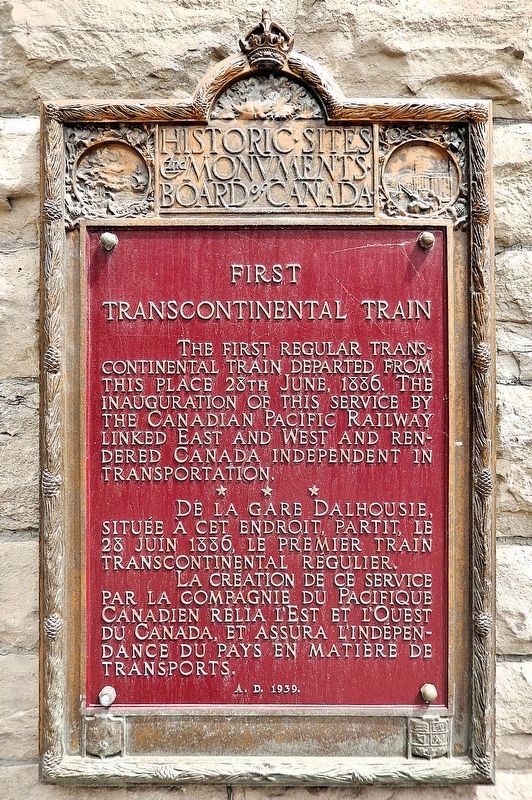
Photographed by Cosmos Mariner, May 21, 2024
1. First Transcontinental Train Marker

Erected 1939 by Historic Sites and Monuments Board of Canada.
Topics and series. This historical marker is listed in this topic list: Railroads & Streetcars. In addition, it is included in the Canada, Historic Sites and Monuments Board series list. A significant historical date for this entry is June 28, 1886.
Location. 45° 30.688′ N, 73° 33.092′ W. Marker is in Montréal, Québec. It is in Old Montreal. It is at the intersection of Rue Barri and Rue Notre-Dame Est, on the right when traveling west on Rue Barri. The marker is mounted on the south side of the former Dalhousie Railroad Station. Touch for map. Marker is at or near this postal address: 417 Rue Berri, Montréal QC H2Y 3E1, Canada. Touch for directions.

Regionally, this marker is in Central Canada. Globally, it is in North America, the Western Hemisphere, and the Western World. Historically, it finds itself in what was once a British colony, the Viceroyalty of New France, the Haudenosaunee (Iroquois) Confederacy, and Rupert’s Land.
Other nearby markers. At least 8 other markers are within walking distance of this marker: Cartier Residences (within shouting distance of this marker); Autour de la Craig (about 90 meters away, measured in a direct line); Parc Fleury-Mesplet (about 120
this page online
Also see . . .
1. First Transcontinental Train National Historic Event (Parks Canada).
Excerpt: Departed from Montréal in 1886, first regular transcontinental service. Designation Date: 1939-05-29.(Submitted on March 23, 2025, by Cosmos Mariner of Cape Canaveral, Florida.)
2. Journey Across a Nation: The First Transcontinental Train Trip in Canada (dayhist.com).
Excerpt: The train departed from Montreal with great fanfare on June 28, making its way through several major cities and towns along what would later be known as The Canadian National Railway line. Onboard were journalists documenting each milestone along with government officials and eager passengers ready to experience(Submitted on March 23, 2025, by Cosmos Mariner of Cape Canaveral, Florida.)an unprecedented adventure.Photographed by Cosmos Mariner, May 21, 20242. First Transcontinental Train MarkerLooking north from Rue Barri; the marker is mounted at eye-level on the south side of the former Dalhousie Railroad Station.
This historical excursion lasted nearly seven days as travelers traversed through landscapes that mirrored Canada's rich diversity from rocky mountains brimming with evergreens to rolling plains dotted with farms showcasing agricultural potential.
The arrival at Port Moody, British Columbia, not only showcased impressive engineering but also signaled an era where isolated communities could now engage meaningfully within national commerce trading goods freely across provinces rather than relying solely on waterways or difficult overland routes before this advancement came about.
The establishment of a transcontinental railway was not merely an engineering triumph; it signified Canada's commitment to national unity and economic development during an era when transportation options were severely limited. Before the railway's inception, traveling across vast stretches of land was both arduous and dangerous.
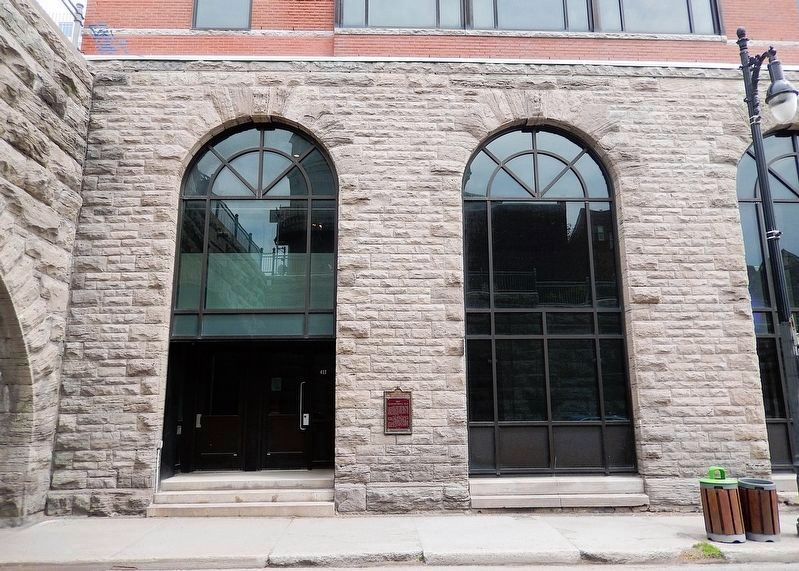
3. Dalhousie station (Canadian Pacific Railway) (Wikipedia).
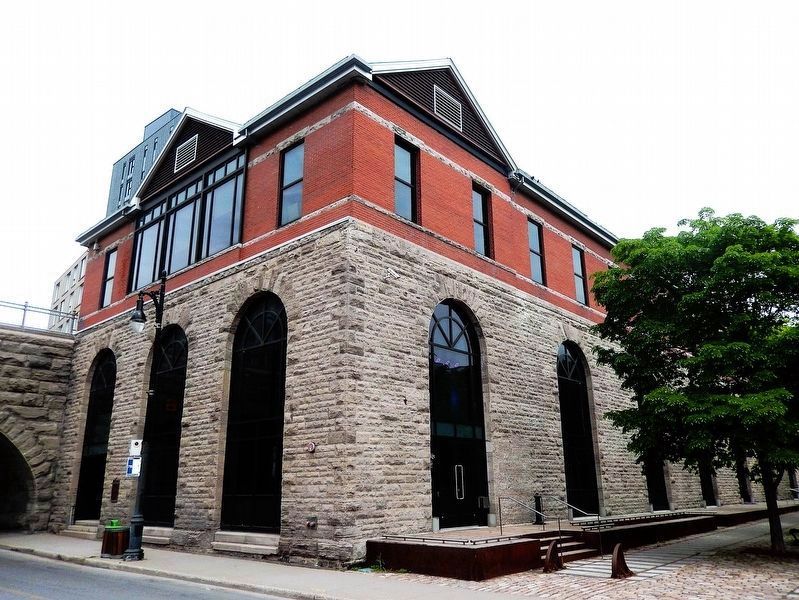
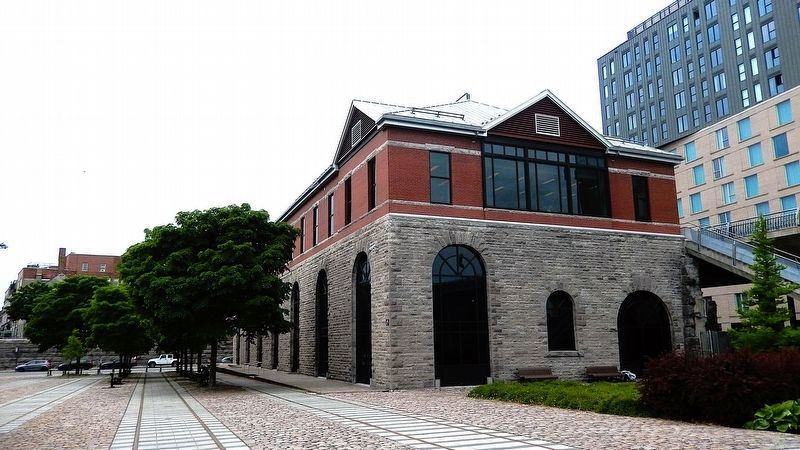
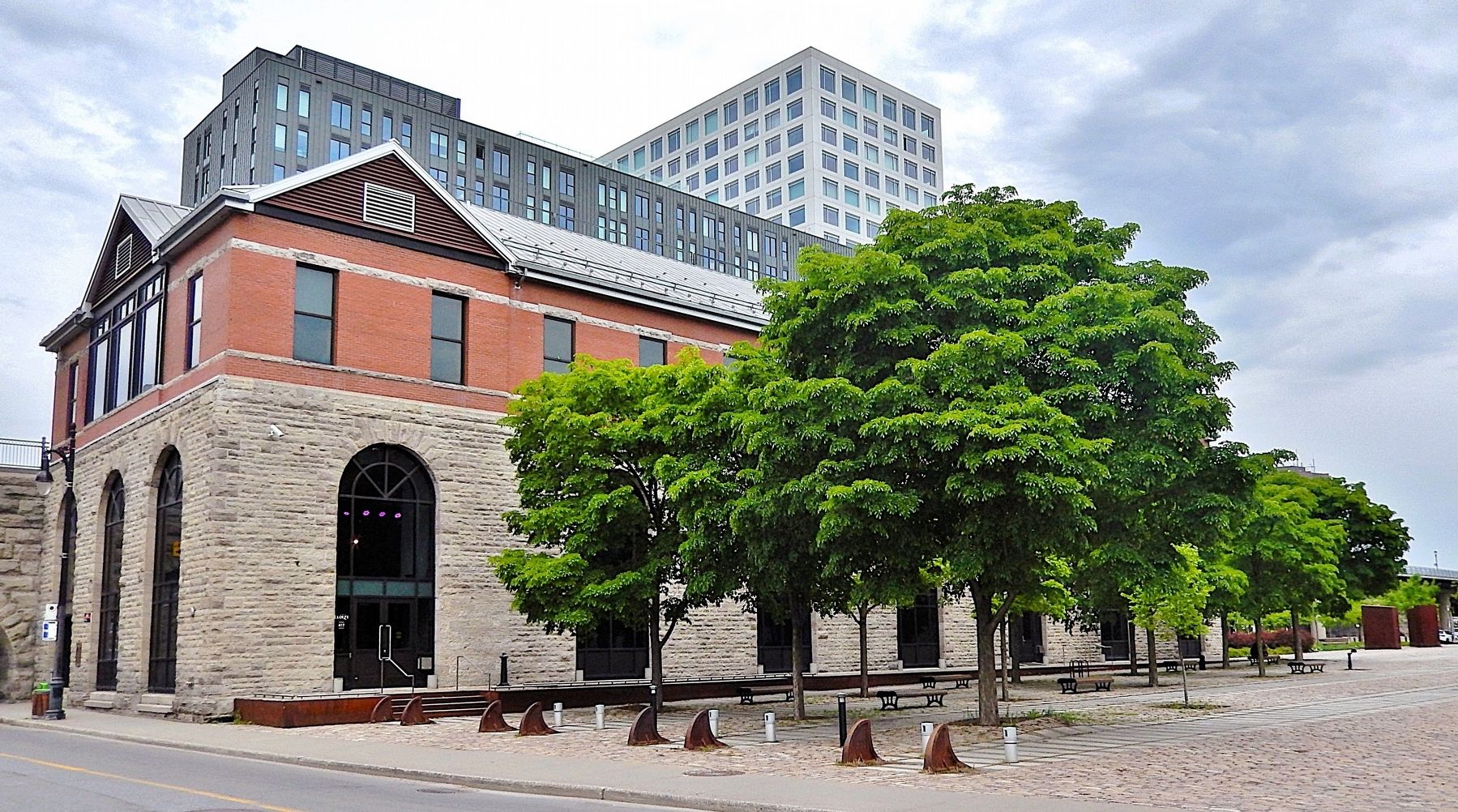
Excerpt:(Submitted on March 23, 2025, by Cosmos Mariner of Cape Canaveral, Florida.)Dalhousie Station (Français: Gare Dalhousie), built in 1884, is the oldest surviving railway station building in Montreal. Dalhousie Station was named after George Ramsay, 9th Earl of Dalhousie, who served as the Governor General of Canada from 1825 to 1828.Photographed by Cosmos Mariner, May 21, 20243. Former Dalhousie Railroad Station
(southeast elevation)
Although the terminal location was originally purchased by the Quebec, Montreal, Ottawa and Occidental Railway, all construction was done by the Canadian Pacific Railway after it purchased the QMO&O in 1882. Consequently, Dalhousie Station thus became the original eastern terminus for CP Rail.
Like other early CPR stations, Dalhousie Station was designed by British-born architect Thomas Charles Sorby. It is architecturally notable for its combination of stone and brick and its high windows. Dalhousie Station was superseded by the grander Place Viger Station, one block to the, in August 1898. Since 2004, the station building has been the home of the Cirque Éloize.
Additional commentary.
1. If you were not a dignitary traveling on a special train,
Photographed by Cosmos Mariner, May 21, 2024
4. Former Dalhousie Railroad Station (northeast elevation)
The September 1886 issue of The Rand-McNally Official Railway Guide and Handbook for the United States and the Dominion of Canada includes Canadian Pacific Railway passenger train schedules dated July 3, 1886. Using these schedules you can plot an transcontinental train trip across Canada—a minimum ten-day journey from Montréal to the west coast with two overnight layovers. Today Via Canada can take you non-stop from Montreal to the Pacific by train in three and a half days.
Westbound, Canadian Pacific’s first transcontinental passenger train left from Port Arthur, Ontario, in the afternoon. From Montréal you could start your journey on the 9 AM express that arrived in Ottawa a little after noon. Or the 8 PM express that arrived Ottawa a little before midnight. After a night in an Ottawa hotel the second leg of the journey departed at 11:45 AM for Port Arthur. It would arrive Port Arthur the next day at 4 PM.
After an overnight layover in a Port Arthur hotel and a leisurely morning, you would be ready for your transcontinental journey across theprairies and mountains of western Canada that began midafternoon.Photographed by Cosmos Mariner, May 21, 20245. Former Dalhousie Railroad Station
The transcontinental departed daily at 3:10 PM. The schedule announces additional fare “Magnificent Palace Sleeping Cars between Port Arthur and Canmore,” which is two stops past Calgary. After that I assume it must be hard benches in a coach car the rest of the way. In total it was a six overnights trip, arriving in at Port Moody at noon. It’s at Winnipeg at 9 AM the second day, Regina at 11:45 PM on the third day, Calgary at 10:50 PM on the fourth. On the fifth day it is in Kamloops at 11 PM, and on the sixth day it arrives on the Pacific coast at noon.
Unless you broke your trip with additional layovers, the total journey in 1886 would have been ten days—an overnight layover at Ottawa, the second overnight on the train to Port Arthur and the third overnight a layover in Port Arthur itself. Then six nights on the transcontinental train to Port Moody.
— Submitted March 24, 2025, by J. J. Prats of Powell, Ohio.
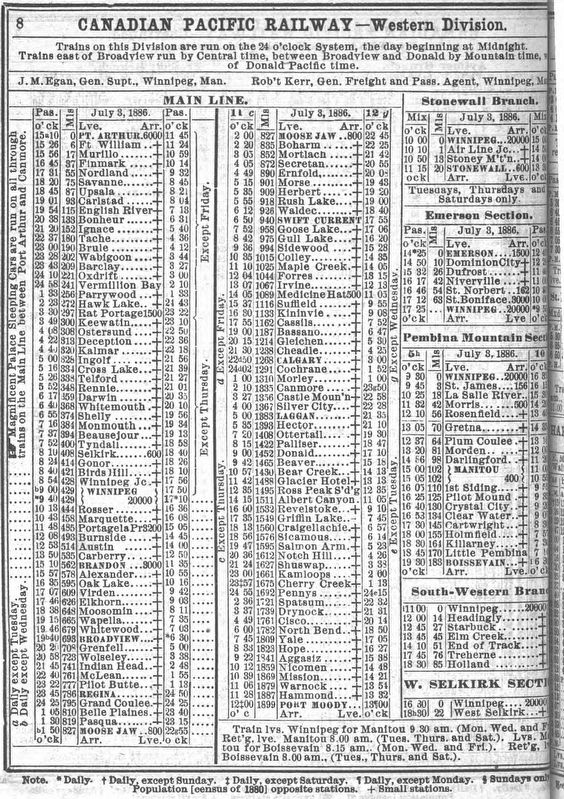
The Rand-McNally Official Railway Guide & Handbook for the United States & the Dominion of Canada, September 1886
6. July 3, 1886, Canadian Pacific Railway Western Division Schedule
Click on image to zoom in.
Credits. This page was last revised on March 24, 2025. It was originally submitted on March 21, 2025, by Cosmos Mariner of Cape Canaveral, Florida. This page has been viewed 134 times since then and 35 times this year. Photos: 1, 2, 3, 4, 5. submitted on March 23, 2025, by Cosmos Mariner of Cape Canaveral, Florida. 6. submitted on March 24, 2025, by J. J. Prats of Powell, Ohio.
