Quartier des Spectacles in Montréal, Québec — Central Canada (French-Canadian)
Le Manège Militaire du Black Watch (Royal Highland Regiment) du Canada
Black Watch (Royal Highland Regiment) of Canada Armoury
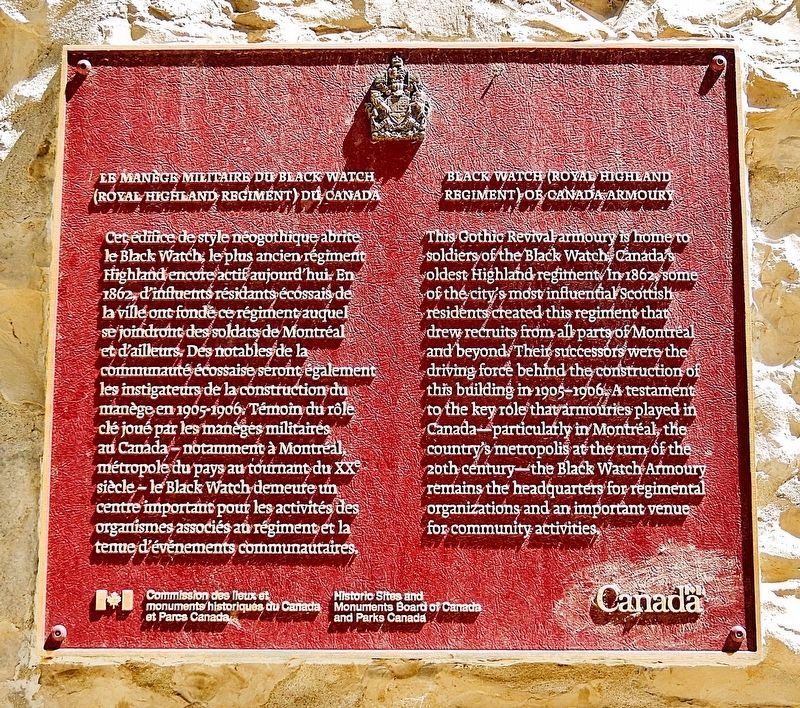
Photographed by Cosmos Mariner, May 22, 2024
1. Le Manège Militaire du Black Watch (Royal Highland Regiment) du Canada Marker

this page online
Erected by Commission des lieux et monuments historiques du Canada et Parcs Canada/Historic Sites and Monuments Board of Canada and Parks Canada.
Topics and series. This historical marker is listed in these topic lists: Architecture • Military. In addition, it is included in the Canada, Historic Sites and Monuments Board, and the Victoria Cross and George Cross Recipients series lists. A significant historical year for this entry is 1905.
Location. 45° 30.468′ N, 73° 34.19′ W. Marker is in Montréal, Québec. It is in Quartier des Spectacles. It is at the intersection of Rue de Bleury and Rue de la Concorde, on the left when traveling east on Rue de Bleury. The marker is mounted at eye-level on the south facade of the subject building. Touch for map. Marker is at or near this postal address: 2067 Rue de Bleury, Montréal QC H3A 2K2, Canada. Touch for directions.

Regionally, this marker is in Central Canada. Globally, it is in North America, the Western Hemisphere, and the Western World.

Photographed by Cosmos Mariner, May 22, 2024
2. Le Manège Militaire du Black Watch (Royal Highland Regiment) du Canada Marker
The marker is mounted on the left side of the south/front entrance.
Other nearby markers. At least 8 other markers are within walking distance of this marker: La terre concédée le 24 octobre 1654 (approx. 0.3 kilometers away); L'église St. James United / St. James United Church (approx. 0.3 kilometers away); Raoul Wallenberg (approx. 0.4 kilometers away); Le Collège Sainte-Marie (approx. 0.4 kilometers away); L'avant-garde artistique au rendez-vous Chez Tranquille (approx. 0.4 kilometers away); La passion partagée de la littérature à la Librairie Tranquille (approx. 0.4 kilometers away); La Librairie Tranquille (approx. 0.4 kilometers away); Henri Tranquille (approx. 0.4 kilometers away). Touch for a list and map of all markers in Montréal.
Regarding Le Manège Militaire du Black Watch (Royal Highland Regiment) du Canada. The Black Watch Armoury was declared a National Historic Site of Canada in 2008. It was previously designated a Recognized Federal Heritage Building, in 1994.
From the Canadian Register Statement of Significance:
Key elementsthat relate to the heritage value of this site include: its symmetrical primary façade, which is faced with grey, rusticated, and textured Montréal limestone; the motifs suggesting a Scottish baronial castle, such as a portcullis with chains, twin semi-circular towers and the early heraldic boar crest of the regiment above the door; the name of the regiment at the time of the armoury’s construction, (5th Royal Highlanders of Canada) and below it, attached to the wall in metal letters, the current name (The Black Watch Royal Highland Regiment of Canada); the drill hall, which is spanned by double-hinged steel trusses, that rises through two storeys and is lit by tall windows on either side; its functional sloped entrance ramp, leading directly into the open drill space; the bronze plaques commemorating the six officers and men who served in the regiment and were awarded the Victoria Cross in the First World War and another plaque that commemorates those who fought at the raid on Dieppe in 1942; its ongoing use by the regiment as the Regimental Museum, the Regimental and Command offices, the Officers’ Mess and library; and the evidence of the original and ongoing use of the building as the headquarters of the regiment and for educational and training purposes, such as office spaces, lecture and training rooms, and accommodation spaces for cadets.Photographed by Cosmos Mariner, May 22, 20243. Black Watch (Royal Highland Regiment) Armoury

Also see . . .
1. Black Watch Armoury (Wikipedia).
Excerpt: The Black Watch Armoury is a Scottish baronial-style armoury in Montreal, completed in 1906 to house the 5th Regiment "Royal Highlanders of Canada" — now the Black Watch (Royal Highland Regiment) of Canada. It was designed by Samuel Arnold Finley and David Jerome Spence. The armoury is home to the regiment's museum, which was opened on 8 November 1949 by the then-colonel of the Black Watch, Field Marshal Lord Wavell.(Submitted on March 23, 2025, by Cosmos Mariner of Cape Canaveral, Florida.)
2. Black Watch (Royal Highland Regiment) of Canada Armoury National Historic Site of Canada.
Excerpt: The irregularly-planned armoury consists of two flat-roofed two-storey blocks at the front and rear joined by the large gable-roofed drill hall between them. It is home to the Black Watch (Royal Highland Regiment) of Canada, one of Canada's oldest regiments and its oldest surviving Highland Regiment, established by Scottish residents of Montréal's Golden Square Mile, and whose descendants were the driving force behind the construction of the armoury.(Submitted on March 23, 2025, by Cosmos Mariner of Cape Canaveral, Florida.)
3. Black Watch (Royal Highland Regiment) of Canada (Wikipedia).
Excerpt: The Black Watch (Royal Highland Regiment) of Canada is a reserve infantry regiment in 34 Canadian Brigade Group, 2nd Canadian Division, of the Canadian Army. They are the senior Canadian-Scottish Regiment. Volunteers have served since the regiment's inception in Montreal on 31 January 1862, as the 5th Battalion, Volunteer Militia Rifles of Canada. Since then, thousands of Canadian citizens have served in the Black Watch. In addition to service during the Fenian raids, they have fought in the First and Second World Wars and bolstered NATO operations in Europe and UN peacekeeping worldwide.(Submitted on March 23, 2025, by Cosmos Mariner of Cape Canaveral, Florida.)
Credits. This page was last revised on March 23, 2025. It was originally submitted on March 21, 2025, by Cosmos Mariner of Cape Canaveral, Florida. This page has been viewed 163 times since then and 43 times this year. Photos: 1, 2, 3. submitted on March 23, 2025, by Cosmos Mariner of Cape Canaveral, Florida.
