
Castricum, North Holland, Netherlands — Northwestern Europe
De Kunstbunker
⎯⎯⎯
The Art Bunker
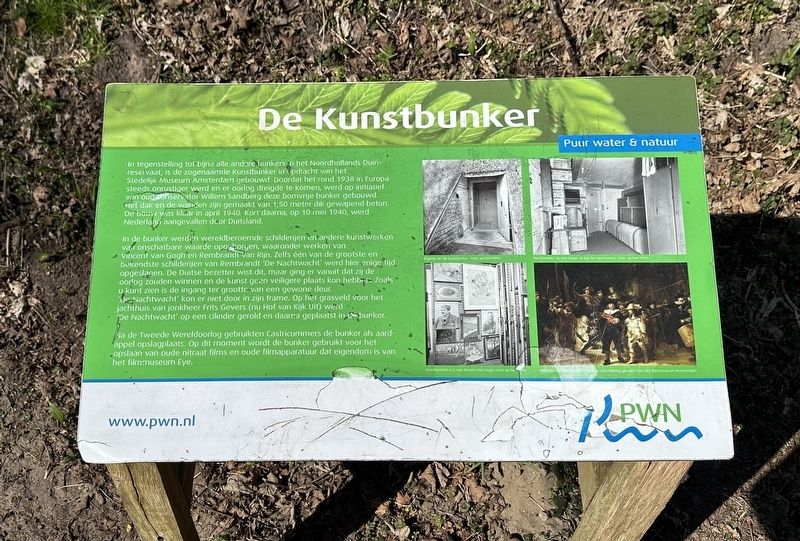
Photographed by Andrew Ruppenstein, March 21, 2025
1. De Kunstbunker / The Art Bunker Marker

In tegenstelling tot bijna alle andere bunkers in het Noordhollands Duinreservaat, is de zogenaamde Kunstbunker in opdracht van het Stedelijk Museum Amsterdam gebouwd. Doordat het rond 1938 in Europa steeds onrustiger werd en er oorlog dreigde te komen, werd op initiatief van oud conservator Willem Sandberg deze bomvrije bunker gebouwd. Het dak en de wanden zijn gemaakt van 1,50 meter dik gewapend beton. De bouw was klaar in april 1940. Kort daarna, op 10 mei 1940, werd Nederland aangevallen door Duitsland.
In de bunker werden wereldberoemde schilderijen en andere kunstwerken van onschatbare waarde opgeborgen, waaronder werken van Vincent van Gogh en Rembrandt van Rijn. Zelfs één van de grootste en bekendste schilderijen van Rembrandt 'De Nachtwacht' werd hier enige tijd opgeslagen. De Duitse bezetter wist dit, maar ging er vanuit dat zij de oorlog zouden winnen en de kunst geen veiligere plaats kon hebben. Zoals u kunt zien is de ingang ter grootte van een gewone deur. De Nachtwacht' kon er niet door in zijn frame. Op het grasveld voor het jachthuis van jonkheer Frits Gevers (nu Hof van Kijk Uit) werd 'De Nachtwacht' op een cilinder gerold en daarna geplaatst in de bunker.
Na de Tweede Wereldoorlog gebruikten Castricummers de bunker als aardappel opslagplaats. Op dit moment wordt de bunker gebruikt voor het opslaan van oude nitraat films en oude filmapparatuur dat eigendom is van het filmmuseum Eye.
The Art Bunker
Unlike almost all other bunkers in the Noordhollands Duinreservaat (“North Holland Dune Reserve”), the so-called Art Bunker was built on behalf of the Stedelijk Museum Amsterdam. Because things were becoming increasingly restless in Europe around 1938 and war was looming, this bombproof bunker was built on the initiative of former curator Willem Sandberg. The roof and walls are made of 1.50 meter thick reinforced concrete. Construction was completed in April 1940. Shortly afterwards, on May 10, 1940, the Netherlands was attacked by Germany.
The bunker was used to store world-famous paintings and other priceless works of art, including works by Vincent van Gogh and Rembrandt van Rijn. Even one of Rembrandt's largest and most famous paintings, 'The Night Watch', was stored here for a while. The German occupiers knew this, but assumed that they would win the war and that the art could not have a safer place. As you can see, the entrance is the size of a normal door. 'The Night Watch' could not fit through in its frame. On the lawn in front of the hunting lodge of squire Frits Gevers (now Hof van Kijk Uit), 'The Night Watch' was rolled onto a cylinder and then placed in the bunker.
After the Second World War, the people of Castricum used the bunker as a potato storage facility. At the moment, the bunker is used to store old nitrate films and old film equipment that is owned by the Eye film museum.
Erected by the
this page online
Topics. This historical marker is listed in these topic lists: Arts, Letters, Music • Forts and Castles • War, World II. A significant historical month for this entry is April 1940.
Location. 52° 32.594′ N, 4° 38.987′ E. Marker is in Castricum, Noord-Holland (North Holland). It is on Helmweg, on the left when traveling south. The marker is in the Noordhollands Duinreservaat, on Helmweg about 120 meters south of where Helmweg splits off from Oude Schulpweg. The marker is along an unpaved but graded road. You may walk or bicycle there, but it isn’t accessible to cars. Touch for map. Marker is at or near this postal address: Oude Schulpweg 3, Castricum, Noord-Holland 1901 NV, Netherlands. Touch for directions.

Regionally, it is in Europe, the European Union, Atlantic Europe, the Benelux Low Countries, the Schengen Area, Western Europe, and the Western World. Historically, it finds itself in what was once the Roman Empire and specifically also the Holy Roman Empire.
Other nearby markers. At least 8 other markers are within walking distance of this marker: V1 Lanceerplaats / V1 Launch Site (about 180 meters away, measured

Photographed by Andrew Ruppenstein, March 21, 2025
2. De Kunstbunker / The Art Bunker Marker and bunker
Also see . . . Kunstbunker bij Castricum (Wikipedia, in Dutch). Overview (in translation):
The Kunstbunker near Castricum was a Dutch art depot on the Helmweg near Castricum where art treasures were stored during the Second World War. The bunker is located in the Geversduin near the rest area "Hof van Kijk-Uit", which was easily accessible by road and train, and was also far away from important military targets.(Submitted on March 21, 2025.)

Photographed by Andrew Ruppenstein, March 21, 2025
3. Bunker entrance

courtesy archief PWN, 1940s
4. Marker photos showing the bunker entrance and ‘De nachtwacht’ rolled up in storage
Credits. This page was last revised on March 21, 2025. It was originally submitted on March 21, 2025, by Andrew Ruppenstein of Lamorinda, California. This page has been viewed 115 times since then and 11 times this year. Photos: 1, 2, 3, 4. submitted on March 21, 2025, by Andrew Ruppenstein of Lamorinda, California.
