El Centro in Coxen Hole in Roatán, Islas de la Bahía, Honduras — Central America
Historical Photos of Coxen Hole Roatan

Photographed by Bradley Owen, March 17, 2025
1. Historical Photos of Coxen Hole Roatan Marker
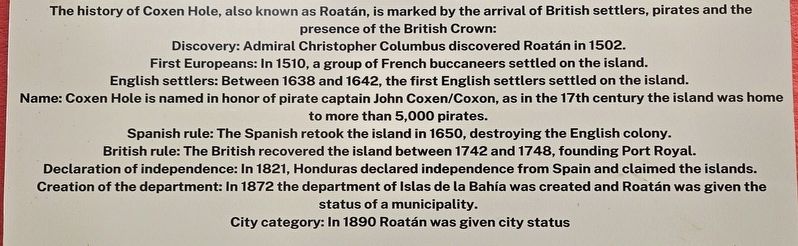
The history of Coxen Hole, also known as Roatán, is marked by the arrival of British settlers, pirates and the presence of the British Crown:
Discovery: Admiral Christopher Columbus discovered Roatán in 1502.
First Europeans: In 1510, a group of French buccaneers settled on the island.
English settlers: Between 1638 and 1642, the first English settlers settled on the island.
Name: Coxen Hole is named in honor of pirate captain John Coxen/Coxon, as in the 17th century the island was home to more than 5,000 pirates.
Spanish rule: The Spanish retook the island in 1650, destroying the English colony.
British rule: The British recovered the island between 1742 and 1748, founding Port Royal.
Declaration of independence: In 1821, Honduras declared independence from Spain and claimed the islands.
Creation of the department: In 1872 the department of Islas de la Bahía was created and Roatán was given the status of a municipality.
City category: In 1890 Roatán was given city status
Erected by Bordifer, The Best on the Island, Roatan, Honduras.
Topics. This historical marker is listed in these topic lists: Political Subdivisions • Settlements & Settlers. A significant historical year for this entry is 1502.
Location. 16° 18.835′ N, 86° 32.299′ W. Marker is in Coxen Hole, Islas de la Bahía, in Roatán. It is in El Centro. It is on Main Street just east of Market Road, on the right when traveling east. Marker is located in Central Park south of the clock tower near water's edge. Touch for map. Marker is at or near this postal address: Main St 34101, Coxen Hole, Islas de la Bahía, Honduras. Touch for directions.

Regionally, it is on the Caribbean Sea, in North America, in Central America, in Mesoamerica, on the Ring of Fire, on the Pacific Rim, and in the Western Hemisphere. Historically, it finds
this page online
Other nearby markers. At least 2 other markers are within 6 kilometers of this marker, measured as the crow flies: Mangroves (approx. 4.6 kilometers away); Herbs of the Bay Island of Roatan (approx. 5.3 kilometers away).
Photographed by Bradley Owen, March 17, 2025
2. Closeup of Marker Text
Photographed by Bradley Owen, March 17, 2025
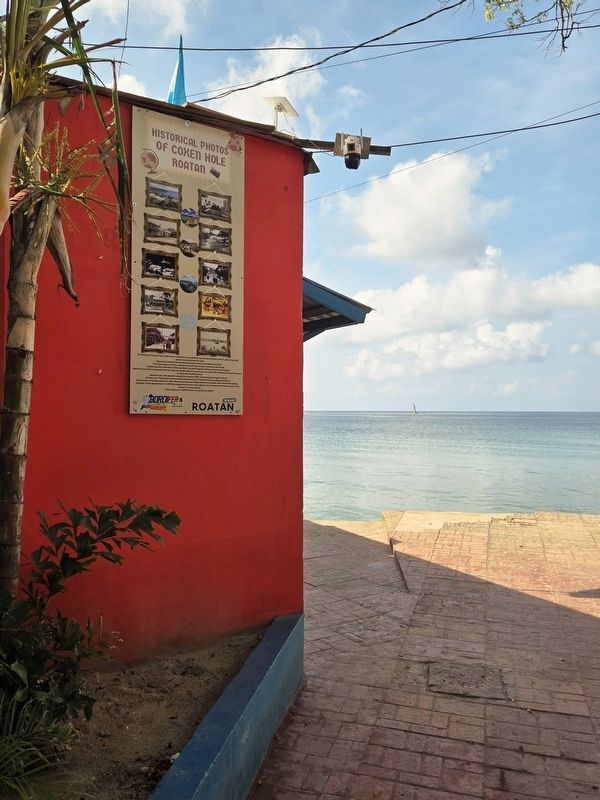
3. Historical Photos of Coxen Hole Roatan Marker
View is looking south.
Credits. This page was last revised on September 9, 2026. It was originally submitted on March 22, 2025, by Bradley Owen of Morgantown, West Virginia. This page has been viewed 296 times since then and 79 times this year. Photos: 1, 2, 3. submitted on March 22, 2025, by Bradley Owen of Morgantown, West Virginia.
