Gentiaanbuurt in Amsterdam, North Holland, Netherlands — Northwestern Europe
17 Juli 1943 Fokkerbombardementen
⎯⎯⎯
17 July 1943 Fokker Bombings
Photographed by Andrew Ruppenstein, March 23, 2025
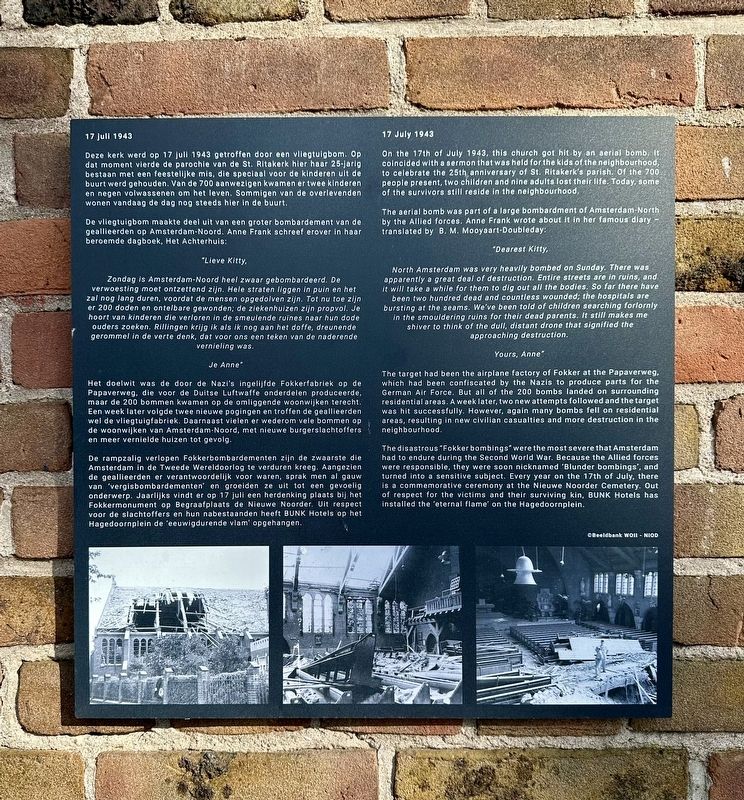
1. 17 July 1943 Fokker Bombings Marker

Deze kerk werd op 17 juli 1943 getroffen door een vliegtuigbom. Op dat moment vierde de parochie van de St. Ritakerk hier haar 25-jarig bestaan met een feestelijke mis, die speciaal voor de kinderen uit de buurt werd gehouden. Van de 700 aanwezigen kwamen er twee kinderen en negen volwassenen om het leven. Sommigen van de overlevenden wonen vandaag de dag nog steeds hier in de buurt.
De vliegtuigbom maakte deel uit van een groter bombardement van de geallieerden op Amsterdam-Noord. Anne Frank schreef erover in haar beroemde dagboek, Het Achterhuis:
Het doelwit was de door de
this page online
De rampzalig verlopen Fokkerbombardementen zijn de zwaarste die Amsterdam in de Tweede Wereldoorlog te verduren kreeg. Aangezien de geallieerden er verantwoordelijk voor waren, sprak men al gauw van 'vergisbombardementen' en groeiden ze uit tot een gevoelig onderwerp. Jaarlijks vindt er op 17 juli een herdenking plaats bij het Fokkermonument op Begraafplaats de Nieuwe Noorder. Uit respect voor de slachtoffers en hun nabestaanden heeft BUNK Hotels op het Hagedoornplein de 'eeuwigdurende vlam' opgehangen.
On the 17th of July 1943, this church got hit by an aerial bomb. It coincided with a sermon that was held for the kids of the neighbourhood, to celebrate the 25th anniversary of St. Ritakerk's parish.

Photographed by Andrew Ruppenstein, March 23, 2025
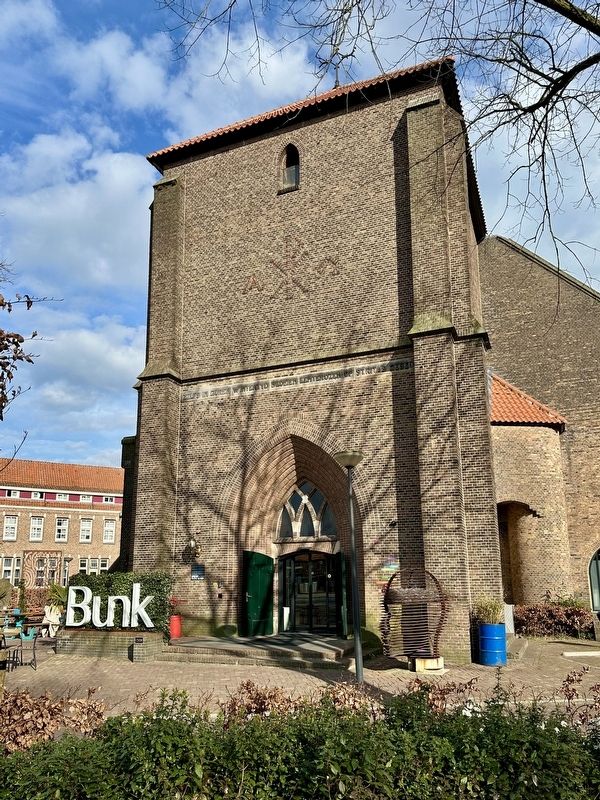
2. 17 July 1943 Fokker Bombings Marker - wide view
The marker is to the left of the hotel entrance. It is difficult to see from any distance.
The aerial bomb was part of a large bombardment of Amsterdam-North by the Allied forces. Anne Frank wrote about it in her famous diary translated by B. M. Mooyaart-Doubleday:
The target had been the airplane factory of Fokker at the Papaverweg, which had been confiscated by the Nazis to produce parts for the German Air Force. But all of the 200 bombs landed on surrounding residential areas. A week later, two new attempts followed and the target was hit successfully.
Photographed by Andrew Ruppenstein, March 23, 2025
3. 17 July 1943 Fokker Bombings Marker - wider view
The disastrous "Fokker bombings” were the most severe that Amsterdam had to endure during the Second World War. Because the Allied forces were responsible, they were soon nicknamed 'Blunder bombings', and turned into a sensitive subject. Every year on the 17th of July, there is a commemorative ceremony at the Nieuwe Noorder Cemetery. Out of respect for the victims and their surviving kin, BUNK Hotels has installed the 'eternal flame' on the Hagedoornplein.
Erected by BUNK Hotels.
Topics. This historical marker is listed in this topic list: War, World II. A significant historical date for this entry is July 17, 1943.
Location. 52° 23.286′ N, 4° 54.834′ E. Marker is in Amsterdam, Noord-Holland (North Holland). It is in Gentiaanbuurt. It is on Hagedoornplein. Touch for map. Marker is at or near this postal address: Hagedoornplein 2, Amsterdam, Noord-Holland 1031 BV, Netherlands. Touch for directions.

Regionally, it is in Europe, the European Union, Atlantic Europe, the Benelux Low Countries,
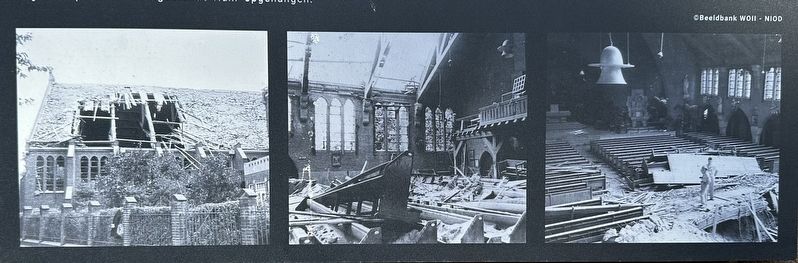
courtesy Beeldbank WOII - NIOD, circa 1943
4. Marker photos, showing the destruction to Sint Ritakerk
Other nearby markers. At least 8 other markers are within walking distance of this marker: 1936-1939 No Pasaran (within shouting distance of this marker); Gerben Wagenaar (about 150 meters away, measured in a direct line); Gerben Wagenaarbrug (about 150 meters away); Lancaster R5512 (approx. 0.4 kilometers away); Museum de Noord (museum of the north) and Vogeldorp (village) (approx. 0.8 kilometers away); Overhoeks (approx. one kilometer away); De Ruijterkade 127 (approx. 1.3 kilometers away); Spoorviaduct Oostertoegang Centraal Station / Railway Viaduct, Eastern Entrance, Central Station (approx. 1.4 kilometers away). Touch for a list and map of all markers in Amsterdam.
Also see . . . Allied bombings of Amsterdam-Noord (Wikipedia). Overview:
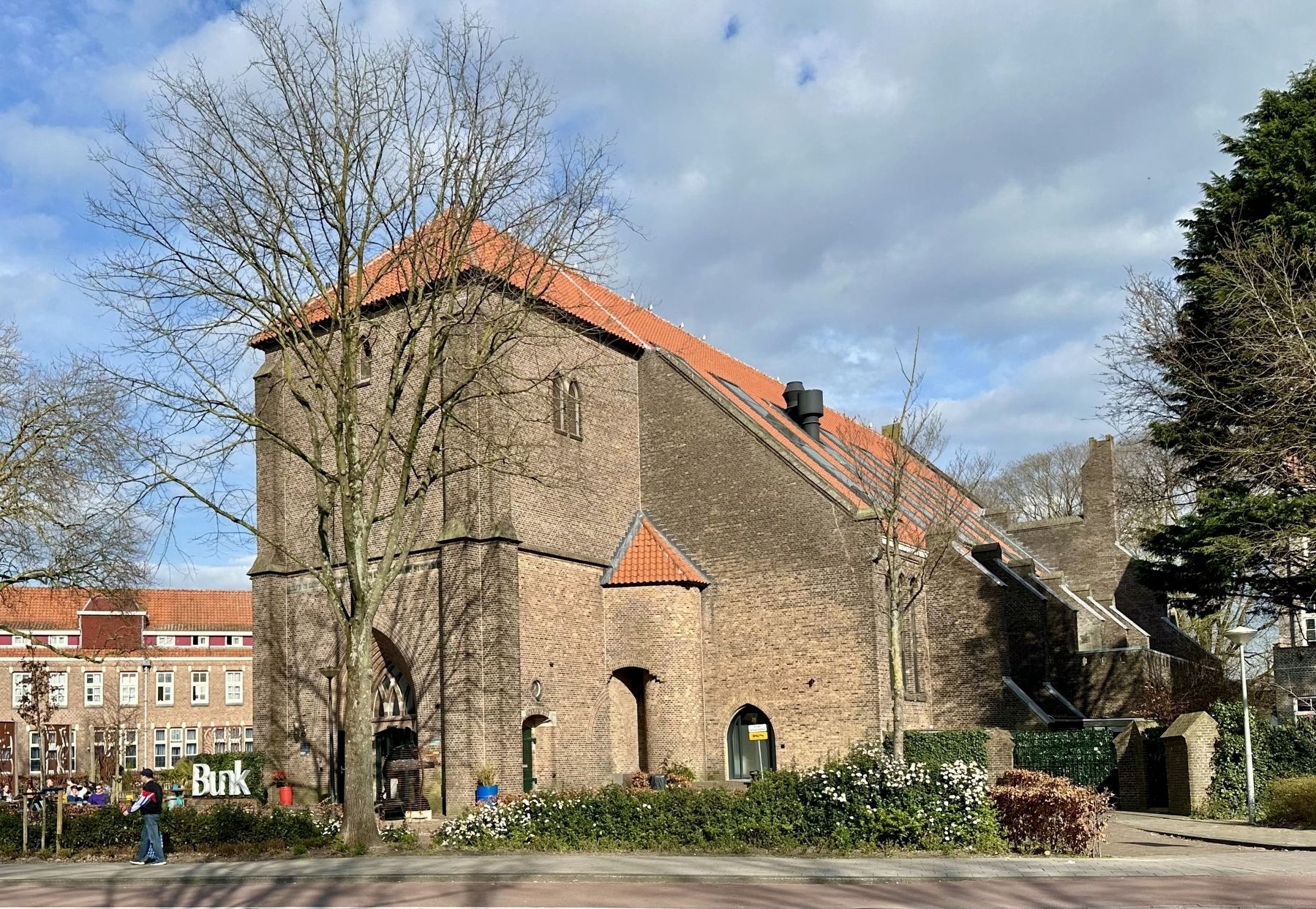
The Allied bombings of Amsterdam-Noord took place in July 1943 during the German occupation of the Netherlands in World War II. Three strategic bombing attacks by Allied Forces were aimed at the former Fokker Aircraft Factory in the northern part of Amsterdam,(Submitted on March 24, 2025.)which was of interest as the factory was confiscated by the Nazis and employees were forced to produce aircraft for the Luftwaffe. However, only 7 out of the 326 bombs from these three airstrikes hit their target, while the others fell on the surrounding residential area, resulting in the loss of more than 206 lives in total. The attacks were the most damaging and deadly bombardment of Amsterdam during the Second World War, and the most disastrous airstrike the city has ever endured. As these were Allied attacks, the losses and trauma caused by the event have always been a sensitive and painful topic for the citizens of Amsterdam-Noord.Photographed by Andrew Ruppenstein, March 23, 20255. Sint Ritakerk today, now BUNK Hotel
Credits. This page was last revised on March 24, 2025. It was originally submitted on March 24, 2025, by Andrew Ruppenstein of Lamorinda, California. This page has been viewed 174 times since then and 38 times this year. Photos: 1, 2, 3, 4, 5. submitted on March 24, 2025, by Andrew Ruppenstein of Lamorinda, California.
