
Binnenstad Hoorn , North Holland, Netherlands — Northwestern Europe
Jan Ruiter and Gré Visser Memorial
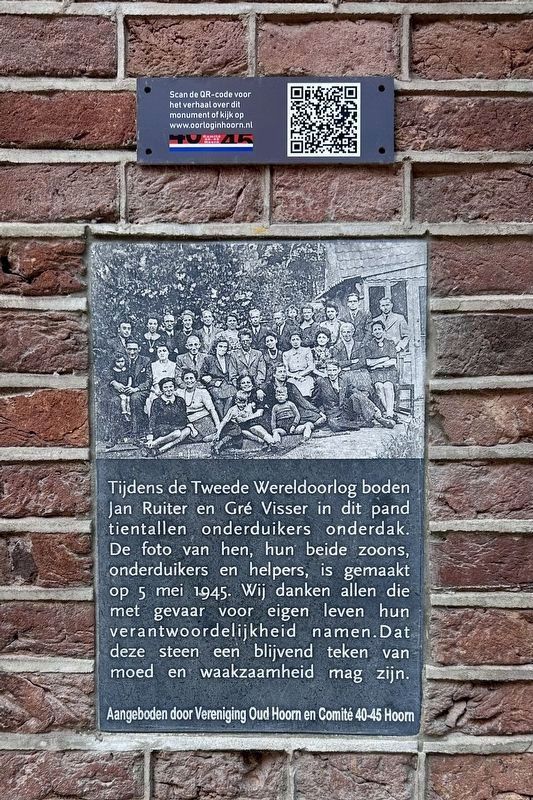
Photographed by Andrew Ruppenstein, March 22, 2025
1. Jan Ruiter and Gré Visser Memorial
The photo was taken on May 5, 1945 - Liberation Day.

(During the Second World War, Jan Ruiter and Gré Visser offered shelter to dozens of people in hiding in this building. This photo of them, their two sons, people who had been in hiding and helpers, was taken on 5 May 1945. We thank all those who risked their own lives to take responsibility. May this plaque be a lasting sign of courage and vigilance.)
Erected by Vereniging Oud Hoorn, Comité 40-45 Hoorn.
Topics. This memorial is listed in this topic list: War, World II. A significant historical date for this entry is May 5, 1945.
Location. 52° 38.371′ N, 5° 3.674′ E. Memorial is in Hoorn, Noord-Holland (North Holland). It is in Binnenstad Hoorn. It is on Grote Oost, on the left when traveling east. Touch for map. Memorial is at or near this postal address: Grote Oost 35, Hoorn, Noord-Holland 1621 BR, Netherlands. Touch for directions.

Regionally, it is in Europe, the European Union, Atlantic Europe, the Benelux Low Countries, the Schengen Area, Western Europe, and the Western World. Historically, it finds itself in what was once the Holy Roman Empire.
Other nearby markers. At least 8 other markers are within walking distance of this marker: Voormalige Postkantoor / Former Post Office (a few steps from this marker); Het Foreestenhuis / The Foreest Building (within shouting distance of this marker); Onderduikers in het Duitse hoofdkwartier / People in hiding at the German headquarters (about 90 meters away, measured in a direct line); Kerkstraat 10
this page online
Also see . . . Het stille geheim achter een winkelpui (Comité 40-45 Hoorn, in Dutch). = The silent secret behind a shop window. Excerpt (in translation):
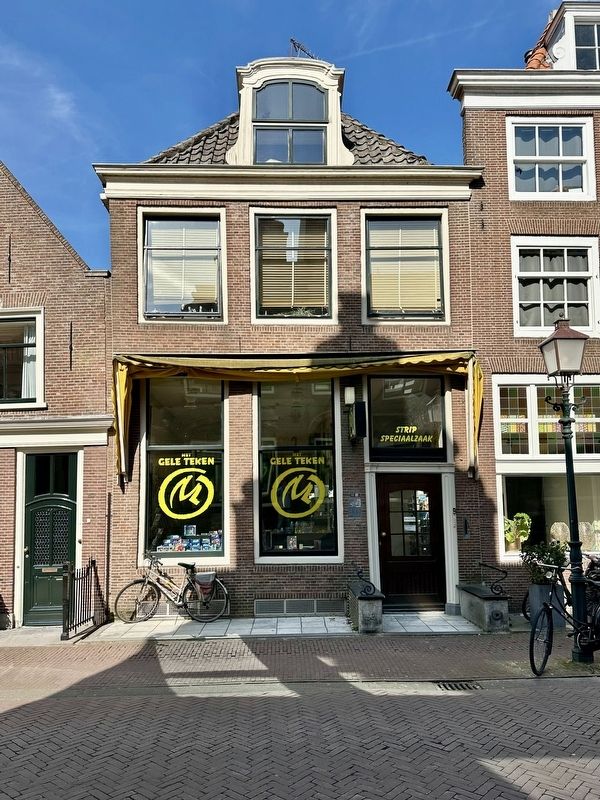
Gré and Jan lived with their sons Bart and Bob on the Grote Oost. They ran a textile and home furnishing business there. The couple had been involved in the resistance since the beginning of the war. Jan managed to gain so much trust at the distribution office that he can freely use ration cards. These are divided among the Jews in hiding in the region and in the North and East of the Netherlands. When Gré and Jan were then asked if they want to take in a Jewish doctor and his wife, they think that it is a given. And when a Jewish business associate comes to say goodbye because he and his wife have to report for Westerbork, Jan states that there is room for them(Submitted on March 24, 2025.)too.Photographed by Andrew Ruppenstein, March 22, 20252. Jan Ruiter and Gré Visser Memorial - wide viewThe plaque is to the left of the door.
Sometimes there were as many as sixteen people in hiding in the house at the same time. Jewish people, resistance fighters, young men who refuse the Arbeitseinsatz (forced employment in Germany): they are all given a safe hiding place behind the shop and in the attic. Gré provided food and, together with Jan, arranges identity cards, ration cards and stamps. Some stayed for a long time, others only until Jan finds another safe hiding place for them. The back of the house is specially renovated for the people in hiding; a hiding place for ten people is built in two cupboards around a chimney. For years, the people in hiding did not go outside, not even in the garden: one is not sure whether the neighbours can be trusted.
Credits. This page was last revised on March 24, 2025. It was originally submitted on March 24, 2025, by Andrew Ruppenstein of Lamorinda, California. This page has been viewed 123 times since then and 14 times this year. Photos: 1, 2. submitted on March 24, 2025, by Andrew Ruppenstein of Lamorinda, California.
