Downtown West in Minneapolis in Hennepin County, Minnesota — The American Midwest (Upper Plains)
A Little Railroad with a Long History
Photographed by McGhiever, September 29, 2024
1. A Little Railroad with a Long History Marker
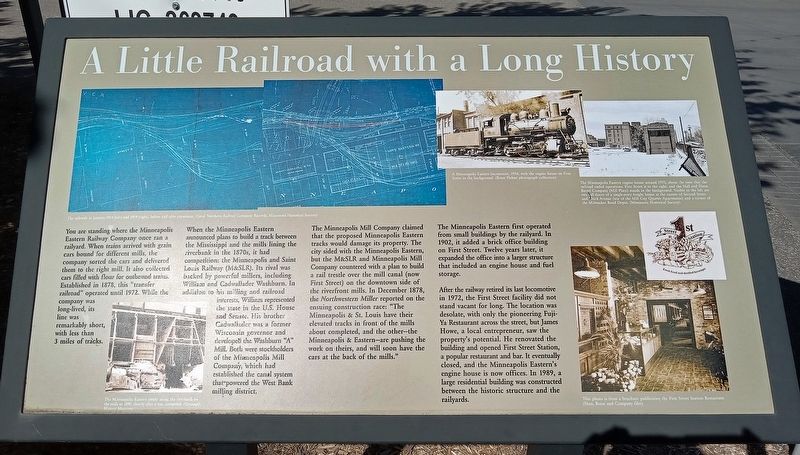
The railyards in January 1914 (left) and 1919 (right), before and after expansion. (Great Northern Railway Company Records, Minnesota Historical Society)
A Minneapolis Eastern locomotive, 1954, with the engine house on First Street in the background. (Brian Flakne photograph collection)
The Minneapolis Eastern engine house around 1970, about the time that the railroad ended operations. First Street is to the right, and the Hall and Dann Barrel Company (Mill Place) stands in the background. Visible to the left are two tall doors of a single-story freight house at the corner of Second Street and Third Avenue (site of the Mill City Quarter Apartments) and a corner of the Milwaukee Road Depot. (Minnesota Historical Society)
You are standing where the Minneapolis Eastern Railway Company once ran a railyard. When the trains arrived with grain cars bound for different mills, the company sorted the cars and delivered them to the right mill. It also collected cars filled with flour for outbound trains. Established in 1878, this "transfer railroad" operated until 1972. While the company was long-lived, its line was remarkably
this page online
The Minneapolis Eastern trestle along the riverbank by the mills in 1890, shortly after it was completed. (Hennepin History Museum)
When the Minneapolis Eastern announced plans to build a track between the Mississippi and the mills lining the riverbank in the 1870s, it had competition: the Minneapolis and Saint Louis Railway (M&SLR). Its rival was backed by powerful millers, including William and Cadwallader Washburn. In addition to his milling and railroad interests, William represented the state in the U.S. House and Senate. His brother Cadwallader was a former Wisconsin governor and developed the Washburn "A" Mill. Both were stockholders of the Minneapolis Mill Company, which had established the canal system that powered the West Bank milling district.
The Minneapolis Mill Company claimed that the proposed Minneapolis Eastern tracks would damage its property. The city sided with the Minneapolis Eastern, but the M&SLR and Minneapolis Mill Company countered with a plan to build a rail trestle over the mill canal (now First Street) on the downtown side of the riverfront mills. In December
Photographed by McGhiever, September 29, 2024
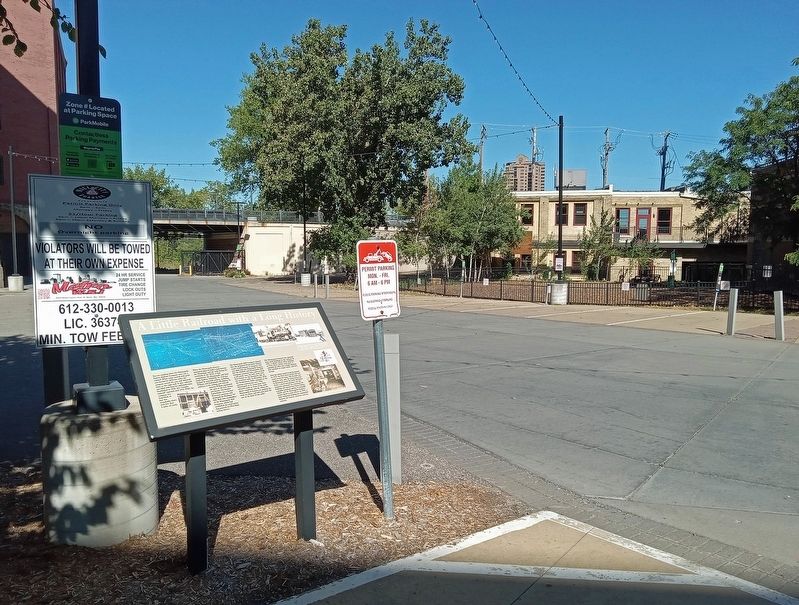
2. A Little Railroad with a Long History Marker at the 300 S. 2nd St. Parking
The Minneapolis Eastern first operated from small buildings by the railyard. In 1902, it added a brick office building on First Street. Twelve years later, it expanded the office into a larger structure that included an engine house and fuel storage.
After the railway retired its last locomotive in 1972, the First Street facility did not stand vacant long. The location was desolate, with only the pioneering Fuji-Ya Restaurant across the street, but James Howe, a local entrepreneur, saw the property's potential. He renovated the building and opened First Street Station, a popular restaurant and bar. It eventually closed, and the Minneapolis Eastern's engine house is now offices. In 1989, a large residential building was constructed between the historic structure and the railyards.
This photo is from a brochure publicizing the First Street Station Restaurant. (Hess, Roise and Company files)
Topics and series. This historical marker is listed in these topic lists: Industry & Commerce • Railroads & Streetcars. In addition, it is included in the Chicago, Milwaukee, St. Paul and Pacific Railroad series list. A significant historical year for this entry is 1878.
Location. 44° 58.863′ N, 93° 15.715′ W. Marker is in Minneapolis, Minnesota, in Hennepin County. It is in Downtown West. It can be reached from S. 2nd Street west of 5th Avenue S., on the right when traveling west. The marker is at the intersection of the 300 S. 2nd St. Parking and the alley. Touch for map. Marker is at or near this postal address: 300 S 2nd Street, Minneapolis MN 55401, United States of America. Touch for directions.

Regionally, this marker is in the Twin Cities Metropolitan Area. It is also in the American Midwest, in the Corn Belt, and in the Great River Road Region. Globally, it is in North America, the Western Hemisphere, the Western World, and the Anglosphere. Historically, it finds itself in what was once Rupert’s Land, the territory of the Mississippian Culture, and the Louisiana Purchase.
Other nearby markers. At least 8 other markers are within walking distance of this marker: Barrels / Bags / Bust / and Beyond (here, next to this marker); Trains Can't Swim (within shouting distance of this marker); Welcome to the Rail Maze (within shouting distance of this marker); Changing Times (about 300 feet away, measured in a direct line); The Washburn and Pillsbury Clans (about 400 feet away); The Barrel-Makers' Co-ops (about 400 feet away); New Uses for Old Mills (about 600 feet away); The Resurrection of Washington Avenue (about 700 feet away). Touch for a list and map of all markers in Minneapolis.
Credits. This page was last revised on March 24, 2025. It was originally submitted on March 24, 2025, by McGhiever of Minneapolis, Minnesota. This page has been viewed 264 times since then and 49 times this year. Photos: 1, 2. submitted on March 24, 2025, by McGhiever of Minneapolis, Minnesota.
