East Florence in Lauderdale County, Alabama — The American South (East South Central)
Tennessee Valley Authority
Photographed by Sandra Hughes Tidwell, March 26, 2025
1. Tennessee Valley Authority Marker
Inscription.
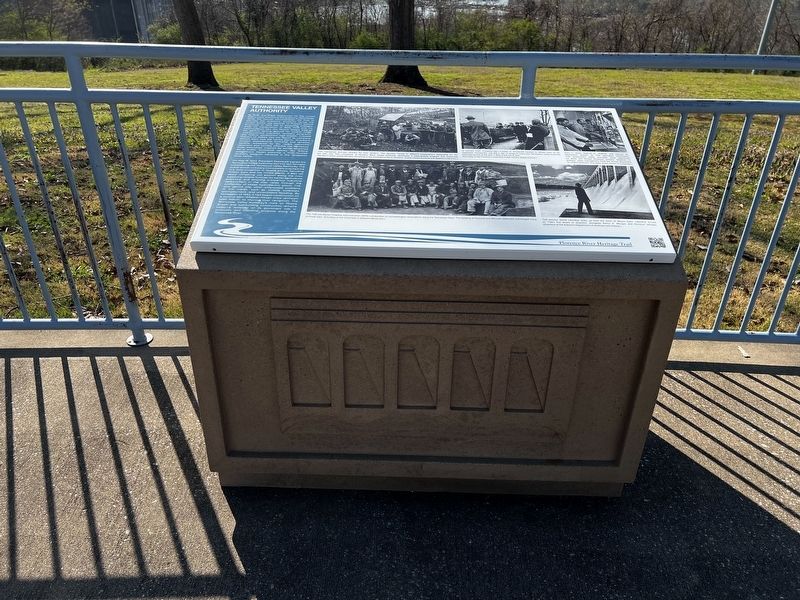
Tennessee Valley Authority. . 1929 the Great Depression hit the United States hard, shattering the economy nationwide. While the Hoover administration did little to alleviate the economic problems facing the United States, the election of Franklin Delano Roosevelt in 1932 led to sweeping changes. After his 1933 inauguration, FDR and his administration saw the Muscle Shoals area as the perfect testing ground for several newly conceptualized economic recovery programs. The federal government had already invested millions of dollars in the region to complete Wilson Dam and the nitrate plants. Riverbank erosion, unproductive farmland, and rampant poverty, worsened by the recent economic downturn, also terribly affected the Tennessee River watershed. Inspired by earlier proposals for a public assistance agency, the federal government began planning a multi-faceted recovery program centered in the Tennessee River Valley., On May 18, 1933, President Roosevelt signed the Tennessee Valley Authority Act into law, formally establishing the Tennessee Valley Authority. The public power company immediately acquired the U.S.-held properties in Muscle Shoals, including Wilson Dam and the nitrate plants. It also set about mitigating soil erosion along the river, supplying reliable fertilizer for better agricultural practices, and ensuring prosperous industrial development in the river valley through the availability of cheap hydroelectric power. TVA also investigated other widespread problems in the region, such as malaria outbreaks, unemployment, and uncontrolled flooding. By November 1933, it had begun construction on a second dam, Wheeler, fifteen miles upstream from Wilson, to improve river navigation. The Tennessee Valley Authority's mark on Muscle Shoals and surrounding communities remains today a reminder of its prominent role in economic and industrial progress along the Tennessee River., Captions: , (Photo #1) TVA maintained portable libraries for its workers, which moved to different headquarters depending on the job site. The TVA library coordinator, Mary Utopia Rothrock, developed a book-lending program that eventually resulted in these mobile libraries. (Courtesy of the University of North Alabama, Collier Library Archives and Special Collections) , (Photo #2) The TVA and Works Progress Administration (WPA) collaborated on archaeological excavations along the Tennessee River. The flooding of Pickwick and Wheeler reservoirs submerged many of these sites. (Courtesy of the University of North Alabama, Collier Library Archives and Special Collections) , (Photo #3) In January 1933, President-elect Franklin D. Floosevell traveled to Wilson Dam for an inspection. Roosevelt's visit was a sign of things to come - the Tennessee Valley Authority assumed control of the dam in May of the same year. (Courtesy of the Florence-Lauderdale Public Library Digital Archive) , (Photo #4) Paul L. Imes, Samuel C. Watking, and George W. Richardson worked as TVA laboratory technicians. TVA's employment policy promised equal opportunity for white and African American workers. However, in practice, upper management hired few African Americans for skilled positions. (Courtesy of the University of North Alabama, Collier Library Archives and Special Collections) , (Photo #5) TVA director David Lilenthal looks up from the base of Wilson Dam. Lilenthal served on TVA's first board of directors, alongside Arthur E. Morgan and Harcourt Morgan. (Courtesy of the University of North Alabama, Collier Library Archives and Special Collections)
1929 the Great Depression hit the United States hard, shattering the economy nationwide. While the Hoover administration did little to alleviate the economic problems facing the United States, the election of Franklin Delano Roosevelt in 1932 led to sweeping changes.
After his 1933 inauguration, FDR and his administration saw the Muscle Shoals area as the perfect testing ground for several newly conceptualized economic recovery programs.
The federal government had already invested millions of dollars in the region to complete Wilson Dam and the nitrate plants. Riverbank erosion, unproductive farmland, and rampant poverty, worsened by the recent economic downturn, also terribly affected the Tennessee River watershed. Inspired by earlier proposals for a public assistance agency, the federal government began planning a multi-faceted recovery program centered in the Tennessee River Valley.
On May 18, 1933, President Roosevelt signed the Tennessee Valley Authority Act into law, formally establishing the Tennessee Valley Authority. The public power company immediately acquired the U.S.-held properties in Muscle Shoals, including Wilson Dam and the nitrate plants. It also set about mitigating soil erosion along the river, supplying reliable fertilizer for better agricultural practices, and ensuring prosperous industrial development
Click or scan to see this page online
in the river valley through the availability of cheap hydroelectric power. TVA also investigated other widespread problems in the region, such as malaria outbreaks, unemployment, and uncontrolled flooding. By November 1933, it had begun construction on a second dam, Wheeler, fifteen miles upstream from Wilson, to improve river navigation. The Tennessee Valley Authority's mark on Muscle Shoals and surrounding communities remains today a reminder of its prominent role in economic and industrial progress along the Tennessee River.
Captions: (Photo #1) TVA maintained portable libraries for its workers, which moved to different headquarters depending on the job site. The TVA library coordinator, Mary Utopia Rothrock, developed a book-lending program that eventually resulted in these mobile libraries. (Courtesy of the University of North Alabama, Collier Library Archives and Special Collections) (Photo #2)
The TVA and Works Progress Administration (WPA) collaborated on archaeological excavations along the Tennessee River. The flooding of Pickwick and Wheeler reservoirs submerged many of these sites. (Courtesy of the University of North Alabama, Collier Library Archives and Special Collections) (Photo #3) In January 1933, President-elect Franklin D. Floosevell traveled to Wilson Dam for an inspection. Roosevelt's visit
Photographed by Sandra Hughes Tidwell, March 26, 2025
2. Tennessee Valley Authority Marker
was a sign of things to come - the Tennessee Valley Authority assumed control of the dam in May of the same year. (Courtesy of the Florence-Lauderdale Public Library Digital Archive)
(Photo #4)
Paul L. Imes, Samuel C. Watking, and George W. Richardson worked as TVA laboratory technicians. TVA's employment policy promised equal opportunity for white and African American workers. However, in practice, upper management hired few African Americans for skilled positions.
(Courtesy of the University of North Alabama, Collier Library Archives and Special Collections) (Photo #5)
TVA director David Lilenthal looks up from the base of Wilson Dam. Lilenthal served on TVA's first board of directors, alongside Arthur E. Morgan and Harcourt Morgan.
(Courtesy of the University of North Alabama, Collier Library Archives and Special Collections)
Erected by Florence River Heritage Trail.
Topics. This historical marker is listed in this topic list: Government & Politics. A significant historical date for this entry is May 18, 1933.
Location. 34° 48.338′ N, 87° 37.895′ W. Marker is in Florence, Alabama, in Lauderdale County. It is in East Florence. It is on Hightower Place. Touch for map. Marker is at or near this postal address: 15 Hightower Pl, Florence AL 35630, United States of America. Touch for directions.

Regionally, this marker is in North Alabama and in the Shoals. It is also in the American South, specifically in the Deep South, in Appalachia, and specifically in Southern Appalachia. Globally, it is in North America, a Gulf of Mexico state, the Western Hemisphere, the Western World, and the Anglosphere. Historically, it finds itself in what was once the territory of the Mississippian Culture, one of the Confederate States of America, and the Antebellum South.
Other nearby markers. At least 8 other markers are within walking
Photographed by Sandra Hughes Tidwell, March 26, 2025
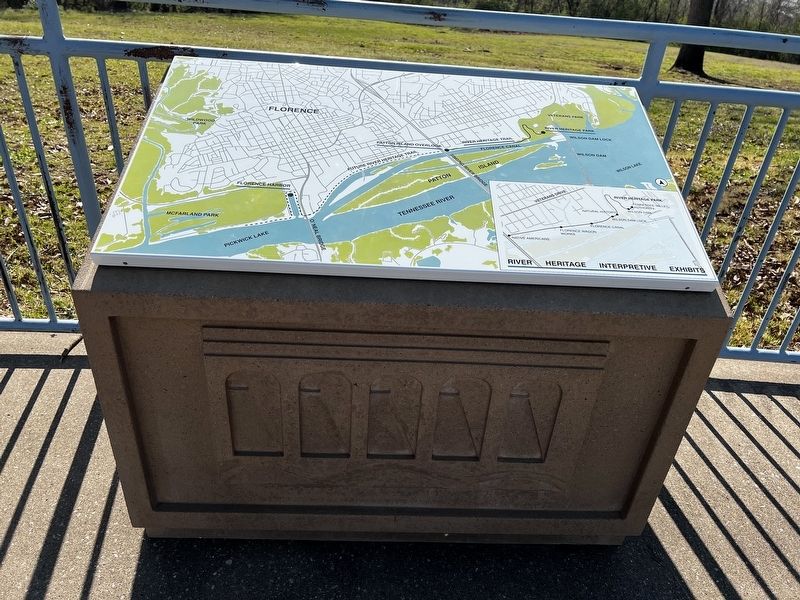
3. River/Heritage/Interpretive/Exhibits
Florence
*McFarland Park,
*Florence Harbor,
*Future River Heritage Trail,
*River Heritage Trail,
*River Heritage Park
*Patton Island Overlook
*Veterans Park
The waterway
.Pickwick "Lake
O'Neal Bridge "
Tennessee River
"Singing River Bridge",
Florence Canal
Wilson Dam Lock
Wilson Dam
Wilson Lake
Markers along the River Heritage Trail
*Native Americans
*Florence Wagon Works
*Florence Canal
*Wilson Dam Lock
Along River Heritage Park
* Keysot
*Wilson Dam
*Tennessee Valley Authority
River/Heritage/Interpretive/Exhibits
One at the beginning and end of the trail.
Credits. This page was last revised on April 1, 2025. It was originally submitted on March 27, 2025, by Sandra Hughes Tidwell of Killen, Alabama, USA. This page has been viewed 155 times since then and 20 times this year. Photos:1, 2, 3. submitted on March 27, 2025, by Sandra Hughes Tidwell of Killen, Alabama, USA. • James Hulse was the editor who published this page.