Norwichtown in Southeastern Region, Connecticut — The American Northeast (New England)
Samuel Huntington
Photographed by Conrad Ward, October 20, 2024
1. Samuel Huntington Marker
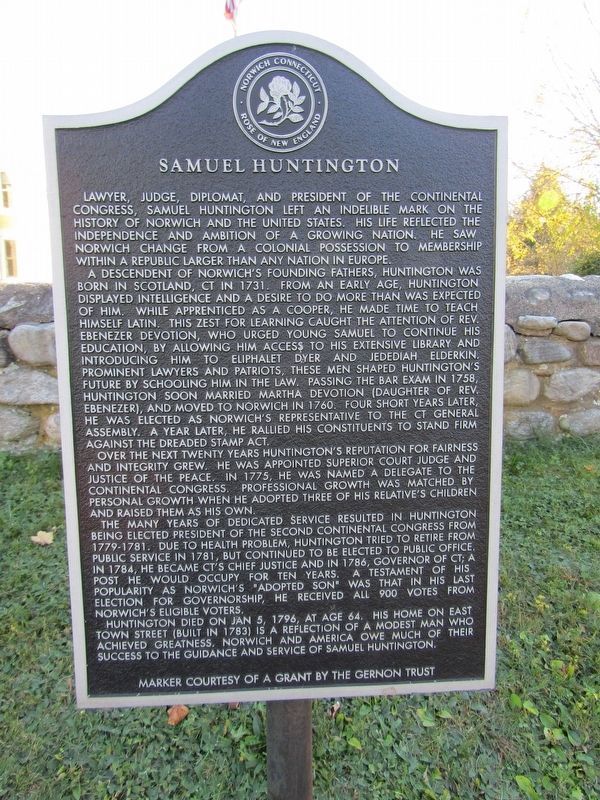
Lawyer, judge, diplomat, and president of the Continental Congress, Samuel Huntington left an indelible mark on the history of Norwich and the United States. His life reflected the independence and ambition of a growing nation. He saw Norwich change from a colonial possession to membership within a republic larger than any nation in Europe.
A descendent of Norwich's founding fathers, Huntington was born in Scotland, CT in 1731. From an early age, Huntington displayed intelligence and a desire to do more than was expected of him. While apprenticed as a cooper, he made time to teach himself Latin. This zest for learning caught the attention of Rev. Ebenezer Devotion, who urged young Samuel to continue his education, by allowing him access to his extensive library and introducing him to Eliphalet Dyer and Jedediah Elderkin. Prominent lawyers and patriots, these men shaped Huntington's future by schooling him in the law. Passing the bar exam in 1758, Huntington soon married Martha Devotion (daughter of Rev. Ebenezer), and moved to Norwich in 1760. Four short years later, he was elected as Norwich's representative
this page online
Over the next twenty years Huntington's reputation for fairness and integrity grew. He was appointed superior court judge and justice of the peace. In 1775, he was named a delegate to the Continental Congress. Professional growth was matched by personal growth when he adopted three of his relative's children and raised them as his own.
The many years of dedicated service resulted in Huntington being elected president of the second Continental Congress from 1779-1781. Due to health problem, Huntington tried to retire from public service in 1781, but continued to be elected to public office. In 1784, he became CT's chief justice and in 1786, governor of CT; a post he would occupy for ten years. A testament of his popularity as Norwich's "adopted son" was that in his last election for governorship, he received all 900 votes from Norwich's eligible voters.
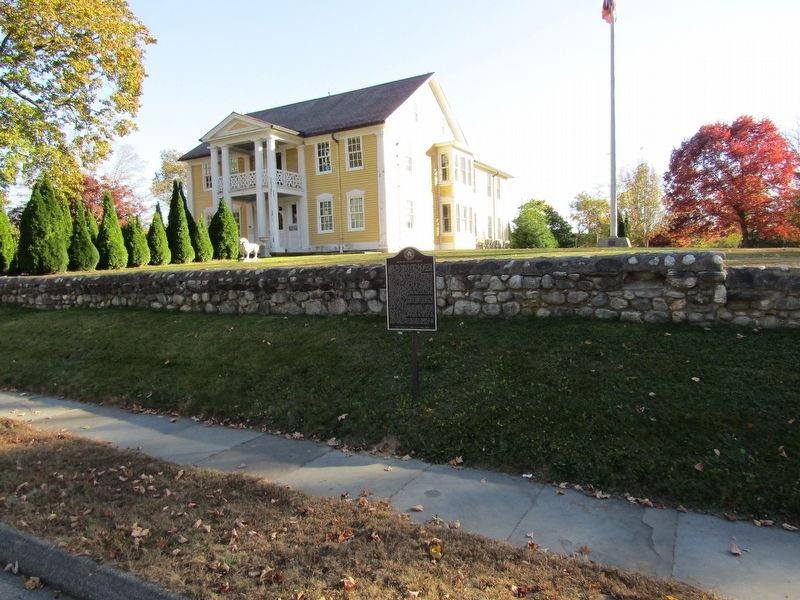
Huntington died on Jan 5, 1796, at age 64. His home on East Town Street (built in 1783) is a reflection of a modest man who achieved greatness.
Photographed by Conrad Ward, October 20, 2024
2. Samuel Huntington Marker & Home
Erected by Town of Norwich.
Topics. This historical marker is listed in these topic lists: Charity & Public Work • Government & Politics • Patriots & Patriotism.
Location. 41° 33.029′ N, 72° 5.509′ W. Marker is in Norwich in Southeastern Region, Connecticut. It is in Norwichtown. It is on East Town Street, on the right when traveling east. Touch for map. Marker is at or near this postal address: 34 East Town Street, Norwich CT 06360, United States of America. Touch for directions.

Regionally, this marker is on the Connecticut Shoreline, in Greater New London and in the Thames River Valley. It is also in the American Northeast, in New England, and on the Eastern Seaboard. Globally, it is in the North Atlantic Region, North America, the Western Hemisphere, the Western World, and the Anglosphere. Historically, it finds itself in what was once New London County and also one of the original Thirteen Colonies.
Other nearby markers. At least 8 other markers are within walking distance of this marker: Home of Samuel Huntington (a few steps from this marker); Revolutionary Soldiers Memorial Gates (within shouting distance of this marker); Gardner Carpenter House (about 500 feet away, measured in a direct line); a different marker also named Samuel Huntington (about 600 feet away); Tomb of Samuel Huntington (about 600 feet away); Once upon a time in Norwich... (about 800 feet away); Gravesite of Boston Trowtrow, Norwich's "Black Governor" (approx. 0.2 miles away); a different marker also named Once upon a time in Norwich... (approx. 0.2 miles away). Touch for a list and map of all markers in Norwich.
Credits. This page was last revised on May 19, 2026. It was originally submitted on March 30, 2025, by Conrad Ward of Guilford, Connecticut. This page has been viewed 133 times since then and 30 times this year. Photos: 1, 2. submitted on March 30, 2025, by Conrad Ward of Guilford, Connecticut. • Andrew Ruppenstein was the editor who published this page.
