Ramseur in Randolph County, North Carolina — The American South (South Atlantic)
Cox’s Mill
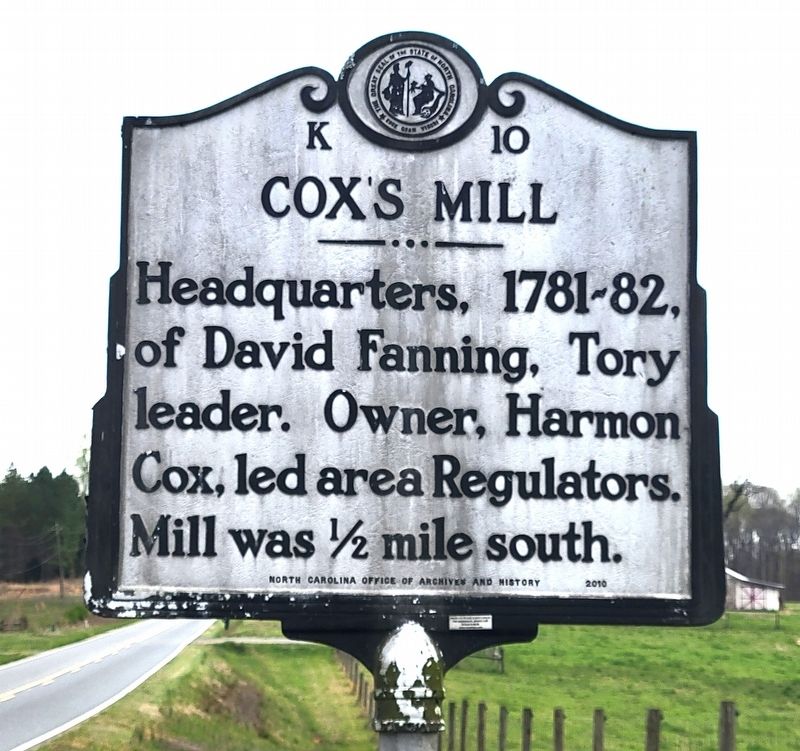
Photographed by J. J. Prats, March 29, 2025
1. Cox’s Mill Marker
Erected 2010 by North Carolina Office of Archives and History. (Marker Number K-10.)
Topics. This historical marker is listed in this topic list: War, US Revolutionary.
Location. 35° 41.352′ N, 79° 37.733′ W. Marker is in Ramseur, North Carolina, in Randolph County. It is on North Carolina 22. Touch for map. Marker is at or near this postal address: 2505 NC-22, Ramseur NC 27316, United States of America. Touch for directions.

Regionally, this marker is in North Carolina’s Piedmont. It is also in the American South and specifically in the Upper South. Globally, it is in North America, the Western Hemisphere, the Western World, and the Anglosphere. Historically, it finds itself in what was once the territory of the Mississippian Culture, one of the original Thirteen Colonies, one of the Confederate States of America, and the Antebellum South.
Other nearby markers. At least 8 other markers are within 10 miles of this marker, measured
this page online
Regarding Cox’s Mill. David Fanning (c. 1755–1825) was a Loyalist leader in the American Revolutionary War in North and South Carolina. Fanning participated in approximately 36 minor engagements and skirmishes, and in 1781, captured the Governor of North Carolina, Thomas Burke, from the temporary capital at Hillsborough. Additionally, Fanning was captured by Patriot forces 14 times throughout the war, each time escaping or receiving a pardon. After the British defeat in the war, Fanning fled to what is now Canada, where he was elected to the Legislative Assembly of New Brunswick from 1791 to 1801 representing Kings County. After being convicted of rape in 1801, Fanning was expelled from New Brunswick, and settled in Nova Scotia, where he lived the remainder of
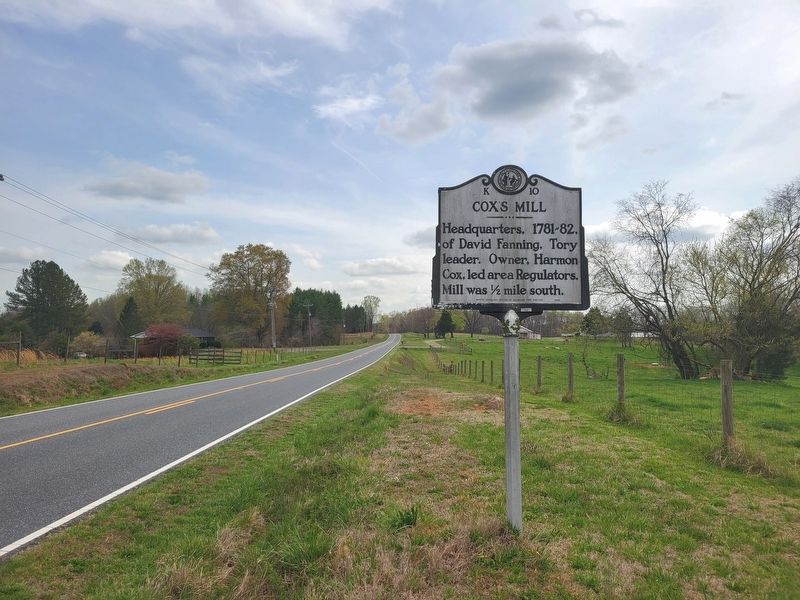
Photographed by J. J. Prats, March 29, 2025
2. Cox’s Mill Marker
The Regulator movement in colonial North Carolina (1766 to 1771) was a rebellion initiated by residents of the colony’s inland region who believed that royal government officials were charging them excessive fees, falsifying records, and engaging in other mistreatments.
Also see . . .
1. Wikipedia entry for David Fanning (loyalist). Excerpt:
After suffering a Pyrrhic victory at the Battle of Guilford Courthouse in March 1781, British General Cornwallis and the British Army were forced to march to the port of Wilmington, leaving Fanning to recruit more Loyalist militia and stir up trouble in the North Carolina backcountry. Fanning asked for, and received a commission as a colonel of the Loyalist Militia in Randolph and Chatham counties on July 5, 1781. Fanning would often conduct raids with fewer than 12 men, and would capture and ransom or parole leading Patriot sympathizers and political figures. It has been estimated that he fought approximately 36 skirmishes during that year. Among these included a raid on a session of court in Chatham Courthouse, during which engagement Fanning took 53 prisoners, among them court officials, militia officers (including Colonel Ambrose Ramsey, and several members of the North Carolina General Assembly. Fanning was also the principal commander of the Loyalist militia involved in the battle at the House in the Horseshoe in the late summer of 1781, in which engagement Fanning forced the surrender of a force of Patriot militia. By the end of the summer of 1781, Fanning's infamy had attracted a force of approximately 950 Loyalist men to his command.(Submitted on March 31, 2025.)
On September 12, 1781, Fanning commenced a daring morning raid on Hillsborough, North Carolina, where the Patriot government of that state was based at the time. Fanning was able to capture North Carolina Governor Thomas Burke, along with 200 other Patriot prisoners, and escaped on the way to Wilmington. Brigadier General John Butler, the commanding officer of the Hillsborough District Brigade of militia, was alerted of Burke's capture, and attempted to stop Fanning from continuing on to British-controlled Wilmington at the Battle of Lindley's Mill on September 13. In that engagement, Fanning's militia, along with a unit of Highlanders commanded by Hector McNeill and Archibald McDugald, attempted to cross the Cane Creek, a tributary of the Haw River, and were surprised by Butler's men. Although Fanning had superior numbers with him, the battle lasted nearly four hours before Butler was dislodged from his position. Fanning was able to continue on to Wilmington, although suffering a grievous wound at Lindley's Mill, and delivered Burke to the British Army.
In January 1782, the larger course of the war had turned against the British, and Fanning found himself forced to request terms of surrender from his adversary, General Butler. In April 1782, he married Sarah Carr, and the two escaped to South Carolina. A legislative act in North Carolina in 1783 which granted pardons to former Loyalists specifically exempted Fanning from its terms, along with only two other men.
2. Harmon Cox (1723-1813). 2021 entry in Forebears and Kingfolks. Excerpt:
The activities of the Regulators were numerous during this period. Harmon signed Regulator notices and petitions, and hosted at least one meeting in 1768 at his home and/or mill.(Submitted on March 31, 2025.)
At the Battle of Alamance on May 16, 1771, the militia of Royal Governor William Tryon defeated approximately 2000 Regulators. The estimated deaths and casualties varies among articles, but it’s certain that twelve Regulator prisoners were tried in Hillsborough after the battles. Six were hanged and six were pardoned, Harmon being one of the lucky ones.
Credits. This page was last revised on March 31, 2025. It was originally submitted on March 31, 2025, by J. J. Prats of Powell, Ohio. This page has been viewed 243 times since then and 56 times this year. Photos: 1, 2. submitted on March 31, 2025, by J. J. Prats of Powell, Ohio.
