
Binnenstad Hoorn , North Holland, Netherlands — Northwestern Europe
Roode Steen 15
| — | Rijksmonument | — |
Photographed by Andrew Ruppenstein, March 22, 2025
1. Roode Steen 15 Marker

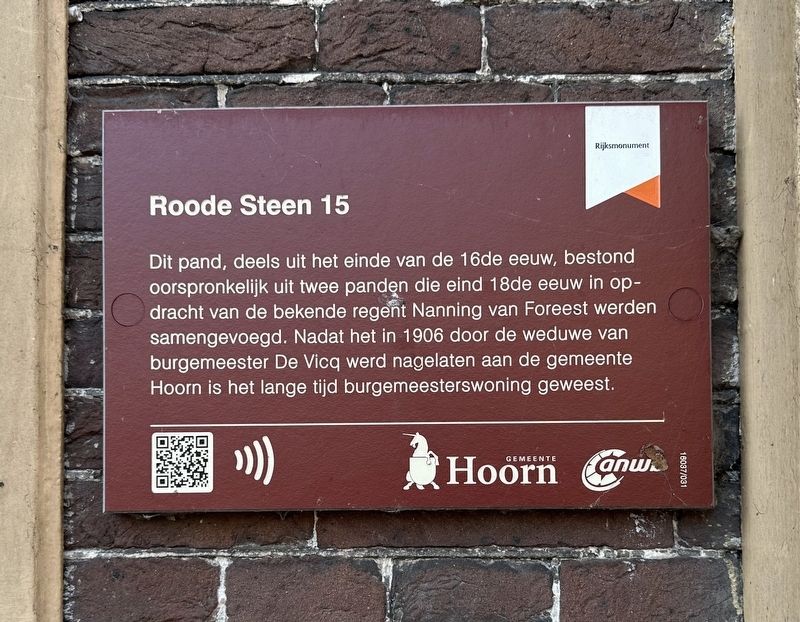
This building, partly from the end of the 16th century, originally consisted of two buildings that were joined together at the end of the 18th century by order of the famous regent Nanning van Foreest. After it was bequeathed to the municipality of Hoorn by the widow of mayor De Vicq in 1906, it was the mayor's residence for a long time.
Erected by Gemeente Hoorn, ANWB. (Marker Number 16037/031.)
Topics. This historical marker is listed in this topic list: Notable Buildings. A significant historical year for this entry is 1906.
Location. 52° 38.361′ N, 5° 3.527′ E. Marker is in Hoorn, Noord-Holland (North Holland). It is in Binnenstad Hoorn. It is on Roode Steen, on the left when traveling north. Touch for map. Marker is at or near this postal address: Roode Steen
this page online

Regionally, it is in Europe, the European Union, Atlantic Europe, the Benelux Low Countries, the Schengen Area, Western Europe, and the Western World. Historically, it finds itself in what was once the Holy Roman Empire.
Other nearby markers. At least 8 other markers are within walking distance of this marker: Statencollege (a few steps from this marker); Jan Pieterszoon Coen (Hoorn 1587 - Batavia 1629) (within shouting distance of this marker); Onderduikers in het Duitse hoofdkwartier / People in hiding at the German headquarters (within shouting distance of this marker); Hadrianus Junius (within shouting distance of this marker); Koepelkerk (1882) (about 90 meters away, measured in a direct line); Kerkstraat 10 (about 90 meters away); Grote Kerk (about 120 meters away); Monument bij het Grote Kerk / Grote Kerk Executions Memorial (about 150 meters away). Touch for a list and map of all markers in Hoorn.
Also see . . . Roode Steen 15 (ErfgoedHoorn.nl, in Dutch). The QR code on the marker leads to this page with some additional information
Photographed by Andrew Ruppenstein, March 22, 2025
2. Roode Steen 15 Marker - wide view
The country roads to the city of Hoorn converged at the Roode Steen, a total of seven streets or alleys that lead to this square. This central location owes its name to the punishment stone that was located here. The punishments determined by the bailiff and aldermen were carried out on this Rode Steen. A replica of the stone can be seen on the square, the original can be found in the Westfries Museum.(Submitted on April 1, 2025.)
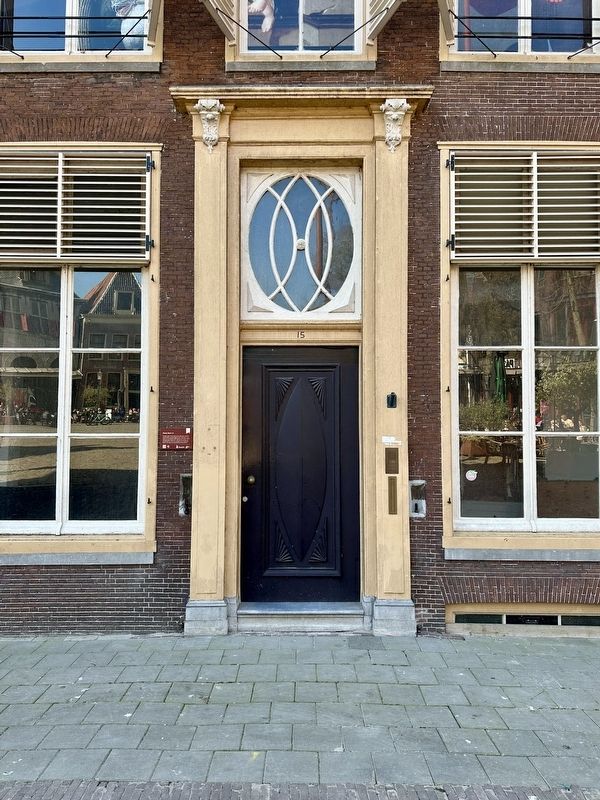
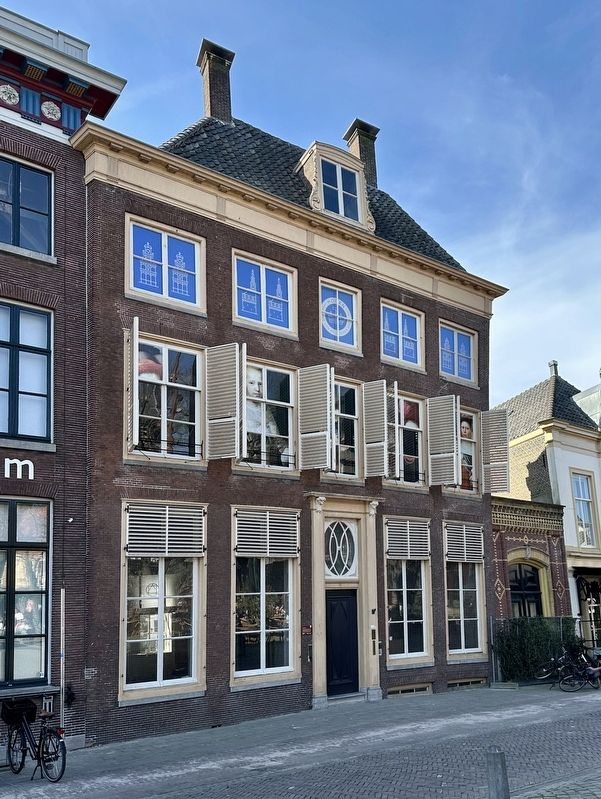
The building at Rode Steen 15 has a long history. The roof construction from around 1581 is the oldest part of the building. This year of construction was determined on the basis of dendrochronological research; this is used to determine in which year a tree must have been felled based on the annual rings in the wood. The current façade with monumental entrance was built in 1787, entirely in the spirit of that time. The façade has a symmetrical design and is closed off at the top by a horizontal band that we call the cornice. The entrance has a frame of pilasters and we see a beautiful oval fanlight. The gate was built in 1871 by order of mayor Willem de Vicq. It was his wish to create a passageto the garden and to realize this the neighboring building was demolished. From the design of this gate, with richly decorated brickwork, a completely different zeitgeist can be read, namely that of a century later.Photographed by Andrew Ruppenstein, March 22, 20253. Roode Steen 15 and Marker
Credits. This page was last revised on April 1, 2025. It was originally submitted on April 1, 2025, by Andrew Ruppenstein of Lamorinda, California. This page has been viewed 109 times since then and 13 times this year. Photos: 1, 2, 3. submitted on April 1, 2025, by Andrew Ruppenstein of Lamorinda, California.
