Downtown West in Minneapolis in Hennepin County, Minnesota — The American Midwest (Upper Plains)
Barrels / Bags / Bust / and Beyond
Photographed by McGhiever, September 29, 2024
1. Barrels / Bags / Bust / and Beyond Marker
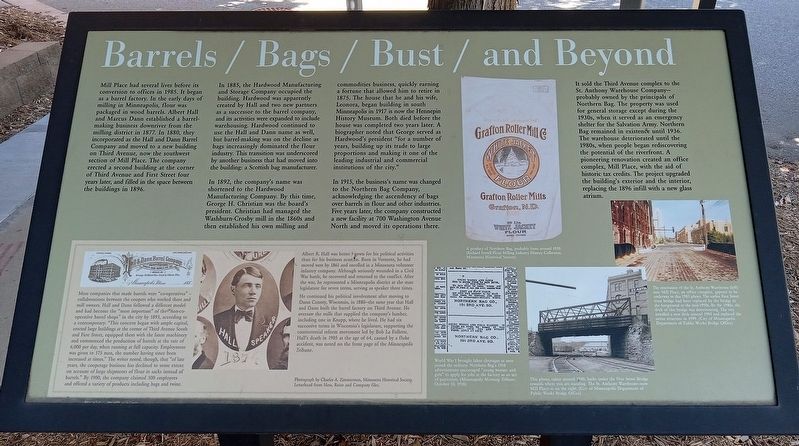
Mill Place had several lives before its conversion to offices in 1985. It began as a barrel factory. In the early days of milling in Minneapolis, flour was packaged in wood barrels. Albert Hall and Marcus Dann established a barrel-making business downriver from the milling district in 1877. In 1880, they incorporated as the Hall and Dann Barrel Company and moved to a new building on Third Avenue, now the southwest section of Mill Place. The company erected a second building at the corner of Third Avenue and First Street four years later, and filled in the space between the buildings in 1896.
In 1885, the Hardwood Manufacturing and Storage Company occupied the building. Hardwood was apparently created by Hall and two new partners as a successor to the barrel company, and its activities were expanded to include warehousing. Hardwood continued to use the Hall and Dann name as well, but barrel-making was on the decline as bags increasingly dominated the flour industry. This transition was underscored by another business that had moved into the building: a Scottish bag manufacturer.
In 1892, the company's name was shortened
this page online
In 1915, the business's name was changed to the Northern Bag Company, acknowledging the ascendency of bags over barrels in flour and other industries. Five years later, the company constructed a new facility at 700 Washington Avenue North and moved its operations there.
It sold the Third Avenue complex to the St. Anthony Warehouse Company—probably owned by the principals of Northern Bag. The property was used for general storage except during the 1930s, when it

Photographed by McGhiever, September 29, 2024
2. Barrels / Bags / Bust / and Beyond Marker (left) at the 300 S. 2nd St. Parking
A product of Northern Bag, probably from around 1920. (Richard Ferrell Flour Milling Industry History Collection, Minnesota Historical Society)
World War I brought labor shortages as men joined the military. Northern Bag's 1918 advertisement encouraged "young woman and girls" to apply for jobs at the factory as an act of patriotism. (Minneapolis Morning Tribune, October 10, 1918)
This photo, taken around 1940, looks under the First Street Bridge towards where you are standing. The St. Anthony Warehouse—now Mill Place—is on the right. (City of Minneapolis Department of Public Works Bridge Office)
The renovation of the St. Anthony Warehouse (left) into Mill Place, an office complex, appears to be underway in this 1985 photo. The earlier First Street truss bridge had been replaced by the bridge in the foreground in the mid-1950s. By the 1980s, the deck of this bridge was deteriorating. The city installed a new deck around 1994 and replaced the entire structure in 1999. (City of Minneapolis Department of Public Works Bridge Office)
Most companies that made barrels were "co-operatives" – collaborations between the coopers who worked there and mill owners. Hall and Dann followed a different model and had become the "most important" of the "non-co-operative barrel shops" in the city by 1893, according to a contemporary: "This concern began with ample capital, erected large buildings at the corner of Third Avenue South and First Street, equipped them with the latest machinery and commenced the production of barrels at the rate of 6,000 per day, when running at full capacity. Employment was given to 175 men, the number having since been increased at times." The writer noted, though, that "of late years, the cooperage business has declined to some extent on account of large shipments of flour in sacks instead of barrels." By 1900, the company claimed 300 employees and offered a variety of products including bags and twine.
Albert R. Hall was better known for his political activities than for his business acumen. Born in Vermont, he had moved west by 1861 and enrolled in a Minnesota volunteer infantry company. Although seriously wounded in a Civil War battle, he recovered and returned to the conflict. After the war, he represented a Minneapolis district at the state legislature for seven terms, serving as speaker three times.
He continued his political involvement after moving to Dunn County, Wisconsin, in 1880—the same year that Hall and Dann built the barrel factory on Third Avenue. He oversaw the mills that supplied the company's lumber, including one in Knapp, where he lived. He had six successive terms in the Wisconsin legislature, supporting the controversial reform movement led by Bob La Follette. Hall's death in 1905 at the age of 64, caused by a fluke accident, was noted on the front page of the Minneapolis Tribune.
Photograph by Charles A. Zimmerman, Minnesota Historical Society. Letterhead from Hess, Roise and Company files.
Topics. This historical marker is listed in this topic list: Industry & Commerce. A significant historical year for this entry is 1880.
Location. 44° 58.863′ N, 93° 15.717′ W. Marker is in Minneapolis, Minnesota, in Hennepin County. It is in Downtown West. It can be reached from S. 2nd Street west of 5th Avenue S., on the right when traveling west. The marker is at the intersection of the 300 S. 2nd St. Parking and the alley. Touch for map. Marker is at or near this postal address: 300 S 2nd Street, Minneapolis MN 55401, United States of America. Touch for directions.

Regionally, this marker is in the Twin Cities Metropolitan Area. It is also in the American Midwest, in the Corn Belt, and in the Great River Road Region. Globally, it is in North America, the Western Hemisphere, the Western World, and the Anglosphere. Historically, it finds itself in what was once Rupert’s Land, the territory of the Mississippian Culture, and the Louisiana Purchase.
Other nearby markers. At least 8 other markers are within walking distance of this marker: A Little Railroad with a Long History (here, next to this marker); Trains Can't Swim (within shouting distance of this marker); Welcome to the Rail Maze (within shouting distance of this marker); Changing Times (about 300 feet away, measured in a direct line); The Washburn and Pillsbury Clans (about 400 feet away); The Barrel-Makers' Co-ops (about 400 feet away); New Uses for Old Mills (about 600 feet away); The Resurrection of Washington Avenue (about 700 feet away). Touch for a list and map of all markers in Minneapolis.
Credits. This page was last revised on April 2, 2025. It was originally submitted on April 2, 2025, by McGhiever of Minneapolis, Minnesota. This page has been viewed 298 times since then and 53 times this year. Photos: 1, 2. submitted on April 2, 2025, by McGhiever of Minneapolis, Minnesota.
