Shaw in Northwest Washington in Washington, District of Columbia — The American Northeast (Mid-Atlantic)
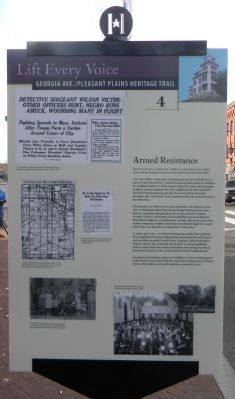
Armed Resistance
Lift Every Voice
| — | Georgia Ave./Pleasant Plains Heritage Trail | — |
Photographed by Richard E. Miller, November 27, 2011
1. Armed Resistance Marker
Shortly before midnight on July 22, 1919, James Scott, a black army veteran, boarded a streetcar at the corner and nearly lost his life.
A few days before, a white mob, including many veterans of World War I, had terrorized Southwest DC, randomly attacking black people in retaliation for an alleged assault on a white woman. Spurred by rumors and newspaper headlines, attackers targeted other Black neighborhoods. But Scott didn't know this. Boarding the streetcar here, he was stunned to hear white passengers yell, “Lynch him!” As he attempted to flee, the conductor shot at him three times.
That summer race relations were tense nationwide, with rioting in many cities. In Washington black men who had fought bravely overseas came home to a city more segregated than the one they had left. President Woodrow Wilson’s administration had established separate facilities for black federal employees. Unemployment was high. African Americans who had been respected as soldiers came home determined to fight U.S. racism. Most whites were determined to keep them “in their place.”
As mobs raged, some 2,000 black Washingtonians rallied here to defend their neighborhood. Veteran sharpshooters manned the Howard Theatre’s roof, and others patrolled Seventh Street. Clergymen called on President Wilson to protect the community. By the time U.S. troops quelled the violence, seven people were dead and hundreds were injured But African Americans took pride in the successful defense of their neighborhoods.
Among those decrying the violence was William A. Taylor, founding pastor of the Florida Avenue Baptist Church, which you just passed, at 633 Florida Avenue. The original 1913 church building was replaced in 1964.
Erected 2011 by Cultural Tourism DC. (Marker Number 4.)
Topics and series. This historical marker is
this page online
Location. Marker has been reported missing. It was located near 38° 54.965′ N, 77° 1.301′ W. Marker was in Northwest Washington in Washington, District of Columbia. It was in Shaw. It was on Florida Avenue Northwest (Route 29) east of 7th Street Northwest, on the left when traveling west. Touch for map. Marker was at or near this postal address: 1915 1/2 7th St NW, Washington DC 20001, United States of America. Touch for directions.

Regionally, this marker was in the Washington Metropolitan Area. It was also in the American Northeast, in the Upper South, in the Mid-Atlantic, in the Tidewater, and in the Chesapeake Bay Region. Globally, it was in North America, the Western Hemisphere, the Western World, and the Anglosphere.
Other nearby markers. At least 8 other markers are within walking distance of this location: Seventh and T
Photographed by J. Makali Bruton, February 22, 2020
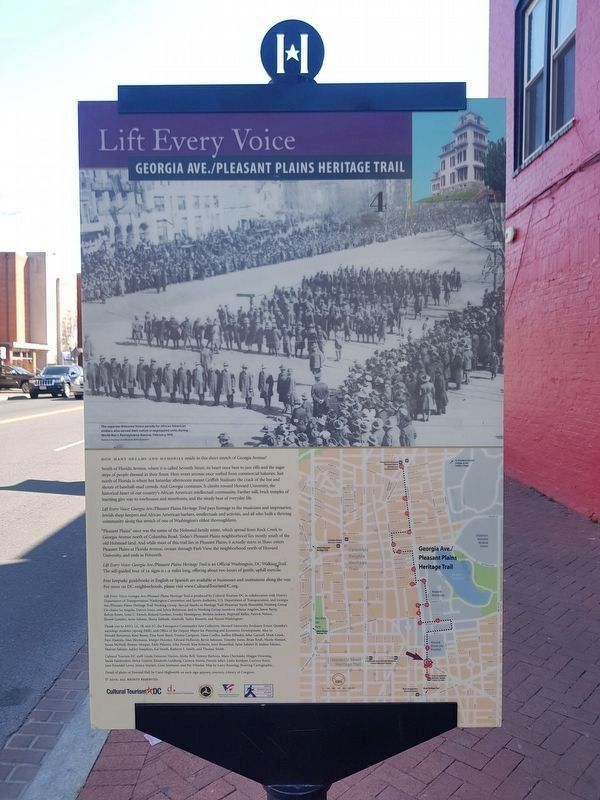
2. Armed Resistance Marker reverse
Another marker is no longer nearby. Chris Pyrate + The Shay (was about 400 feet away but has been confirmed missing).
More about this marker.
[Photo captions:]
For the duration of the disturbances, the Washington Post ran inflammatory headlines including this one from July 22, 1919. The Washington Post
This map, published in the old Washington Times in 1919, shows areas of the city hit by “rioting” on July 21. “Zone 1” was the around where this sign is today. Washingtoniana Division, DC Public Library
After the disturbances ended, copies of this handbill
Photographed by Richard E. Miller, November 27, 2011
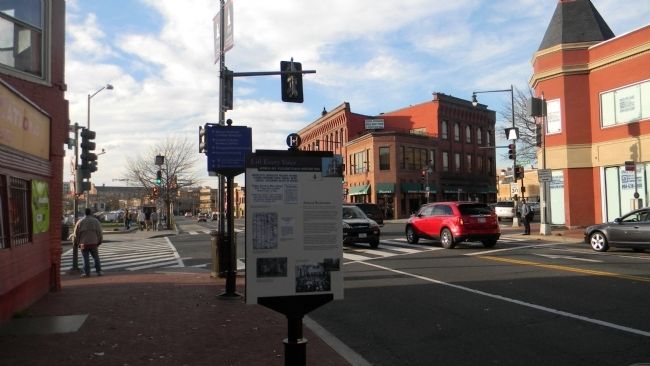
3. Armed Resistance Marker - intersection of Florida & Georgia Avenues, NW
Rev. William A. Taylor, center, and family at his 2119 13th St. home, 1938. At upper left is grandson Billy Taylor, later an influential jazz musician and educator. Collection of Rudy Taylor
The Florida Avenue Baptist Church, right, celebrated its mortgage burning in 1944. Scurlock Studio Records, Archives Center, National Museum of American History
Additional keywords. Red Summer
Photographed by J. Makali Bruton, February 22, 2020
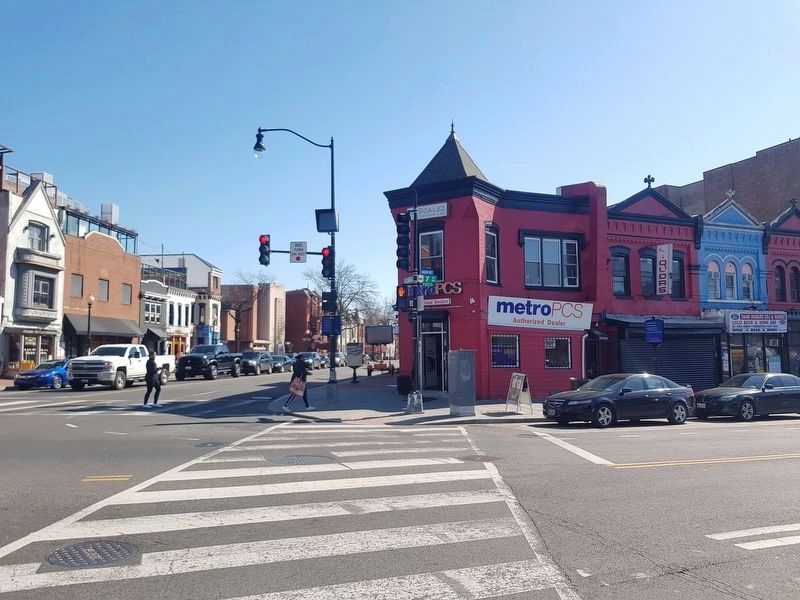
4. Armed Resistance Marker
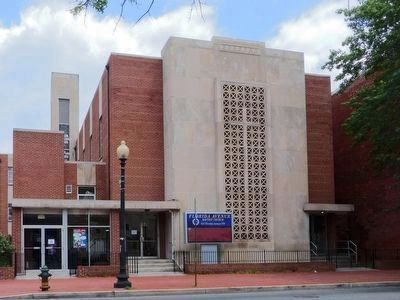
Photographed by Allen C. Browne, June 21, 2015
5. Florida Avenue Baptist Church
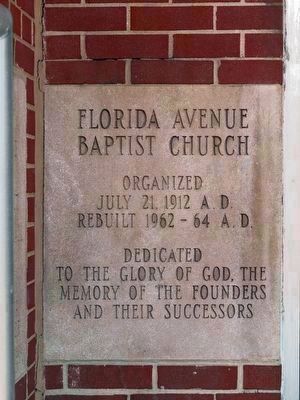
Photographed by Allen C. Browne, June 21, 2015
6. Cornerstone
Baptist Church
Organized
July 21,1912 A.D.
Rebuilt 1962 - 64 A. D.
Dedicated
To the Glory of God, The
Memory of the Founders
and their Successors
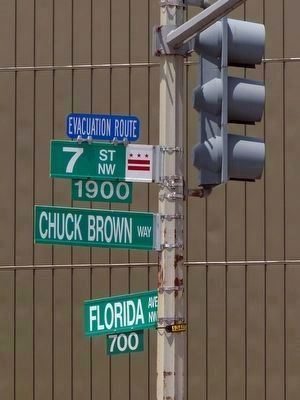
Photographed by Allen C. Browne, June 21, 2015
7. 7th Street and Florida Avenue
Georgia Avenue becomes 7th street south of Florida Avenue. Here 7th Street is also named “Chuck Brown Way” for the Godfather of Go-Go.
Credits. This page was last revised on April 8, 2025. It was originally submitted on January 17, 2012, by Richard E. Miller of Oxon Hill, Maryland. This page has been viewed 1,164 times since then and 36 times this year. Last updated on April 3, 2025, by Aname of Washington, District of Columbia. Photos: 1. submitted on January 17, 2012, by Richard E. Miller of Oxon Hill, Maryland. 2. submitted on March 8, 2020, by J. Makali Bruton of Washington, District of Columbia. 3. submitted on January 17, 2012, by Richard E. Miller of Oxon Hill, Maryland. 4. submitted on March 8, 2020, by J. Makali Bruton of Washington, District of Columbia. 5, 6, 7. submitted on August 29, 2015, by Allen C. Browne of Silver Spring, Maryland. • Devry Becker Jones was the editor who published this page.
