Vieux-Québec-Cap-Blanc-colline Parlementaire in Capitale-Nationale, — Central Canada (French-Canadian)
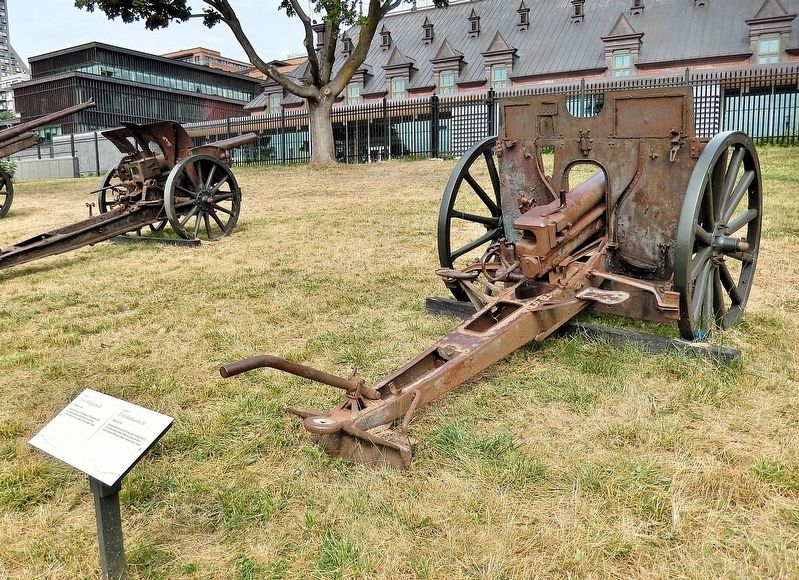
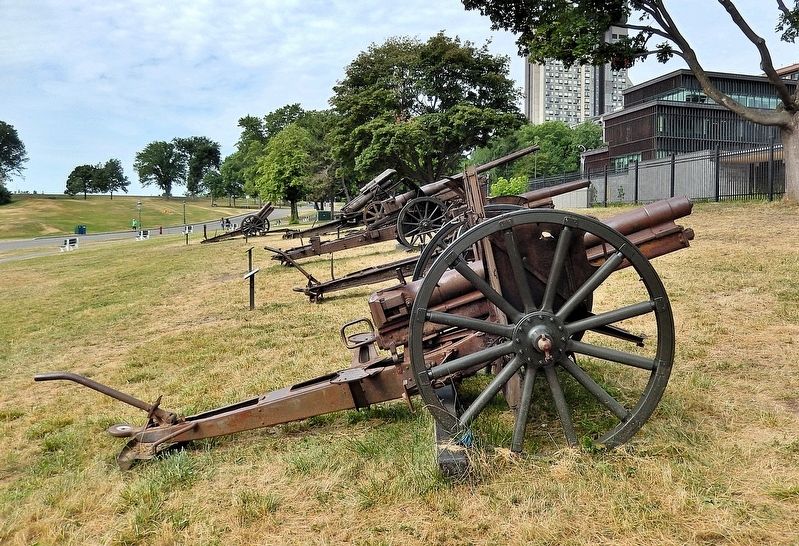
Calibre: 7.7 cm Feldkanone 16
Canon de campagne de 7,7 cm
⎯⎯⎯
7.7 cm Field Gun

Photographed by Cosmos Mariner, August 3, 2019
1. Calibre: 7.7 cm Feldkanone 16 Marker

Production : 1916
Canon capturé par le 87e bataillon le 27 septembre 1918 aux frontières ouest de Bourlon lors de la bataille du Canal-du-Nord et de Cambrai, Pas-de-Calais, France.
Produced: 1916
Field gun captured by the 87th battalion on September 27, 1918 at the western limits of Bourlon during the Battle of the Canal-du-Nord and Cambrai, Pas-de-Calais, France.
Topics. This historical marker is listed in this topic list: War, World I. A significant historical date for this entry is September 27, 1918.
Location. 46° 48.345′ N, 71° 12.799′ W. Marker is in Québec, in Capitale-Nationale. It is in Vieux-Québec-Cap-Blanc-colline Parlementaire. It is on George VI Avenue just west of Avenue Ontario, on the right when traveling west. The marker and cannon are in the historical cannon exhibit in Battlefields Park, on the south side of the Voltigeurs de Québec Armoury. Touch for map. Marker is at or near this postal address: 805 Avenue Wilfrid-Laurier, Québec G1R 2L3, Canada. Touch for directions.

Regionally, this marker is in Central Canada. Globally, it is in North America, the Western Hemisphere, and the Western
this page online
Other nearby markers. At least 8 other markers are within walking distance of this marker: Souvenirs de Guerre / Memories of War (here, next to this marker); Le Canada au Front / Canada at the Front (here, next to this marker); Calibre: 10.5 cm Feldhaubitze 98/09 (a few steps from this marker); Calibre: 7.7 cm Feldkanone 96 neuer Art (a few steps from this marker); Calibre: 10.5 cm Leichte Feldhaubitze 16 (a few steps from this marker); Calibre: 10 cm Kanone 17 (a few steps from this marker); Calibre: 21 cm Mörser 16 (a few steps from this marker); Calibre: 15 cm schwere Feldhaubitze 02 (within shouting distance of this marker). Touch for a list and map of all markers in Québec.
Related markers. Click here for a list of markers that are related to this marker. World War I German Cannon Exhibit
Also see . . .
1. 7.7 cm Feldkanone 16 (Wikipedia).
Excerpt: Field gun used by Germany in World War I. Most surviving examples in German service were rebarrelled(Submitted on April 10, 2025, by Cosmos Mariner of Cape Canaveral, Florida.)after the war as the 7.5 cm FK 16 nA (neuer Art, meaning "new model"). A total of 298 guns of the old type were still in German army service in 1939, making it the oldest field artillery piece in German inventory at the beginning of the Second World War.Photographed by Cosmos Mariner, August 3, 20192. Calibre: 7.7 cm Feldkanone 16 Marker
The older 7.7 cm FK 96 n.A. field gun was very mobile, but, once the war settled into trench warfare, its lack of range became a serious disadvantage. The FK 16 was intended to remedy this problem. The barrel was lengthened, and it was given a box carriage to allow for greater elevation, which increased the range.
2. Battle of the Canal du Nord (Wikipedia).
Excerpt: The Battle of Canal du Nord was part of the Hundred Days Offensive of the First World War by the Allies against German positions on the Western Front. The battle took place in the Nord-Pas-de-Calais region of France, along an incomplete portion of the Canal du Nord and on the outskirts of Cambrai between 27 September and 1 October 1918.(Submitted on April 8, 2025, by Cosmos Mariner of Cape Canaveral, Florida.)
At 5:20 on the morning of 27 September, all four Allied divisions attacked under total darkness,taking the German defenders of the 1st Prussian Guards Reserve Division and the 3rd German Naval Division by absolute surprise. By mid-morning, all defenders had retreated or been captured.Photographed by Cosmos Mariner, August 3, 20193. Calibre: 7.7 cm Feldkanone 16
The Canadian Corps had the important objective of capturing Bourlon Woods, the German army used the high ground of the woods for their guns. The objectives of the Canadian Corps were reached by the end of the day. Because of Canal du Nord's capture, the final road to Cambrai was open.
Credits. This page was last revised on April 18, 2025. It was originally submitted on April 5, 2025, by Cosmos Mariner of Cape Canaveral, Florida. This page has been viewed 216 times since then and 54 times this year. Photos: 1, 2, 3. submitted on April 8, 2025, by Cosmos Mariner of Cape Canaveral, Florida.
