Vieux-Québec-Cap-Blanc-colline Parlementaire in Capitale-Nationale, — Central Canada (French-Canadian)
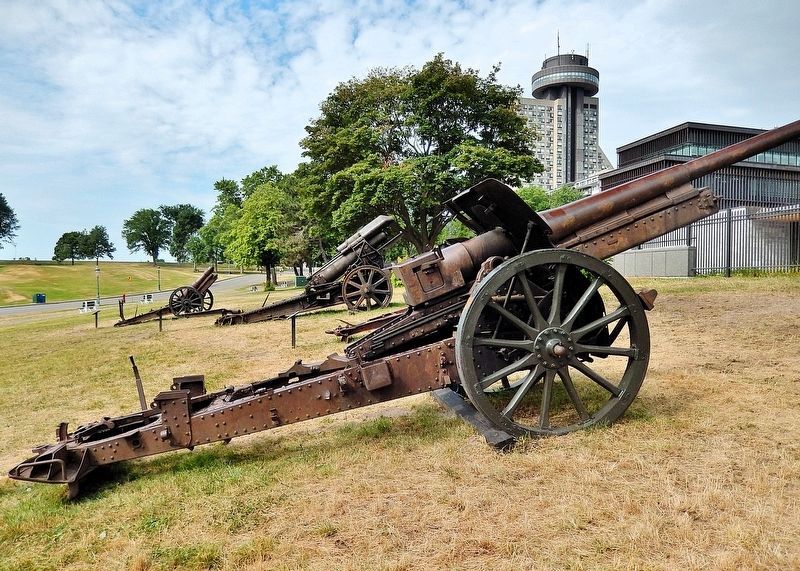
Calibre: 10.5 cm Leichte Feldhaubitze 16
Obusier léger de campagne de 10,5 cm
⎯⎯⎯
10.5 cm Light Field Howitzer

Photographed by Cosmos Mariner, August 3, 2019
1. Calibre: 10.5 cm Leichte Feldhaubitze 16 Marker

Production : 1917
Canon capturé par le 13e bataillon le 2 septembre 1918 au bois de Cagnicourt lors de la bataille d'Arras, Pas-de-Calais, France.
Produced: 1917
Field gun captured by the 13th battalion on September 2, 1918 in the Bois de Cagnicourt during the Battle of Arras, Pas-de-Calais, France.
Topics. This historical marker is listed in this topic list: War, World I. A significant historical date for this entry is September 2, 1918.
Location. 46° 48.341′ N, 71° 12.81′ W. Marker is in Québec, in Capitale-Nationale. It is in Vieux-Québec-Cap-Blanc-colline Parlementaire. It is on George VI Avenue just west of Avenue Ontario, on the right when traveling west. The marker and cannon are in the historical cannon exhibit in Battlefields Park, on the south side of the Voltigeurs de Québec Armoury. Touch for map. Marker is at or near this postal address: 805 Avenue Wilfrid-Laurier, Québec G1R 2L3, Canada. Touch for directions.

Regionally, this marker is in Central Canada. Globally, it is in North America, the Western Hemisphere, and the Western World. Historically, it finds itself in what was once a British
this page online
Other nearby markers. At least 8 other markers are within walking distance of this marker: Calibre: 7.7 cm Feldkanone 96 neuer Art (here, next to this marker); Calibre: 21 cm Mörser 16 (a few steps from this marker); Le Canada au Front / Canada at the Front (a few steps from this marker); Souvenirs de Guerre / Memories of War (a few steps from this marker); Calibre: 7.7 cm Feldkanone 16 (a few steps from this marker); Calibre: 15 cm schwere Feldhaubitze 02 (a few steps from this marker); Calibre: 10.5 cm Feldhaubitze 98/09 (a few steps from this marker); Calibre: 10 cm Kanone 17 (within shouting distance of this marker). Touch for a list and map of all markers in Québec.
Related markers. Click here for a list of markers that are related to this marker. World War I German Cannon Exhibit
Also see . . .
1. 10.5 cm Feldhaubitze (Wikipedia).
Excerpt: It was originally built by Rheinmetall as the 10.5 cm Feldhaubitze 98, an old-fashioned, fixed-recoil weapon delivered to the German army in 1898. The 10.5 cm Leichte Feldhaubitze(Submitted on April 9, 2025, by Cosmos Mariner of Cape Canaveral, Florida.)16 was introduced in 1916 as a successor to the 10.5 cm Feldhaubitze 98/09, featuring a longer barrel and hence longer range.Photographed by Cosmos Mariner, August 3, 20192. Calibre: 10.5 cm Leichte Feldhaubitze 16 Marker

2. The Second Battle of Arras, 26 August - 3 September 1918.
Excerpt: After a successful push at Amiens in early August 1918, the Allies continued their offensive against the German army. The battles that took place between 26 August and 3 September 1918 (Battle of the Scarpe and Battle of Drocourt-Quéant) are known as the Second Battle of Arras.(Submitted on April 9, 2025, by Cosmos Mariner of Cape Canaveral, Florida.)
At daybreak on 2 September, the 1st and 4th Canadian Divisions, with support from Mark V tanks and intense artillery fire, launched the attack. By the end of a day of relentless battle, the Canadians had taken the villages of Dury, Cagnicourt and Villez-sur-Cagnicourt, located beyond the Drocourt-Quéant Line, to the east. On 3 September, the Canadian Corps continued to advance, liberating villages on its way, without facing any resistance other than enemy artillery fire. At the end of their offensive, the Canadians controlled the territory west of the Canal du Nord, from the villageof Sains-les-Marquion to the Sensée River.Photographed by Cosmos Mariner, August 3, 20193. Calibre: 10.5 cm Leichte Feldhaubitze 16
The successful battle, praised by Lieutenant-General Arthur Currie in his diary, nevertheless came at a heavy cost. In the Second Battle of Arras, the Canadian Corps suffered 11,000 casualties, including killed, wounded and missing.
Credits. This page was last revised on April 18, 2025. It was originally submitted on April 7, 2025, by Cosmos Mariner of Cape Canaveral, Florida. This page has been viewed 138 times since then and 34 times this year. Photos: 1, 2, 3. submitted on April 9, 2025, by Cosmos Mariner of Cape Canaveral, Florida.
