
Dundurn B in Hamilton, Ontario — Central Canada (North America)
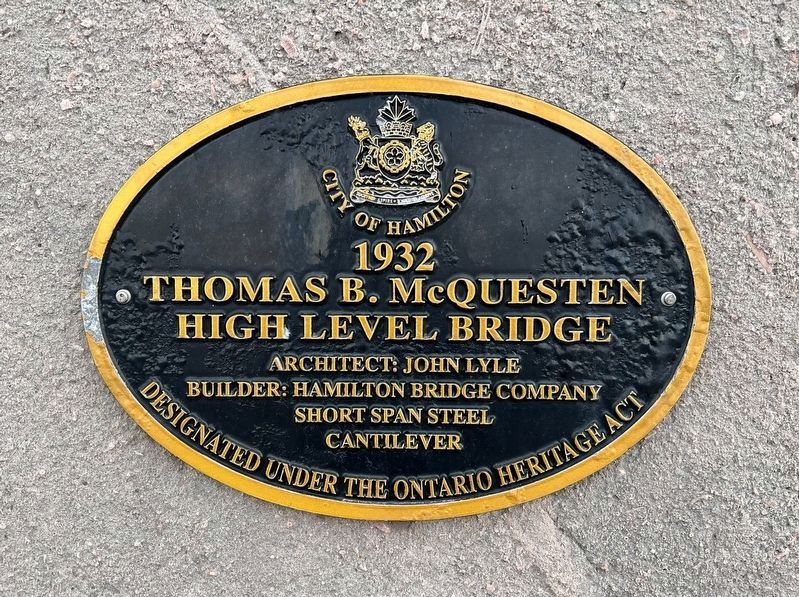
Thomas B. McQuesten High Level Bridge
1932
Photographed by Tim Boyd, April 23, 2023
1. Thomas B. McQuesten High Level Bridge Marker
Architect: John Lyle
Builder: Hamilton Bridge Company
Short span steel
Cantilever
Designated under the Ontario Heritage Act
Erected by City of Hamilton.
Topics. This historical marker is listed in this topic list: Bridges & Viaducts. A significant historical year for this entry is 1932.
Location. 43° 16.751′ N, 79° 53.453′ W. Marker is in Hamilton, Ontario. It is in Dundurn B. It is at the intersection of York Boulevard and Dundurn Street North, on the right when traveling east on York Boulevard. Touch for map. Marker is in this post office area: Hamilton ON L8R 2A4, Canada. Touch for directions.

Regionally, this marker is on Ontario’s Golden Horseshoe, in the Hamilton-Halton-Brant Area, and specifically in the Toronto Metropolitan Area. It is also in Central Canada. Globally, it is in North America, on the Great Lakes, in the Western Hemisphere, in the Western World, and in the Anglosphere. Historically, it finds itself in what was once a British colony, the Viceroyalty of New France, the Haudenosaunee (Iroquois) Confederacy, and Rupert’s Land.
Other nearby markers. At least 8 other
this page online
Also see . . . The Thomas B. McQuesten High Level Bridge (Cultural Landmarks of Hamilton Wentworth).
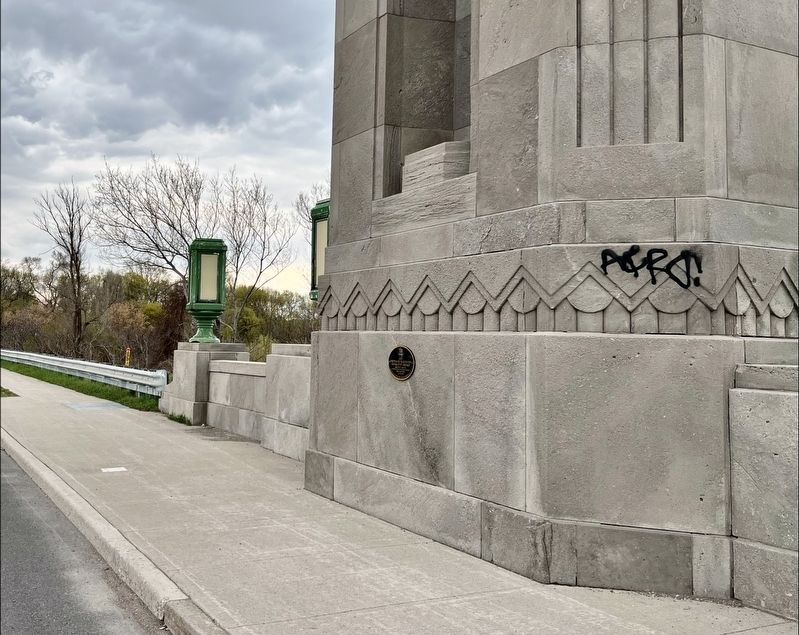
The Hamilton and Milton Road Company had a toll roadway that entered Hamilton by Burlington Heights. However, the company decided it would be advantageous to construct a second bridge. The bridge was so poorly constructed that it was eventually closed down. In 1896, a properly constructed high level bridge was built over the Desjardins Canal. The steel arch which was the(Submitted on April 9, 2025, by Tim Boyd of Hamilton, Ontario.)substructure of the bridge spanned over 180 feet. The bridge was able to withstand the weight of pedestrians, horses and carriages. The development of the North American automobile placed a new strain on the bridge. The structure of the bridge was unable to withstand the weight of heavy automobile traffic and narrow roadway had become dangerous to traverse. Reports also surfaced that the bridge would sway under heavy traffic. The bridge remained in place, however, proposals for the improvement of the bridge and the city's north-west entrance would result in it being dismantled to make way for the high level bridge.Photographed by Tim Boyd, April 23, 20232. Thomas B. McQuesten High Level Bridge Marker

1932
3. The High-Level (later named for Thomas B. McQuesten) Bridge, 1932
Hamilton Public Library Special Collections (public domain)

Photographed by Tim Boyd, April 7, 2025
4. Thomas B. McQuesten High Level Bridge, 2025
Credits. This page was last revised on April 10, 2025. It was originally submitted on April 9, 2025, by Tim Boyd of Hamilton, Ontario. This page has been viewed 200 times since then and 51 times this year. Photos: 1, 2, 3, 4. submitted on April 9, 2025, by Tim Boyd of Hamilton, Ontario. • Andrew Ruppenstein was the editor who published this page.
