Trafford in Westmoreland County, Pennsylvania — The American Northeast (Mid-Atlantic)
The Trafford Foundry
Photographed by Bradley Owen, April 9, 2025
1. The Trafford Foundry Marker
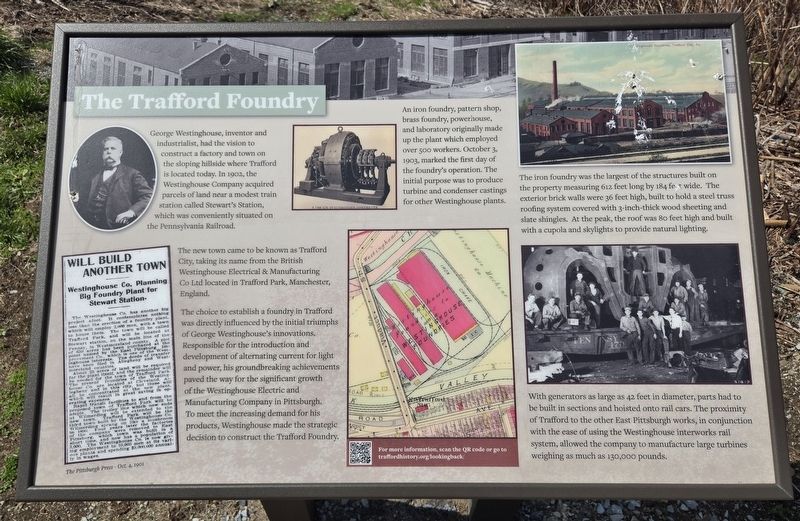
George Westinghouse, inventor and industrialist, had the vision to construct a factory and town on the sloping hillside where Trafford is located today. In 1902, the Westinghouse Company acquired parcels of land near a modest train station called Stewart's Station, which was conveniently situated on the Pennsylvania Railroad.
The new town came to be known as Trafford City, taking its name from the British Westinghouse Electrical & Manufacturing Co Ltd located in Trafford Park, Manchester, England.
The choice to establish a foundry in Trafford was directly influenced by the initial triumphs of George Westinghouse's innovations. Responsible for the introduction and development of alternating current for light and power, his groundbreaking achievements paved the way for the significant growth of the Westinghouse Electric and Manufacturing Company in Pittsburgh. To meet the increasing demand for his products, Westinghouse made the strategic decision to construct the Trafford Foundry.
An iron foundry, pattern shop, brass foundry, powerhouse, and laboratory originally made up the plant which employed over 500 workers.
this page online
The iron foundry was the largest of the structures built on the property measuring 612 feet long by 184 feet wide. The exterior brick walls were 36 feet high, built to hold a steel truss roofing system covered with 3-inch-thick wood sheeting and slate shingles. At the peak, the roof was 80 feet high and built with a cupola and skylights to provide natural lighting.
With generators as large as 42 feet in diameter, parts had to be built in sections and hoisted onto rail cars. The proximity of Trafford to the other East Pittsburgh works, in conjunction with the ease of using the Westinghouse interworks rail system, allowed the company to manufacture large turbines weighing as much as 130,000 pounds.
(Caption):
The Pittsburgh Press - Oct. 4, 1901
Erected 2024 by The Trafford Historical Society.
Topics. This historical marker is listed in these topic lists: Industry & Commerce • Railroads & Streetcars. A significant historical date for this entry is October 3, 1903.
Location. 40° 23.156′ N,
Photographed by Bradley Owen, April 9, 2025
2. The Trafford Foundry Marker

Regionally, this marker is in the Laurel Highlands and in Greater Pittsburgh. It is also in the American Northeast, in the Mid-Atlantic, in Appalachia, and specifically in Northern Appalachia. Globally, it is in North America, the Western Hemisphere, the Western World, and the Anglosphere. Historically, it finds itself in what was once the Viceroyalty of New France, the Haudenosaunee (Iroquois) Confederacy, and one of the original Thirteen Colonies.
Other nearby markers. At least 8 other markers are within walking distance of this marker: Trafford (here, next to this marker); World War Memorial (about 700 feet away, measured in a direct line); World War II Memorial (about 700 feet away); American Gold Star Mothers Memorial (about 700 feet away); Korea • Vietnam Memorial (about 800 feet away); a different marker also named World War II Memorial (about 800 feet away); Global War on Terror Memorial (about 800 feet away); Trafford's Fallen Heroes (about 800 feet away). Touch for a list and map of all markers in Trafford.
Credits. This page was last revised on April 11, 2025. It was originally submitted on April 11, 2025, by Bradley Owen of Morgantown, West Virginia. This page has been viewed 529 times since then and 201 times this year. Photos: 1, 2. submitted on April 11, 2025, by Bradley Owen of Morgantown, West Virginia.
