Montmartre in Paris in Département de Paris, Île-de-France, France — Western Europe
Erik Satie

Photographed by Andrew Ruppenstein, April 11, 2025
1. Erik Satie Marker

Compositeur de Musique
a vécu dans cette maison
de 1890 à 1898
Topics. This historical marker is listed in this topic list: Arts, Letters, Music. A significant historical date for this entry is May 17, 1866.
Location. 48° 53.261′ N, 2° 20.463′ E. Marker is in Paris, Île-de-France, in Département de Paris. It is in Montmartre. It is on Rue Cortot, on the right when traveling west. Touch for map. Marker is at or near this postal address: 6 Rue Cortot, Paris, Île-de-France 75018, France. Touch for directions.

Regionally, it is in the North Atlantic Region, Europe, the European Union, Atlantic Europe, the Schengen Area, Western Europe, a coastal Mediterranean country, and the Western World. Historically, it finds itself in what was once a French colony and also the Roman Empire.
Other nearby markers. At least 8 other markers are within walking distance of this marker: Musée de Montmartre (within shouting distance of this marker); Square Claude-Charpentier (1931) (within shouting distance of this marker); Le Cabaret de Patachou
this page online
Other markers no longer nearby. La maison de Rose de Rosimond (was within shouting distance of this marker but has been confirmed missing); Clos Montmartre (was about 90 meters away but has been permanently removed).
Also see . . .
1. Erik Satie (Wikipedia). Excerpt:
Eric Alfred Leslie Satie (17 May 1866 – 1 July 1925), who signed his name Erik Satie after 1884, was a French composer and pianist. He was the son of a French father and a British mother. He studied at the Paris Conservatoire, but was an undistinguished student and obtained no diploma. In the 1880s he worked as a pianist in café-cabaret in Montmartre, Paris, and began composing works, mostly for solo piano, such as his Gymnopédies and Gnossiennes…(Submitted on April 11, 2025.)
Satie's example guided a new generation of Frenchcomposers away from post-Wagnerian impressionism towards a sparer, terser style. Among those influenced by him during his lifetime were Maurice Ravel, Claude Debussy, and Francis Poulenc, and he is seen as an influence on more recent composers such as John Cage and John Adams. His harmony is often characterised by unresolved chords, he sometimes dispensed with bar-lines, as in his Gnossiennes, and his melodies are generally simple and often reflect his love of old church music…Photographed by Andrew Ruppenstein, April 11, 20252. Erik Satie Marker - wide view
Satie never married, and his home for most of his adult life was a single small room, first in Montmartre and, from 1898 to his death, in Arcueil, a suburb of Paris. He adopted various images over the years, including a period in quasi-priestly dress, another in which he always wore identically coloured velvet suits, and is known for his last persona, in neat bourgeois costume, with bowler hat, wing collar, and umbrella. He was a lifelong heavy drinker, and died of cirrhosis of the liver at the age of 59.

2. Erik Satie (Complete Gnossiennes 1 - 7) (YouTube, 24:07). (Submitted on April 11, 2025.)

Photographed by Andrew Ruppenstein, April 11, 2025
3. Erik Satie Marker - wider view
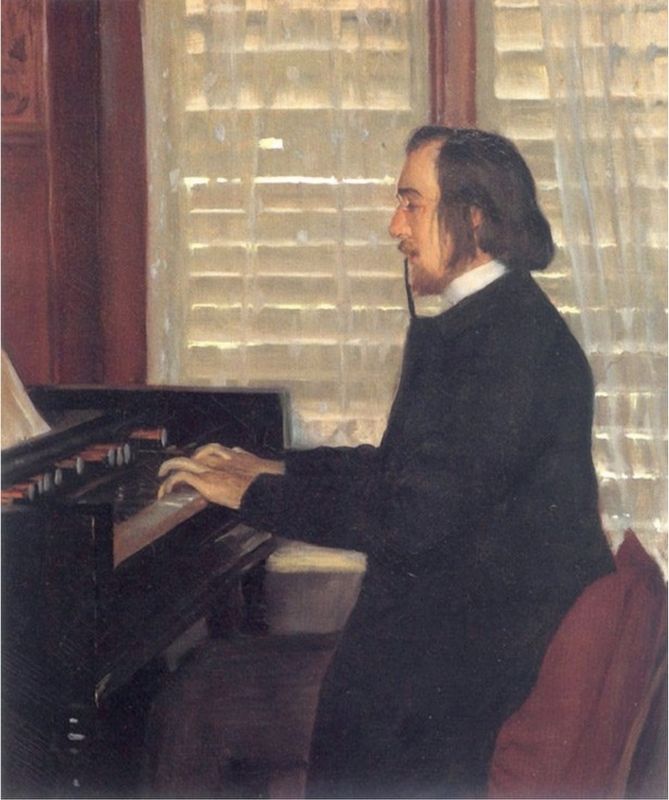
Photographed by Santiago Rusiñol (courtesy Wikimedia Foundation), circa 1890s
4. Portrait of Eric Satie at the harmonium
Credits. This page was last revised on April 11, 2025. It was originally submitted on April 11, 2025, by Andrew Ruppenstein of Lamorinda, California. This page has been viewed 127 times since then and 24 times this year. Photos: 1, 2, 3, 4. submitted on April 11, 2025, by Andrew Ruppenstein of Lamorinda, California.
