
Athlone and Bigmeadow in County Westmeath, Leinster, Ireland — Mid-East (and Dublin)
Athlone Castle/Church of SS Peter and Paul
Caisleán Bhaile Átha Luain/Eaglais Naomh Peader agus Pól
| — | Historic Town/ | — |
Photographed by William Fischer, Jr., April 4, 2025
1. Athlone Castle/Church of SS Peter and Paul Marker

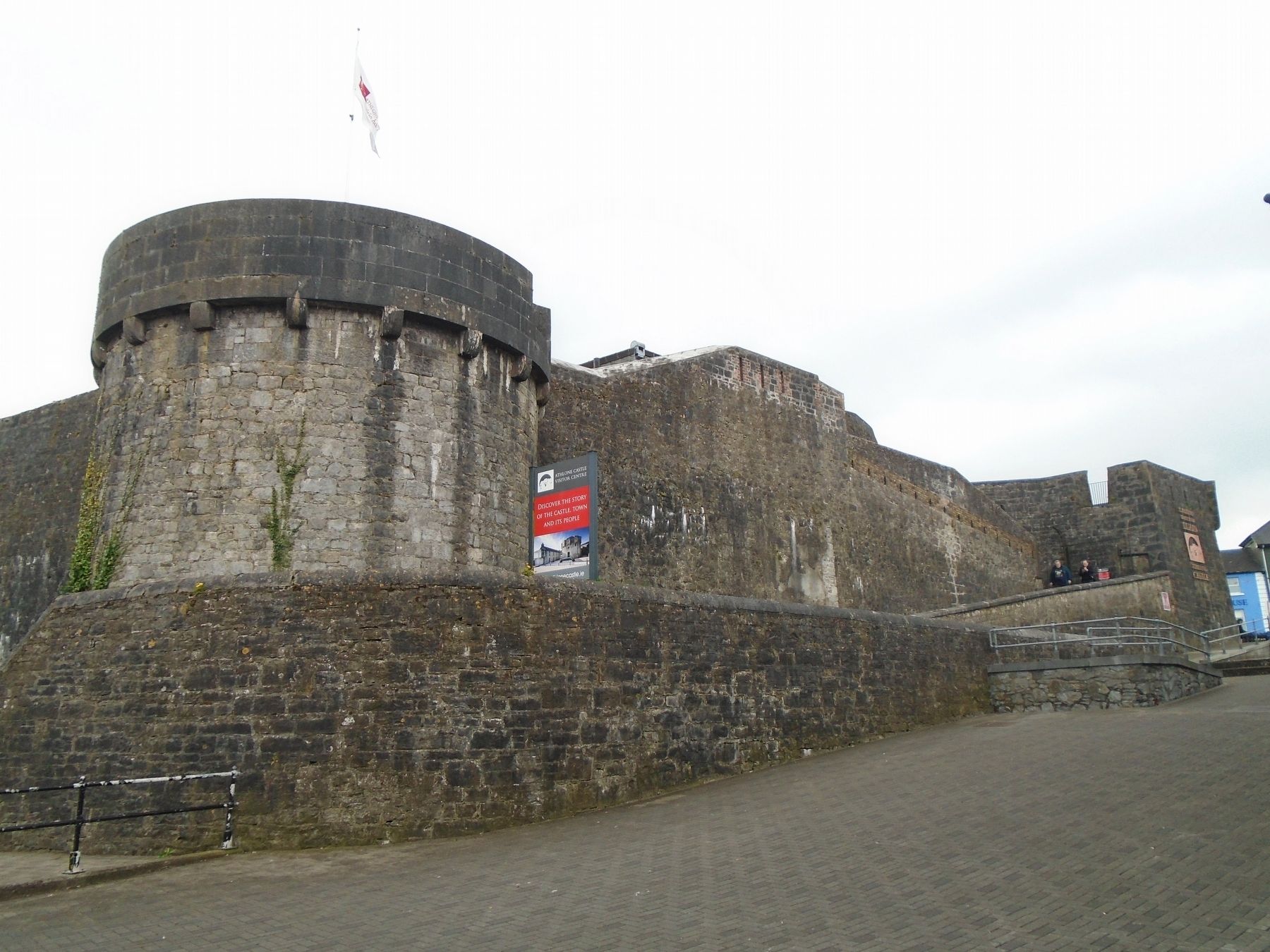
⑰ Athlone Castle
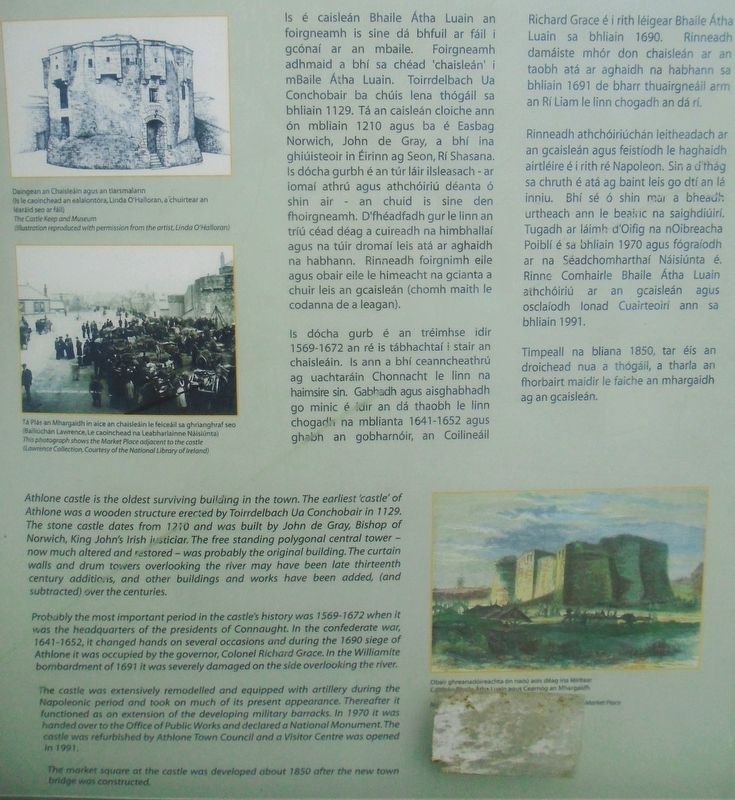
Athlone castle is the oldest surviving building in the town. The earliest 'castle' of Athlone was a wooden structure erected by Toirrdelbach Ua Conchobair in 1129. The stone castle dates from 1210 and was built by John de Gray, Bishop of Norwich, King John's Irish justiciar. The free standing polygonal central tower - now much altered and restored - was probably the original building. The curtain walls and drum towers overlooking the river may have been late thirteenth century additions, and other buildings and works have been added, (and subtracted) over the centuries.
Probably the most important period in the castle's history was 1569-1672 when it was the headquarters of the presidents of Connaught. In the confederate war, 1641-1652, it changed hands on several occasions and during the 1690 siege of Athlone it was occupied by the governor, Colonel Richard Grace. In the Williamite bombardment of 1691 it was severely damaged on the side overlooking the river.
The castle was extensively remodelled and equipped with artillery during the Napoleonic period and took on much of its present appearance. Thereafter it functioned as an extension of the developing military barracks. In 1970 it was handed over to the Office of Public Works and declared a National Monument. The castle was refurbished by Athlone Town Council and a Visitor Centre was opened in 1991.
The market square at the castle was developed about 1850 after the new town bridge was constructed.
[Photo captions, top to bottom, read]
• The Castle Keep and Museum (Illustration reproduced with permisson from the artist, Linda O'Halloran)
• This photograph shows the Market Place adjacent to the castle
• Nineteenth-century engraving depicting Athlone Castle and Market Square [obscured, taken from Gaelic translation]
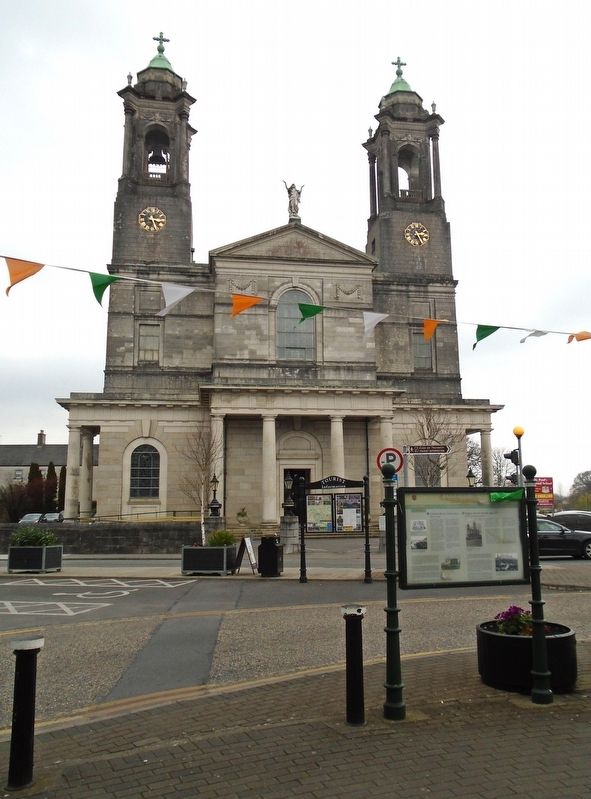
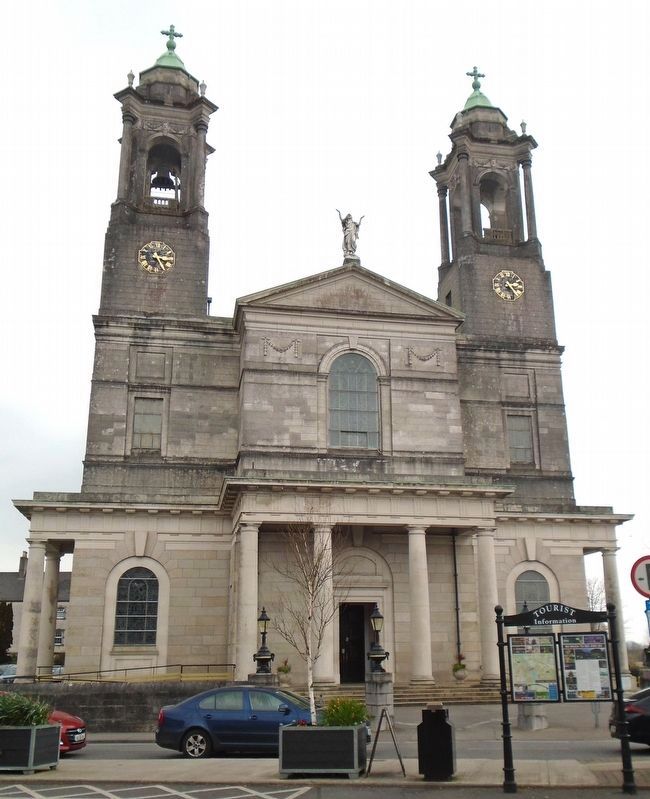
㉜ Church of SS Peter and Paul
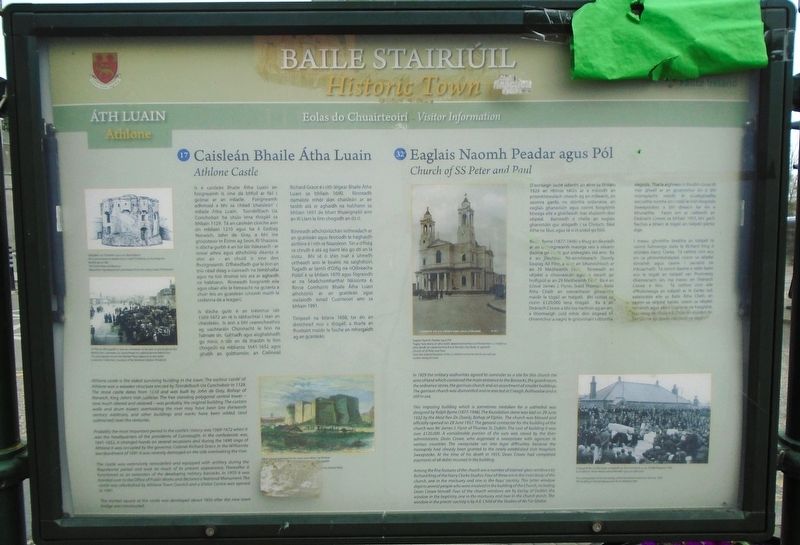
In 1929 the military authorities agreed to surrender as a site for this church the area of land which contained the main entrance to the Barracks, the guard room, the ordnance stores, the garrison church and an assortment of smaller buildings. The garrison church was dismantled and re-erected at Creagh, Ballinasloe and is still in use.
This imposing building which is sometimes mistaken for a cathedral was designed by Ralph Byrne (1877-1946). The foundation stone was laid on 29 June 1932 by the Most Rev. Dr. Doorly, Bishop of Elphin. The church was blessed and officially opened on 29 June 1937. The general contractor for the building of the church was Mr James J. Flynn of Thomas St, Dublin. The cost of building it was over £120,000. A considerable portion of the sum was raised by the then administrator, Dean Crowe, who organised a sweepstake with agencies in various countries. The sweepstake ran into legal difficulties because the monopoly had already been granted to the newly established Irish Hospitals Sweepstake. At the time of his death in 1955, Dean Crowe had completed payments of all debts incurred in the building.
Among the fine features of the church are a number of stained-glass windows by Richard King of the Harry Clarke Studios. Four of these are in the main body of the church, one in the mortuary and one in the boys' sacristy. This latter window depicts several people who were involved in the building of the Church, including Dean Crowe himself. Four of the church windows are by Earley of Dublin, the window in the baptistry, one in the mortuary and two in the church porch. The window in the priests' sacristy is by A.E. Child of the Studios of An Túr Gloine.
Photo captions, top to bottom, read]
• Church of SS Peter and Paul. Note the original location of the J.J. Walsh memorial which you will see further along the trail
• This photograph shows the laying of the foundation stone on 29 June 1932. The building in the backgrond is the Fr. Mathew Hall
Is
this page online
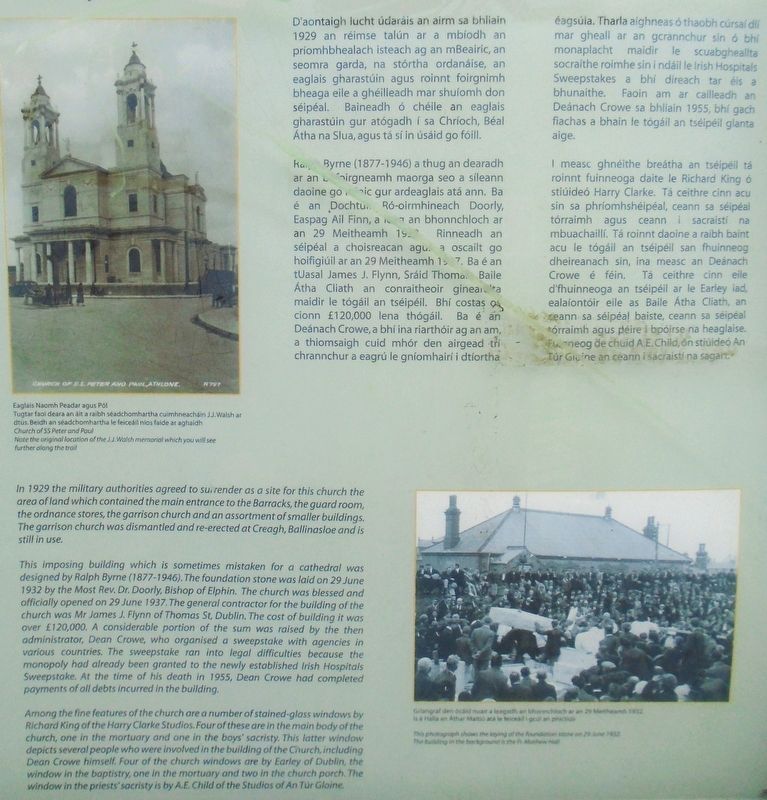
Is dócha gurb é an tréimhse idir 1569-1672 an ré is tábhachtaí i stair an chaisleáin. Is ann a bhí ceanncheathrú ag uachtaráin Chonnacht le linn na haimsire sin. Gabhadh agus aisghabhadh go minic é luir an dá thaobh le linn chogadh na mblianta 1641-1652 agus ghabh an gobharnóir, an Coilineáil Richard Grace é i rith léigear Bhaile Átha Luain sa bhliain 1690. Rinneadh damáiste mhór don chaisleán ar an taobh atá
Photographed by William Fischer, Jr., April 4, 2025
2. Athlone Castle/Church of SS Peter and Paul Marker
Rinneadh athchóiriúchán leitheadach ar an gcaisleán agus feistíodh le haghaidh airtléire é i rith ré Napoleon. Sin a d'thág sa chruth é atá ag baint leis go dtí an lá inniu. Bhí sé ó shin mar a bheadh urtheach ann le beairic na saighdiúiri. Tugadh ar láimh d'Oifig na nOibreacha Poiblí é sa bhliain 1970 agus fógraíodh ar na Séadchomharthaí Náisiúnta é. Rinne Comhairle Bhaile Átha Luain athchóiriú ar an gcaisleán agus osclaíodh lonad Cuairteoirí ann sa bhliain 1991.
Timpeall na bliana 1850, tar éis an droichead nua a thógáil, a tharla an fhorbairt maidir le faiche an mhargaidh ag an gcaisleán.
[Fotheidil grianghraf, ó bhun go barr, léite]
• Daingean an Chaisleáin agus an tiarsmalann. (I le caoinchead an ealalontora, Linda O'Halloran, a chuirtear an learáid seo ar fáil)
• Ta Plas an Mhargaidh in aice an chaisleáin le feiceáil sa ghrianghraf seo
• Obair ghreanadóireáchta ón naoú déag ina léirftear Caisleán Bhaile Átha Luain agus Cearnóg an Mhargaigh
㉜ Eaglais Naomh Peadar agus Pol
D'aontaigh lucht údaráis an airm sa
Photographed by William Fischer, Jr., April 4, 2025
3. Athlone Castle/Church of SS Peter and Paul Marker
Ralph Byrne (1877-1946) a thug an dearadh ar an [?]foirgneamh maorga seo a síleann daoine go [?]ic gur ardeaglais atá ann. Ba é an Dochtu[?] Ró-oirmhineach Doorly, Easpag Ail Finn, a [?] an bhonnchloch ar an 29 Meitheamh 1932. Rinneadh an séipéal a choisreacan agus a oscailt go hoifigiúil ar an 29 Meitheamh 1937. Ba é an tUasal James J. Flynn, Sráid Thomas, Baile Átha Cliath an conraitheoir ginea[?]ta maidir le tógáil an tséipéil. Bhí costas os cionn £120,000 lena thógáil. Ba é an Deánach Crowe, a bhí ina riarthóir ag an am, a thiomsaigh cuid mhór den airgead trí chrannchur a eagrú le gníomhairí i dtíortha éagsúla. Tharla aighneas ó thaobh cúrsaí dlí mar gheall ar an gcrannchur sin ó bhi monaplacht maidir le scuabgheallta socraithe roimhe sin i ndáil le Irish Hospitals Sweepstakes a bhi direach tar éis a bhunaithe.
Photographed by William Fischer, Jr., April 4, 2025
4. Athlone Visitor Information/Átha Luain Eolas do Chuairteoirí Marker
I measc ghnéithe breátha an tséipéil tá roinnt fuinneoga daite le Richard King o stiúideó Harry Clarke. Tá ceithre cinn acu sin sa phríomhshéipéal, ceann sa séipéal tórraimh agus ceann i sacraistí na mbuachaillí. Tá roinnt daoine a raibh baint acu le tógáil an tséipéil san fhuinneog dheireanach sin, ina measc an Deánach Crowe é féin. Ta ceithre cinn eile d'fhuinneoga an tséipéil ar le Earley lad, ealaíontóir eile as Baile Átha Cliath, an ceann sa séipéal baiste, ceann sa séipéal tórraimh agus péire i bpoirse na heaglaise. Fhuinneog de chuid A.E. Child, on stiúideó An Túr Guine an ceann i sacraisti na sagart.
[Fotheidil grianghraf, ó bhun go barr, léite]
• Tugtar faoi deara an ait a raibh séadchomhartha cuimhneachdin JJ. Walsh ar drus. Beidh an séadchomhartha le feiceáil mios faide ar aghaidh
• Grlangraf den ócáid nuair a leagadh an bhonnchloch ar an 29 Meitheamh 1932. Is é Halla an Athar Maltiú atá le feiceáil i gcúl an phictiúir
Erected by Town of Athlone, National Development Plan, and Fáilte Ireland.
Topics.
Photographed by William Fischer, Jr., April 4, 2025
5. Athlone Castle/Church of SS Peter and Paul Marker
Location. 53° 25.406′ N, 7° 56.589′ W. Marker is in Athlone, Leinster, in County Westmeath. It is in Athlone and Bigmeadow. It is at the intersection of Castle Street and Custume Place, on the right when traveling west on Castle Street. Marker is adjacent to the Athlone Castle entrance. Touch for map. Marker is in this post office area: Athlone, Leinster N37 A6D7, Ireland. Touch for directions.

Regionally, this marker is in the Hidden Heartlands. Globally, it is on the Atlantic Ocean, in the North Atlantic Region, in Europe, on the Island of Ireland, on the Celtic Fringe, in the European Union, in Atlantic Europe, on one of the British Isles, in the Western World, and in the Anglosphere.
Other nearby markers. At least 8 other markers are within walking distance of this marker: Tourist Information (a few steps from this marker); Adamson Castle (a few steps from this marker); Athlone Castle (within shouting distance of this marker); Historical Garden at Athlone Castle (within shouting distance of this marker); Custume Barracks/Church of Saints Peter and Paul/Railway Bridge/Luan Gallery (within shouting distance of this marker); Athlone Woollen Mills/Town Bridge (within shouting distance
Photographed by William Fischer, Jr., April 4, 2025
6. Athlone Castle/Caisleán Bhaile Átha Luain
Photographed by William Fischer, Jr., April 4, 2025
7. Church of SS Peter and Paul/Eaglais Naomh Peader agus Pól
Credits. This page was last revised on December 3, 2025. It was originally submitted on April 13, 2025, by William Fischer, Jr. of Reynoldsburg, Ohio. This page has been viewed 202 times since then and 42 times this year. Photos: 1, 2, 3, 4, 5, 6, 7. submitted on April 13, 2025, by William Fischer, Jr. of Reynoldsburg, Ohio.
