
Santa Rosa in Sonoma County, California — The American West (Pacific Coastal)
Mableton
The McDonald Mansion

Photographed by Joseph Alvarado, November 2, 2024
1. Mableton Marker
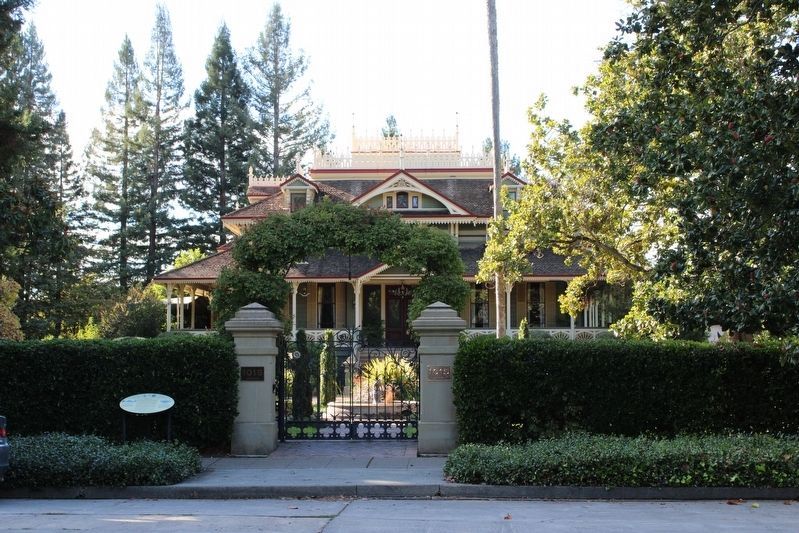
The McDonald Mansion, originally called "Mableton", was built in 1879 as a summer home for the McDonald Family, whose primary residence was in San Francisco. The family chose the name "Mableton" in homage to the Mississippi family home of Ralphine North McDonald. Colonel Mark L. McDonald, one of Santa Rosa's most prominent early citizens was a Kentucky native who came west as captain of a wagon train in the early 1850's. Trained in engineering, he first built roadways servicing gold and silver mines. This and other early successes allowed him to buy a seat on the San Francisco Stock Exchange, during which time he joined the ranks of the rich and powerful, including Randolph Hearst, Leland Stanford and Charles Crocker. By the late 1860's, McDonald had begun to apply his wealth, influence and entrepreneurial spirit to new business opportunities in Santa Rosa. These included purchase and subdivision of 160 acres of land in what became known as McDonald's Addition. During the 1870's, the new development flourished and McDonald Avenue became the premier residential street of Santa Rosa. The neighborhood's popularity was enhanced
this page online
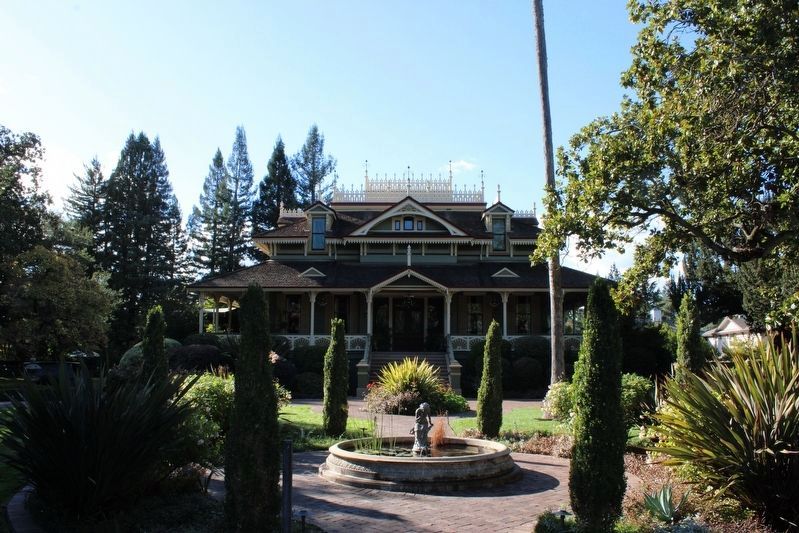
The architectural form of the McDonald Mansion is unusual for substantial California homes of its era. Designed with a single main living level over an above-ground basement (intended as a flood precaution), it can be described as a large-scale adaptation
Photographed by Joseph Alvarado, November 2, 2024
2. Mableton Marker & Home
Pollyanna (1960), a classic Walt Disney Productions full-length film, starring child actress Hayley Mills, and featuring Jane Wyman, Richard Egan, Adolphe Menjou and Agnes Moorehead, was filmed in part on location at the McDonald Mansion. While the interior locations were filmed in a studio, many of the building's exterior features and grounds are recognizable in the film.
Between 2006 and 2011, Mableton was completely rehabilitated.
Photographed by Joseph Alvarado, November 2, 2024
3. Mableton
The McDonald Mansion is a survivor of the 1906 earthquake, decades of neglect, an ongoing threat of demolition and redevelopment, and a serious 1977 fire. The property survived because of the dedication, persistence and hard work of numerous community members who recognized its historical and cultural significance to the City of Santa Rosa. This beloved landmark is listed in the National Register of Historic Places.
Please respect the privacy of the property owners.
Image courtesy of Sonoma County Library History Annex and Santa Rosa Press Democrat.
Taken from a lithograph published in the 1880s, this is the earliest known view of the house. Note the original two-tiered roof cresting, the bands of patterned roof shingles, and the side staircase on the left. These elements were missing for decades and were recently restored. Partly visible on the far right of the image is the gazebo, which was reconstructed and relocated in the garden on the left (south) side of the house. Also visible is the carriage house, which survives in its original location (now on a separate parcel), and has been altered from its original appearance.
Image courtesy of the California Historical Society.
Included in a promotional brochure published by the Santa Rosa Chamber of Commerce, this photograph shows that, by this date, dormer windows had been added to the second floor bedrooms. Also, some of the original roof cresting is still visible. After 1918, following the deaths of the elder McDonalds, numerous renovations were undertaken by their eldest son, Mark L. McDonald Jr. (b. 1868-d.1932), and his wife, Isabelle Juilliard McDonald (b. circa 1870-d.1960), a Santa Rosa native from a prominent early local family. These later changes included the awning-covered extension that can be seen on the south side of the porch. Other later additions were selectively removed when the house exterior was restored to its 1910 appearance during the restoration that took place between 2006 and 2011.
Topics. This historical marker is listed in these topic lists: Architecture • Industry & Commerce • Settlements & Settlers. A significant historical year for this entry is 1879.
Location. 38° 26.958′ N, 122° 42.289′ W. Marker is in Santa Rosa, California, in Sonoma County. It is on McDonald Avenue east of McDonald Place, on the right when traveling west. The resin marker of mounted at the sidewalk next to the main gate. Touch for map. Marker is at or near this postal address: 1015 McDonald Avenue, Santa Rosa CA 95404, United States of America. Touch for directions.

Regionally, this marker is in California’s Wine Country, in the San Francisco Bay Area, in the North Coast, and specifically on the Coast Ranges. It is also on the American Pacific Coast. Globally, it is in North America, on the Ring of Fire, in the Pacific Rim, in the Western Hemisphere, in the Western World, and in the Anglosphere. Historically, it finds itself in what was once New Spain and also Mexico’s Alta California.
Other nearby markers. At least 8 other markers are within 7 miles of this marker, measured as the crow flies: Santa Rosa Rural Cemetery (approx. 0.4 miles away); Santa Rosa Post Office and Federal Building (approx. 0.9 miles away); Luther Burbank Home (approx. one mile away); Luther Burbank's Garden (approx. one mile away); Lee Bros. Building - 1906 (approx. 1.2 miles away); Isaac De Turk 1843 - 1896 (approx. 1.2 miles away); Hood House (approx. 6.9 miles away); The St. Francis Bell (approx. 7 miles away). Touch for a list and map of all markers in Santa Rosa.
Another marker is no longer nearby. Comstock House Restoration (was approx. 0.7 miles away but has been confirmed missing).
Credits. This page was last revised on July 22, 2025. It was originally submitted on April 13, 2025, by Joseph Alvarado of Livermore, California. This page has been viewed 397 times since then and 176 times this year. Photos: 1. submitted on April 13, 2025, by Joseph Alvarado of Livermore, California. 2, 3. submitted on July 21, 2025, by Joseph Alvarado of Livermore, California. • Devry Becker Jones was the editor who published this page.
