Tallahassee in Leon County, Florida — The American South (South Atlantic)
Bel Air Community

Photographed by Tim Fillmon, April 15, 2025
1. Bel Air Community Marker, Side One
In the early 1800s, wealthy Tallahasseans traveled to the mountains of Tennessee, the Carolinas, and Georgia during the summer. When the Panic of 1837 caused a national economic depression that resulted in the decline of Tallahassee's Union Bank, many of them could no longer afford to travel so far. In 1841, a resort community named Bel Air was developed two miles south of downtown Tallahassee. French for "Beautiful Air." the name refers to the air in the pine woods, which they believed would protect them from yellow fever. Bel Air was situated on a dry sandy ridge where breezes flowed and so had relatively fewer mosquitoes, the carrier of yellow fever. Early landowners and seasonal residents were plantation owners who, among others, included a future Governor and a Secretary of State, a prominent railroad manager, and a Circuit Court Judge. Another well- known resident was the Reverend James Page. who was enslaved by the Parkhill family. Page was ordained one of Florida's first Black Baptist ministers and founded Bel Air's Bethlehem Missionary Baptist Church.
Bel Air quickly became a bustling summer
this page online
A Florida Heritage Site
Erected 2024 by The Tallahassee Historical Society and the Florida Department of State. (Marker Number F-1268.)
Topics. This historical marker is listed in these topic lists:
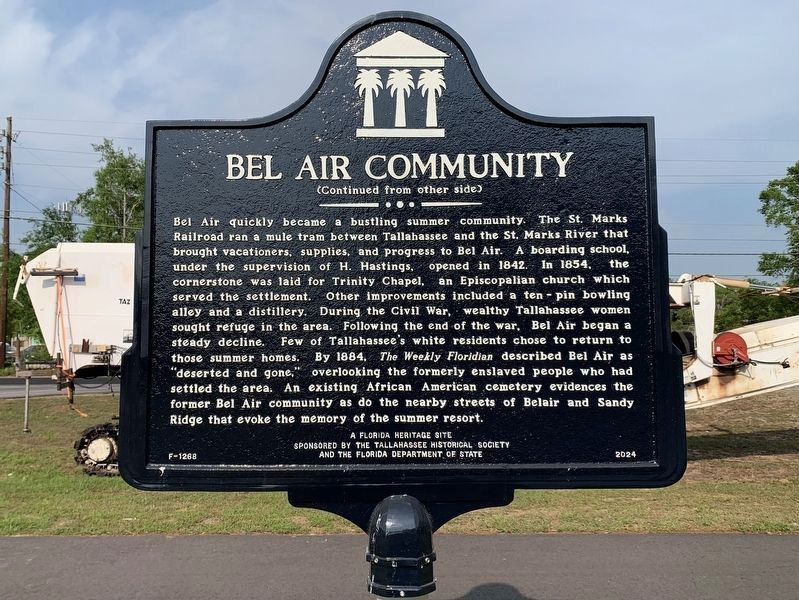
Photographed by Tim Fillmon, April 15, 2025
2. Bel Air Community Marker, Side Two
Location. 30° 23.214′ N, 84° 16.521′ W. Marker is in Tallahassee, Florida, in Leon County. It is at the intersection of Woodville Highway (Florida Route 363) and McNeil Boulevard, on the left when traveling north on Woodville Highway. Marker is located along the Tallahassee - St. Marks Historic Railroad State Trail. Touch for map. Marker is at or near this postal address: 3922 Woodville Hwy, Tallahassee FL 32305, United States of America. Touch for directions.

Regionally, this marker is in North Florida. It is also in the American South and specifically in the Deep South. Globally, it is in the North Atlantic Region, North America, a Gulf of Mexico state, the Western Hemisphere, the Western World, and the Anglosphere. Historically, it finds itself in what was once New Spain, the territory of the Mississippian Culture, one of the Confederate States of America, and the Antebellum South.
Other nearby markers. At least 8 other markers are within 3 miles of this marker, measured as the crow

Photographed by Tim Fillmon, April 15, 2025
3. Bel Air Community Marker
Credits. This page was last revised on June 29, 2025. It was originally submitted on April 16, 2025, by Tim Fillmon of Webster, Florida. This page has been viewed 647 times since then and 127 times this year. Photos: 1, 2, 3. submitted on April 16, 2025, by Tim Fillmon of Webster, Florida.
