Vieux-Québec-Cap-Blanc-colline Parlementaire in Capitale-Nationale, — Central Canada (French-Canadian)
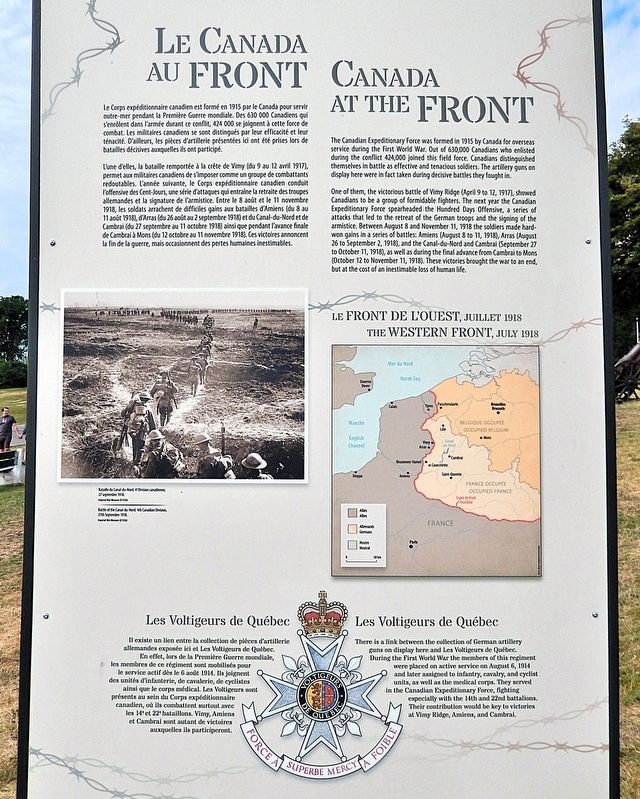
Le Canada au Front
⎯⎯⎯
Canada at the Front
Photographed by Cosmos Mariner, August 3, 2019
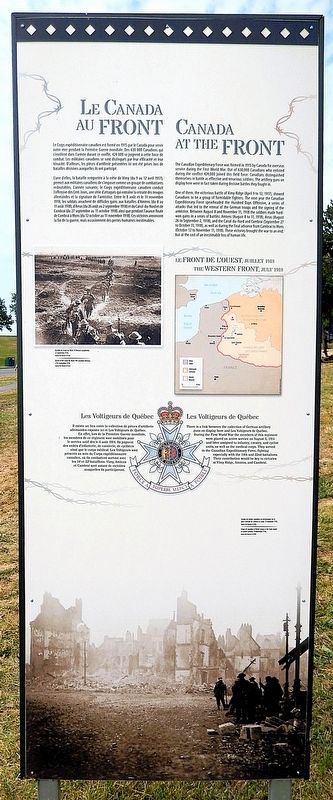
1. Le Canada au Front / Canada at the Front Marker

L'une d'elles, la bataille remportée à la crête de Vimy (du 9 au 12 avril 1917), permet aux militaires canadiens de s'imposer comme un groupe de combattants redoutables. L'année suivante, le Corps expéditionnaire canadien conduit l'offensive des Cent-Jours, une série d'attaques qui entraîne la retraite des troupes allemandes et la signature de l'armistice. Entre le 8 août et le 11 novembre 1918, les soldats arrachent de difficiles gains aux batailles d'Amiens (du 8 au 11 août 1918), d'Arras (du 26 août au 2 septembre 1918) et du Canal-du-Nord et de Cambrai (du 27 septembre au 11 octobre 1918) ainsi que pendant l'avance finale de Cambrai à Mons (du 12 octobre au 11
this page online
Les Voltigeurs de Québec
Il existe un lien entre la collection de pièces d'artillerie allemandes exposée ici et Les Voltigeurs de Québec. En effet, lors de la Première Guerre mondiale, les membres de ce régiment sont mobilisés pour le service actif dès le G août 1914. Ils joignent des unités d'infanterie, de cavalerie, de cyclistes ainsi que le corps médical. Les Voltigeurs sont présents au sein du Corps expéditionnaire canadien, où ils combattent surtout avec les I4e et 22e bataillons. Vimy, Amiens et Cambrai sont autant de victoires auxquelles ils participeront.
One of them, the victorious battle of Vimy Ridge (April 9 to 12, 1917), showed
Courtesy Imperial War Museum (Q 9326)
2. Marker detail: Le Bataille du Canal-du-Nord
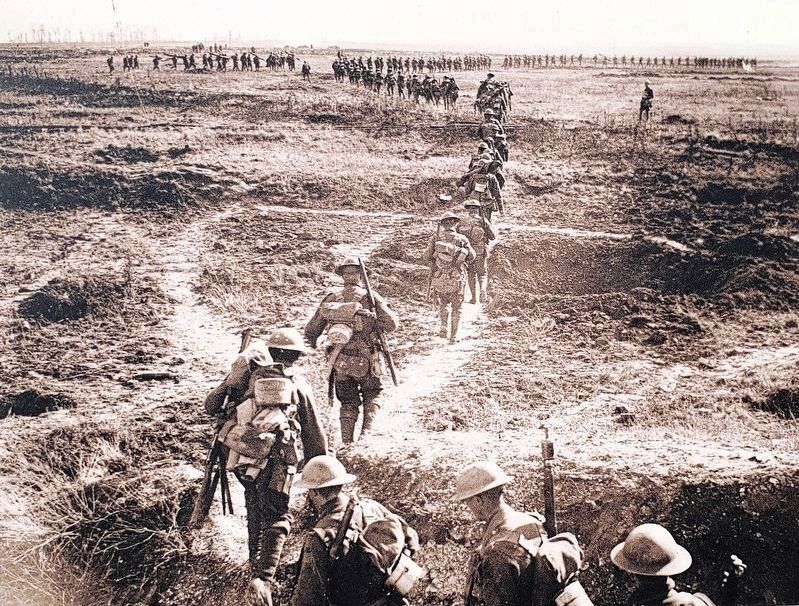
4e Division canadienne, 27 septembre 1918. • • • Battle of the Canal-du-Nord
4th Canadian Division, 27th September 1918.
4th Canadian Division, 27th September 1918.
Les Voltigeurs de Québec
There is a link between the collection of German artillery guns on display here and Les Voltigeurs de Québec. During the First World War the members of this regiment were placed on active service on August 6, 1914 and later assigned to infantry, cavalry, and cyclist units, as well as the medical corps. They served in the Canadian Expeditionary Force, fighting especially with the 14th and 22nd battalions. Their contribution would be key to victories at Vimy Ridge,
Courtesy Musée Le Régiment de la Chaudière
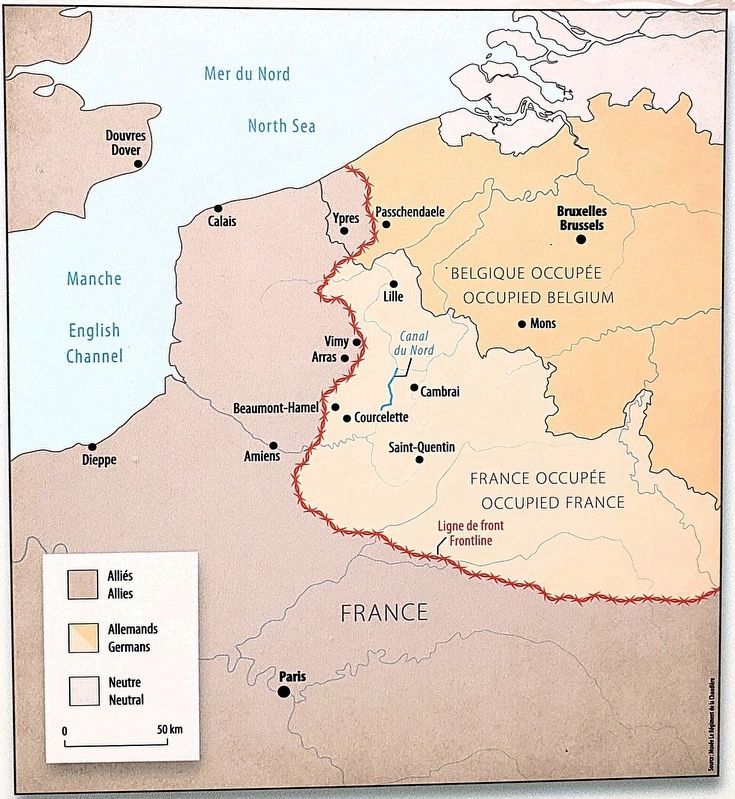
3. Marker detail: Le front de l’ouest, juillet 1918
The Western Front, July 1918
Erected by Commission des champs de bataille nationaux / The National Battlefields Commission.
Topics. This historical marker is listed in this topic list: War, World I. A significant historical date for this entry is August 6, 1914.
Location. 46° 48.341′ N, 71° 12.801′ W. Marker is in Québec, in Capitale-Nationale. It is in Vieux-Québec-Cap-Blanc-colline Parlementaire. It is on George VI Avenue just west of Avenue Ontario, on the right when traveling west. The marker is located at the front of the historical cannon exhibit in Battlefields Park, on the south side of the Voltigeurs de Québec Armoury. Touch for map. Marker is at or near this postal address: 805 Avenue Wilfrid-Laurier, Québec G1R 2L3, Canada. Touch for directions.

Regionally, this marker is in Central Canada. Globally, it is in North America, the Western Hemisphere, and the Western World. Historically, it finds itself in what was once a British colony, the Viceroyalty of New France, the Haudenosaunee (Iroquois) Confederacy, and Rupert’s Land.
Other nearby markers. At least 8 other markers are within walking distance of this marker: Souvenirs de Guerre / Memories of War
Courtesy Imperial War Museum (Q 78789)
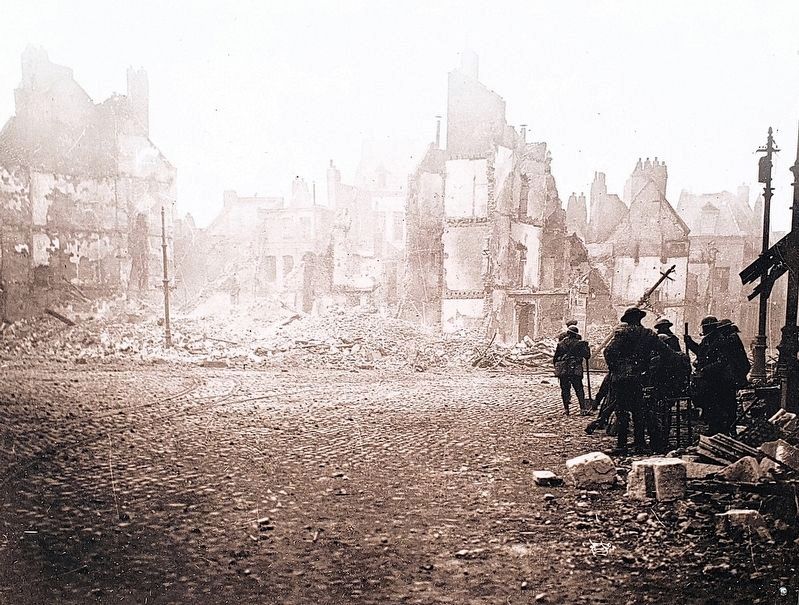
4. Marker detail: Cambrai en ruine
Groupe de soldats canadiens ou britanniques sur la place centrale de Cambrai en ruine, 10 novembre 1918. • • • Group of Canadian or British troops in the main square of ruined Cambrai, 10 November 1918.
Related markers. Click here for a list of markers that are related to this marker. World War I German Cannon Exhibit
Photographed by Cosmos Mariner, August 3, 2019
5. Le Canada au Front / Canada at the Front Marker
Photographed by Cosmos Mariner, August 3, 2019
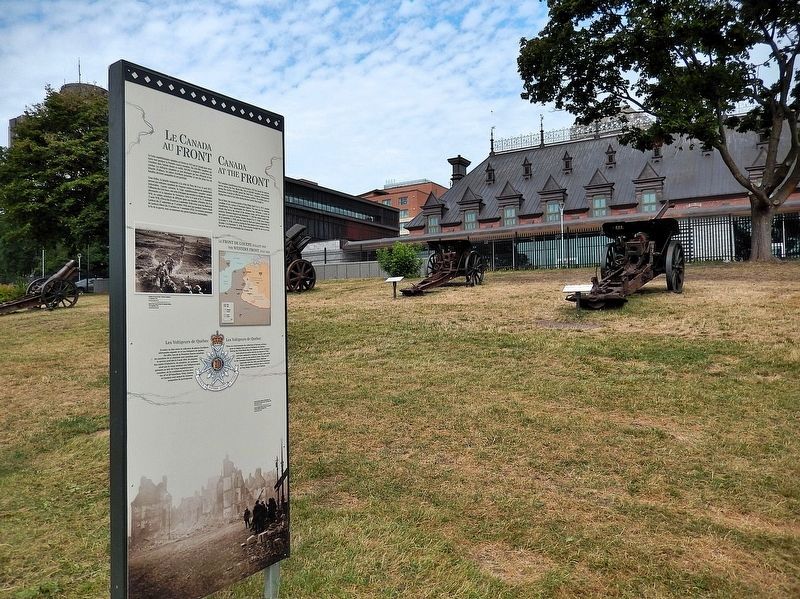
6. Le Canada au Front / Canada at the Front Marker
Looking northwest; captured World War I German cannons and the Voltigeurs de Québec Armoury are in the background.
Credits. This page was last revised on April 17, 2025. It was originally submitted on April 17, 2025, by Cosmos Mariner of Cape Canaveral, Florida. This page has been viewed 112 times since then and 21 times this year. Photos: 1, 2, 3, 4, 5, 6. submitted on April 17, 2025, by Cosmos Mariner of Cape Canaveral, Florida.
