Alexandria in Fairfax County, Virginia — The American South (Mid-Atlantic)
In Support of American Defense
George Washington Memorial Parkway
| — | National Park Service, U.S. Department of the Interior | — |
Photographed by Craig Swain, March 26, 2011
1. In Support of American Defense Marker
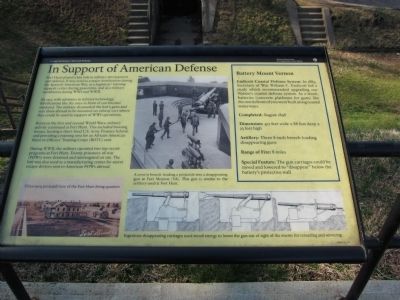
Fort Hunt played a key role in military development and defense. It was used as a major fortification during the Spanish-American War, as a logistical/training support center during peacetime, and as a military installation during WWI and WWII.
By 1917, with advances in military technology, fortifications like the ones in front of you became outdated. The military dismantled the fort's guns and sent them abroad to be mounted on railway cars where they could be used in support of WWI operations.
Between the first and second World Wars, military activity continued at Fort Hunt. This included housing troops, hosting a short-lived U.S. Army Finance School, and providing a training area for an African-American Reserve Officers' Training Corps (ROTC) unit.
During WWII, the military operated two top-secret programs at Fort Hunt. Enemy prisoners-of-war (POWs) were detained and interrogated on site. The fort was also used as a manufacturing center for secret escape devices sent to American POWs abroad.
Battery Mount Vernon
Endicott Coastal Defense System: In 1885, Secretary of War William C. Endicott led a study which
this page online
Completed: August 1898
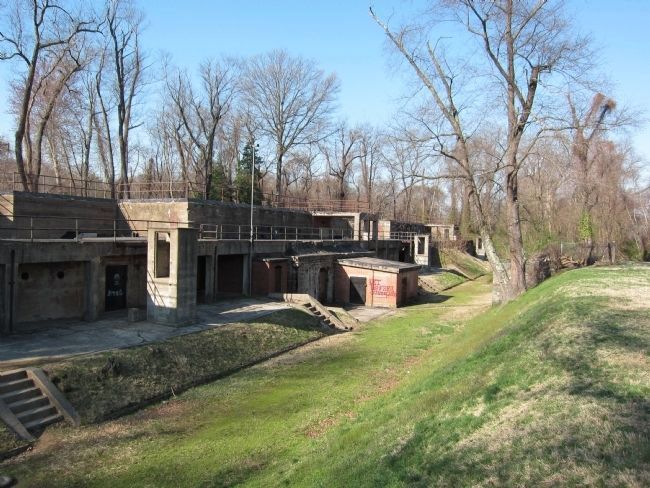
Dimension: 417 feet wide x 88 feet deep x 23 feet high
Artillery: Three 8-inch breech-loading disappearing guns
Range of Fire: 8 miles
Special Features: The gun carriages could be raised and lowered to "disappear" below the battery's protective wall.
(captions)
Circa 1909 postcard view of the Fort Hunt living quarters
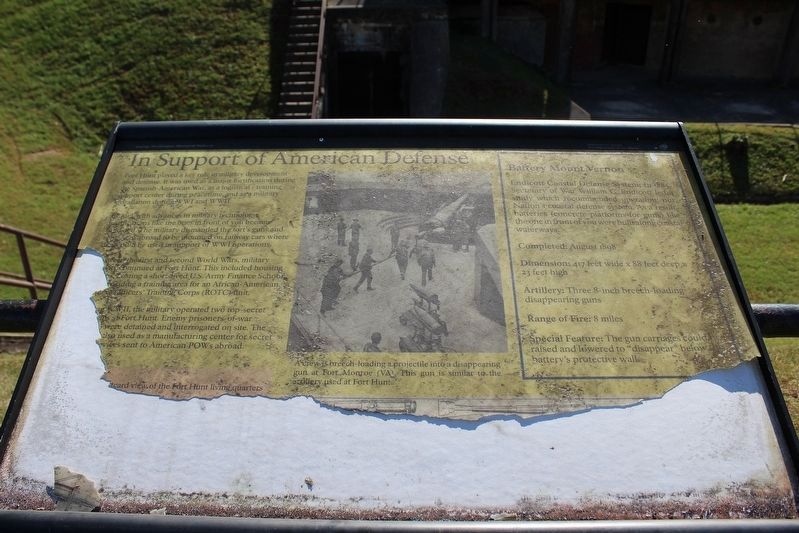
A crew is breech-loading a projectile into a disappearing gun at Fort Monroe (VA). This gun is similar to the artillery used at Fort Hunt.
Ingenious disappearing carriages used recoil energy to lower the gun out of sight of the enemy for reloading and servicing.
Erected by National Park Service, U.S. Department of the Interior.
Topics. This historical marker is listed in these topic lists: African Americans • War, Spanish-American • War, World I • War, World II. A significant historical year for this entry is 1917.
Location. 38° 42.912′ N, 77° 3.087′ W. Marker has been reported damaged. Marker
Photographed by Craig Swain, March 26, 2011
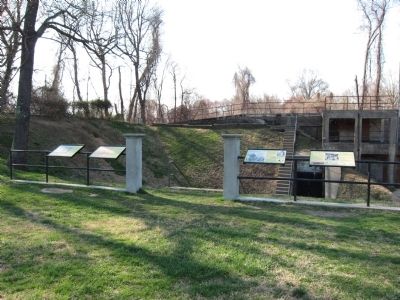
2. Markers in Front of Battery Mount Vernon

Regionally, this marker is in the Washington Metropolitan Area and in Northern Virginia. It is also in the American South, specifically in the Upper South, in the Mid-Atlantic, and on the Eastern Seaboard. Globally, it is in the North Atlantic Region, North America, the Western Hemisphere, the Western World, and the Anglosphere. Historically, it finds itself in what was once the territory of the Mississippian Culture, one of the original Thirteen Colonies, one of the Confederate States of America, and the Antebellum South.
Other nearby markers. At least 8 other markers are within walking distance of this location: Civilian Conservation Corps (here, next to this marker); People and the Land (here,
Photographed by Craig Swain, March 26, 2011
3. Battery Mount Vernon
Also see . . . Plan Your Visit - Fort Hunt Park. National Park Service (Submitted on April 24, 2025.)
Photographed by Evan Dwyer, October 19, 2024
4. In Support of American Defense Marker
As of 2024 this marker is in poor condition and missing 1/3 of its readable area.
Credits. This page was last revised on April 24, 2025. It was originally submitted on March 27, 2011, by Craig Swain of Leesburg, Virginia. This page has been viewed 847 times since then and 23 times this year. Last updated on April 18, 2025, by Evan Dwyer of Richmond, Virginia. Photos: 1. submitted on March 27, 2011, by Craig Swain of Leesburg, Virginia. 2, 3. submitted on June 5, 2011, by Craig Swain of Leesburg, Virginia. 4. submitted on April 18, 2025, by Evan Dwyer of Richmond, Virginia. • Bernard Fisher was the editor who published this page.
