
Alexandria in Fairfax County, Virginia — The American South (Mid-Atlantic)
Beyond What You See Today
George Washington Memorial Parkway
| — | National Park Service, U.S. Department of the Interior | — |
Photographed by Craig Swain, March 26, 2011
1. Beyond What You See Today Marker
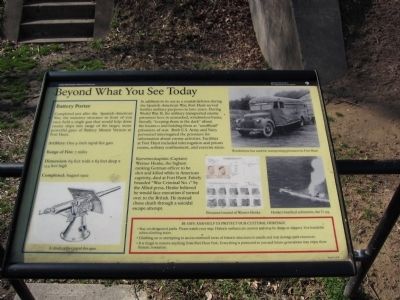
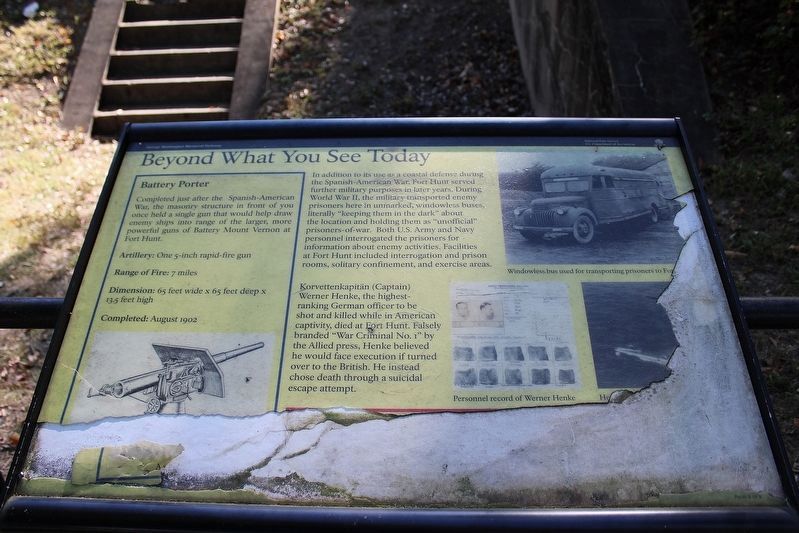
In addition to its use as a coastal defense during the Spanish-American War, Fort Hunt served further military purposes in later years. During World War II, the military transported enemy prisoners here in unmarked, windowless buses, literally "keeping them in the dark" about the location and holding them as "unofficial" prisoners-of-war. Both U.S. Army and Navy personnel interrogated the prisoners for information about enemy activities. Facilities at Fort Hunt included interrogation and prison rooms, solitary confinement, and exercise areas.
Korvettenkaptan (Captain) Werner Henke, the highest-ranking German officer to be shot and killed while in American captivity, died at Fort Hunt. Falsely branded "War Criminal No. 1" by the Allied pres, Henke believed he would face execution if turned over to the British. He instead chose death through a suicidal escape attempt.
Battery Porter
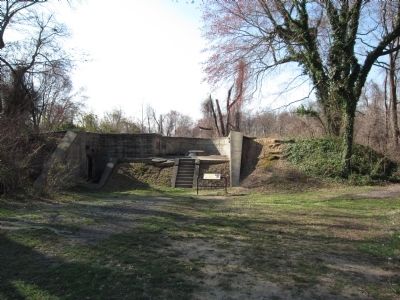
Completed just after the Spanish-American War, the masonry structure in front of you once held a single gun that would help draw enemy ships into range of the larger, more powerful guns of Battery Mount Vernon at Fort Hunt.
Artillery:
this page online
Range of Fire: 7 miles
Dimension: 65 feet wide x 65 feet deep x 13.5 feet high
Completed: August 1902
(captions)
A small caliber rapid-fire gun
Windowless bus used for transporting prisoners in Fort Hunt
Personnel record of Werner Henke
Henke's bombed submarine, the U-515
• Stay on designated paths. Please watch your step. Historic surfaces are uneven and may be damp or slippery. Use handrails when climbing stairs.
• Climbing on or attempting to access restricted areas of historic structures is unsafe and may damage park resources.
• It is illegal to remove anything from Fort Hunt Park. Everything is protected so you and future generations may enjoy these historic resources.
Erected by National Park Service, U.S. Department of the Interior.
Topics. This historical marker is listed in these topic lists: War, Spanish-American • War, World II. A significant historical year for this entry is 1902.
Location. 38° 42.904′ N, 77° 3.049′ W. Marker has been reported damaged. Marker is in Alexandria, Virginia, in Fairfax County. It is on Fort
Photographed by Craig Swain, March 26, 2011
2. Battery Porter and Marker

Regionally, this marker is in the Washington Metropolitan Area and in Northern Virginia. It is also in the American South, specifically in the Upper South, and in the Mid-Atlantic. Globally, it is in the North Atlantic Region, North America, the Western Hemisphere, the Western World, and the Anglosphere. Historically, it finds itself in what was once the territory of the Mississippian Culture, one of the original Thirteen Colonies, one of the Confederate States of America, and the Antebellum South.
Other nearby markers. At least 8 other markers are within walking distance of this location: Fort Hunt Park (within shouting distance of this marker); Battery Mount Vernon (within shouting distance of this marker); People and the Land (within shouting distance of
Photographed by Craig Swain, March 26, 2011
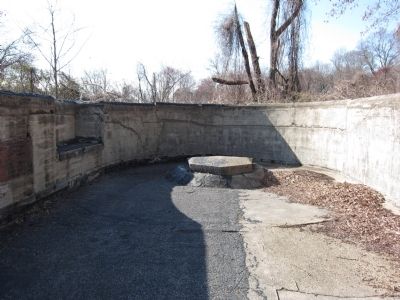
3. Gun Pedestal and Interior of Battery
Also see . . . Plan Your Visit - Fort Hunt Park. National Park Service (Submitted on June 5, 2011, by Craig Swain of Leesburg, Virginia.)
Photographed by Evan Dwyer, October 19, 2024
4. Beyond What You See Today Marker
As of 2024 this marker is missing its lower 1/4
Credits. This page was last revised on April 24, 2025. It was originally submitted on March 27, 2011, by Craig Swain of Leesburg, Virginia. This page has been viewed 1,116 times since then and 22 times this year. Last updated on April 18, 2025, by Evan Dwyer of Richmond, Virginia. Photos: 1. submitted on March 27, 2011, by Craig Swain of Leesburg, Virginia. 2, 3. submitted on June 5, 2011, by Craig Swain of Leesburg, Virginia. 4. submitted on April 18, 2025, by Evan Dwyer of Richmond, Virginia. • Bernard Fisher was the editor who published this page.
