Capital Township in Springfield in Sangamon County, Illinois — The American Midwest (Great Lakes)
Rippon-Kinsella House
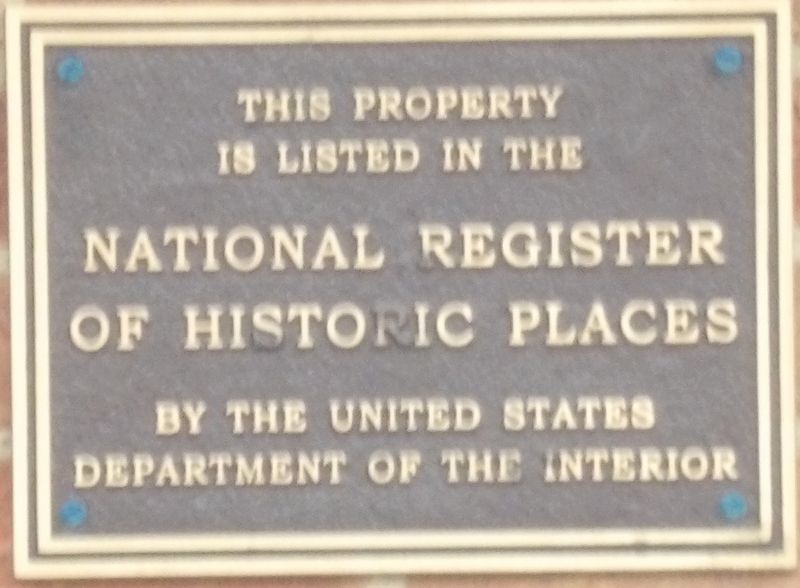
Photographed by Duane and Tracy Marsteller, April 4, 2025
1. Rippon-Kinsella House Marker
Topics and series. This historical marker is listed in these topic lists: Architecture • Government & Politics • Sports. In addition, it is included in the National Register of Historic Places (NRHP) series list. A significant historical year for this entry is 1871.
Location. 39° 49.07′ N, 89° 39.132′ W. Marker is in Springfield, Illinois, in Sangamon County. It is in Capital Township. It is on North 3rd Street south of Eastman Avenue, on the right when traveling south. Touch for map. Marker is at or near this postal address: 1317 N 3rd St, Springfield IL 62702, United States of America. Touch for directions.

Regionally, this marker is in Central Illinois. It is also in the American Midwest and in the Corn Belt. Globally, it is in North America, the Western Hemisphere, the Western World, and the Anglosphere. Historically, it finds itself in what was once the territory of the Mississippian Culture and also the Northwest Territory.
Other nearby markers. At least 8 other markers are
this page online
Other markers no longer nearby. The Lincoln Descendants (was approx. 0.4 miles away but has been confirmed missing); Some Exterior Features (was approx. 0.4 miles away but has been confirmed missing); Temporary Tombs (was approx. 0.4 miles away but has been confirmed missing); The Grave of Abraham Lincoln (was approx. 0.4 miles away but has been confirmed missing).
Regarding Rippon-Kinsella House. Excerpts from the National Register nomination:
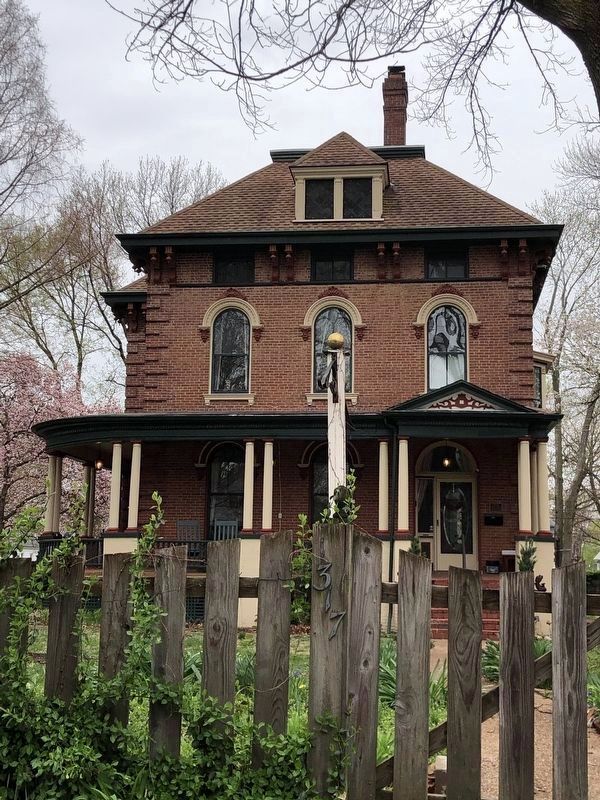
The house was constructed about 1870 in the Italianate style, probably for John Rippon, Jr., a Springfield industrialist and was extensively remodelled in the Classical Revival style by subsequentowner Richard “Dick” Kinsella circa 1905.…Photographed by Duane and Tracy Marsteller, April 5, 20252. Rippon-Kinsella House MarkerMarker is right of the door.
Rippon, who may have had the house built, was born in Connecticut and came to Springfield in 1854, eventually becoming owner of the Excelsior Machine Works and, later, Flouring Mills – two prosperous Springfield institutions. In 1891, the house was sold to Gustavus Wendlant and, later, to John Mockler, before being purchased by Richard “Dick” Kinsella in 1899.
Kinsella was a locally well-known businessman, sports promoter and political boss. Born in Springfield in 1862, he was one of several children of a laboring class Irish family. The ambitious, young Kinsella quickly found a route to financial success through contacts with other men involved in the local underworld of sports and politics. Before he was 25, he had become enough of a commodity to the Sangamon County Democratic machine to be backed by that organization in a successful bid for county office, first as a member of the Board of Supervisors and, later, as County Treasurer.…
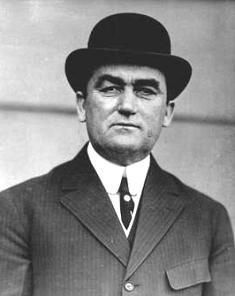
Kinsella was equally well-known as a sports promoter. For over twenty years, beginning in the 1890s, he was closely associated with the New York Giants baseballclub, serving as a talent scout and travelled the Midwest, south and southwest seeking new stars. … Kinsella also owned and operated Springfield's semi-pro Three I baseball league and developed Springfield's first baseball stadium which once stood at the southeast corner of Black Avenue and North 11th Street.via Baseball History Daily blog (Public Domain)3. Richard “Dick” Kinsella (c. 1863-1939)He was known as “Sinister Dick”, a nickname bestowed by a New York sportswriter because of his eyebrows that “looked like fright wigs.” As a baseball scout primarily for the New York Giants, Kinsella is credited with signing future Hall of Famers Frankie Frisch, Carl Hubbell, Travis Jackson, George Kelly, Freddie Lindstrom, Lewis “Hack” Wilson and Ross Youngs, most of whom played on the Giants' powerful teams in the 1910s and 1920s.
Also see . . .
1. Rippon/Kinsella House (PDF). National Register nomination form for the house, which was listed in 1992. (Prepared by Edward J. Russo, via Illinois Historic Preservation Agency; archived January 9, 2015 by Internet Archive) (Submitted on April 18, 2025, by Duane and Tracy Marsteller of Murfreesboro, Tennessee.)
2. Rippon-Kinsella House. The two-story brick home set back from the road at 1317 N. Third Street on a large wooded lot was built around 1871 in an Italianate style with narrow arched windows. Renovations in 1905 in a Classical Revival style added a new roofline to keep up with changing styles. (Laurie Paonessa, Clio: Your Guide to History, October 24, 2020) (Submitted on April 18, 2025, by Duane and Tracy Marsteller of Murfreesboro, Tennessee.)
3. Richard Kinsella (baseball scout, team owner). Richard “Sinister Dick” Kinsella (1862-1939) was a semi-pro baseball player, owner of Springfield’s Three-I League team and a well-known local politician. But he was famous nationally as the right-hand man of John J. McGraw, the Hall of Fame manager of the New York Giants from 1902 to 1932. (Sangamon County Historical Society via SangamonLink blog, Dec. 3, 2015) (Submitted on April 18, 2025, by Duane and Tracy Marsteller of Murfreesboro, Tennessee.)
Credits. This page was last revised on April 18, 2025. It was originally submitted on April 18, 2025, by Duane and Tracy Marsteller of Murfreesboro, Tennessee. This page has been viewed 107 times since then and 14 times this year. Photos: 1, 2, 3. submitted on April 18, 2025, by Duane and Tracy Marsteller of Murfreesboro, Tennessee.
