Douglas in Chicago in Cook County, Illinois — The American Midwest (Great Lakes)
Bronzeville
Photographed by Sean P. Flynn, April 14, 2025
1. Bronzeville Marker
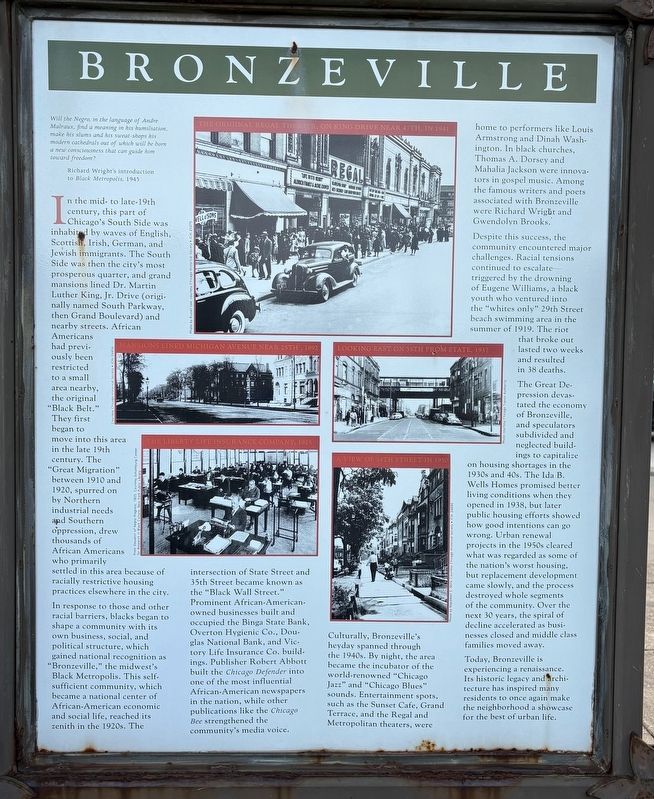
Will the Negro, in the language of Andre Malraux, find a meaning in his humiliation, make his slums and his sweat-shops his modern cathedrals out of which will be born a new consciousness that can guide him toward freedom?
Richard Wright's introduction to Black Metropolis, 1945
In the mid- to late-19th century, this part of Chicago's South Side was inhabited by waves of English, Scottish, Irish, German, and Jewish immigrants. The South Side was then the city's most prosperous quarter, and grand mansions lined Dr. Martin Luther King, Jr. Drive (originally named South Parkway, then Grand Boulevard) and nearby streets. African Americans had previously been restricted to a small area nearby, the original "Black Belt." They first began to move into this area in the late 19th century. The "Great Migration" between 1910 and 1920, spurred on by Northern industrial needs and Southern oppression, drew thousands of African Americans who primarily settled in this area because of racially restrictive housing practices elsewhere in the city.
In response to those and other racial barriers, blacks began to shape a community with
this page online
Culturally, Bronzeville's heyday spanned through the 1940s. By night, the area became the incubator of the world-renowned "Chicago Jazz" and "Chicago Blues" sounds. Entertainment spots, such as the Sunser Cafe, Grand Terrace, and the Regal and Metropolitan theaters, were home to performers like Louis Armstrong and Dinah Washington. In black churches, Thomas A. Dorsey and Mahalia Jackson were
Photographed by Sean P. Flynn, April 14, 2025
2. Bronzeville Marker
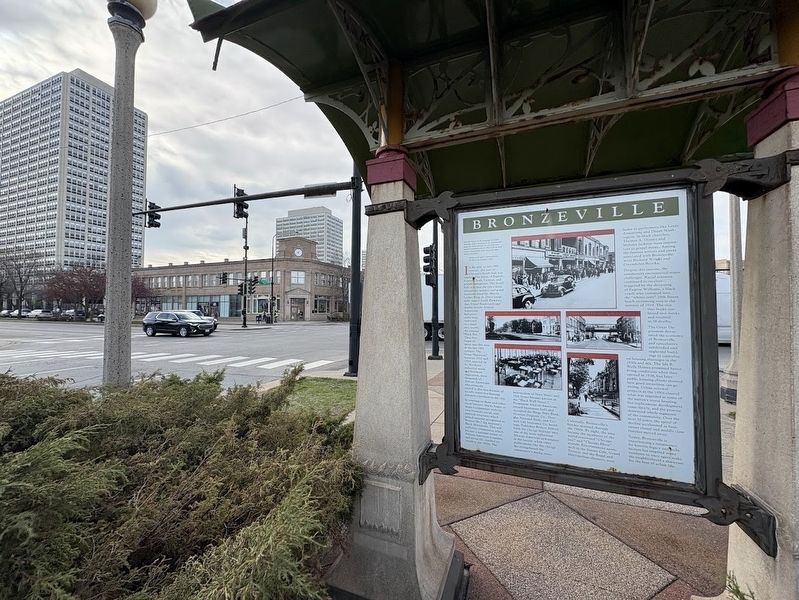
The Supreme Life Building, a Chicago Landmark buliding located on the southeast corner of 35th and MLK Drive, can be seen just to the left of the marker.
Despite this success, the community encountered major challenges. Racial tensions continued to escalate triggered by the drowning of Eugene Williams, a black youth who ventured into the "whites only" 29th Street beach swimming area in the summer of 1919. The riot that broke out lasted two weeks and resulted in 38 deaths.
The Great Depression devastated the economy of Bronzeville, and speculators subdivided and neglected buildings to capitalize on housing shortages in the 1930s and 40s. The Ida B. Wells Homes promised better living conditions when they opened in 1938, but later public housing efforts showed how good intentions can go wrong. Urban renewal projects in the 1950s cleared what was regarded as some of the nation's worst housing, but replacement development came slowly, and the process destroyed whole segments of the community. Over the next 30 years, the spiral of decline accelerated as businesses closed and middle class families moved away.
Today, Bronzeville is experiencing a renaissance.

Photographed by Sean P. Flynn, April 14, 2025
3. Bronzeville Marker
In this southwesterly facing view from the marker, two landmark buildings are visible in the distance: Sunset Cafe (the white building in the distance behind the gas station) and the 8th Regiment Armory.
Erected 1995 by City of Chicago.
Topics. This historical marker is listed in these topic lists: African Americans • Arts, Letters, Music • Entertainment • Industry & Commerce. A significant historical year for this entry is 1945.
Location. 41° 49.881′ N, 87° 37.029′ W. Marker is in Chicago, Illinois, in Cook County. It is in Douglas. It is at the intersection of South Martin Luther King Jr. Drive and 35th Street, in the median on South Martin Luther King Jr. Drive. Touch for map. Marker is in this post office area: Chicago IL 60616, United States of America. Touch for directions.

Regionally, this marker is on Chicago’s South Side and in Chicago’s Bronzeville. It is also in the American Midwest. Globally, it is in North America, on the Great Lakes, in the Western Hemisphere, in the Western World, and in the Anglosphere. Historically, it finds itself in what was once the Viceroyalty of New France, the territory of the Mississippian Culture, and the Northwest Territory.

Photographed by Sean P. Flynn, April 14, 2025
4. Bronzeville
The marker is on the rear side of the kiosk in the background of this photo. The visible front marker is about Chicago's boulevard system.
Other nearby markers. At least 8 other markers are within walking distance of this marker: The Boulevard System (here, next to this marker); a different marker also named Bronzeville (a few steps from this marker); Earl B. Dickerson (within shouting distance of this marker); Gwendolyn Brooks (within shouting distance of this marker); Col. Franklin A. Denison (within shouting distance of this marker); Frank Gillespie (within shouting distance of this marker); Earl “Fatha” Hines (within shouting distance of this marker); Lt. George Giles (within shouting distance of this marker). Touch for a list and map of all markers in Chicago.
More about this marker. A historical marker about Chicago's boulevard system is on the other side of this marker, facing south. These kiosks with two-sided markers, believed to have been erected in 1995, can be found across the city along its grand boulevards.
Also see . . . History of Bronzeville. From the Illinois Institute of Technology, located about three blocks from this marker. (Submitted on April 19, 2025, by Sean P. Flynn of Oak Park, Illinois.)
Credits. This page was last revised on April 19, 2025. It was originally submitted on April 19, 2025, by Sean P. Flynn of Oak Park, Illinois. This page has been viewed 430 times since then and 108 times this year. Photos: 1, 2, 3, 4. submitted on April 19, 2025, by Sean P. Flynn of Oak Park, Illinois.
