Bluff in San Juan County, Utah — The American Mountains (Southwest)
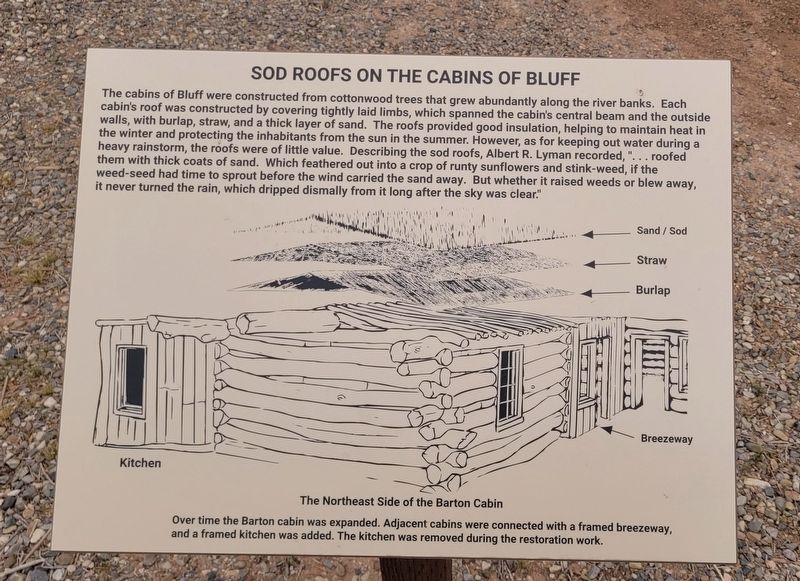
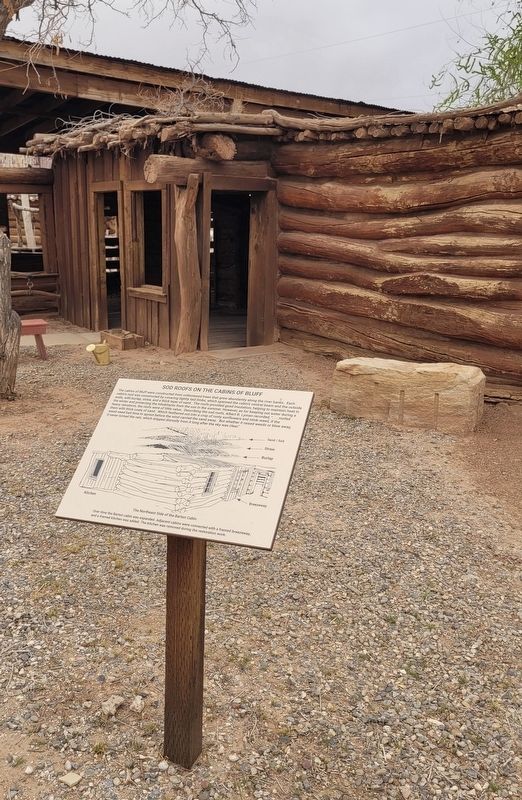
Sod Roofs on the Cabins of Bluff
Photographed by James Hulse, March 28, 2025
1. Sod Roofs on the Cabins of Bluff Marker
The Northeast Side of the Barton Cabin
Over time the Barton cabin was expanded. Adjacent cabins were connected with a framed breezeway, and a framed kitchen was added. The kitchen was removed during the restoration work.
Topics. This historical marker is
this page online
Location. 37° 17.019′ N, 109° 33.196′ W. Marker is in Bluff, Utah, in San Juan County. It is at the intersection of Black Locust Avenue and 5th E Street on Black Locust Avenue. The marker is located at the Bluff Fort Historic Site. Touch for map. Marker is at or near this postal address: 550 Black Locust Ave, Bluff UT 84512, United States of America. Touch for directions.

Regionally, this marker is in the Navajo Nation and in Canyon Country. It is also in the American Mountain West, on the Colorado Plateau, and at the Four Corners. Globally, it is in North America, the Western Hemisphere, the Western World, and the Anglosphere. Historically, it finds itself in what was once New Spain, the territory of the Ancestral Puebloans, and Mexico’s Alta California.

Other nearby markers. At least 8 other markers are within walking distance of this marker: Barton Family (here, next to this marker); The Barton Cabin/West Wall of the Bluff Fort (a few steps from this marker); The Barton's Well (a few steps from this marker); Kumen Jones Home
Photographed by James Hulse, March 28, 2025
2. Sod Roofs on the Cabins of Bluff Marker
Also see . . . Bluff Fort Visitor Center. Hole in the Rock Foundation website entry (Submitted on April 21, 2025, by James Hulse of Medina, Texas.)
Photographed by James Hulse, March 28, 2025
3. Sod Roofs on the Cabins of Bluff Marker
Credits. This page was last revised on June 23, 2025. It was originally submitted on April 20, 2025, by James Hulse of Medina, Texas. This page has been viewed 133 times since then and 15 times this year. Photos: 1, 2, 3. submitted on April 22, 2025, by James Hulse of Medina, Texas.
