Bluff in San Juan County, Utah — The American Mountains (Southwest)
Farming Implements Used by the Settlers of Bluff
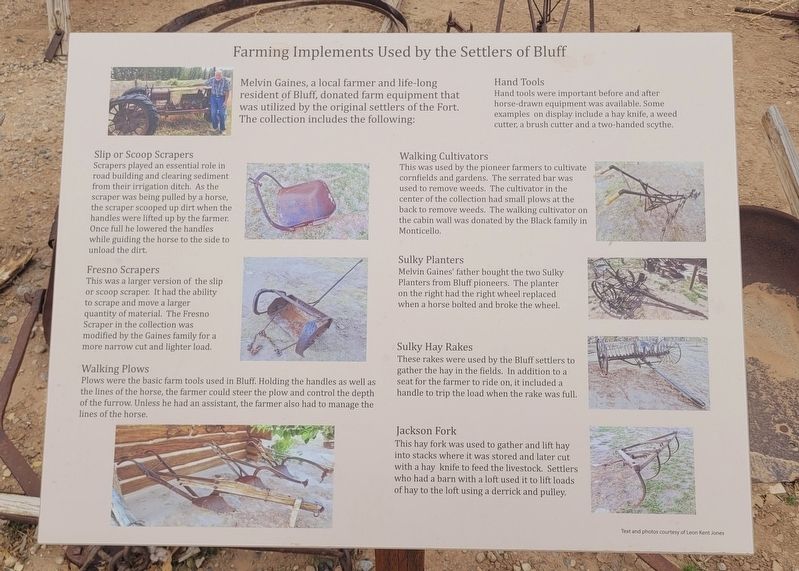
Photographed by James Hulse, March 28, 2025
1. Farming Implements Used by the Settlers of Bluff Marker
The collection includes the following:
Slip or Scoop Scrapers
Scrapers played an essential role in road building and clearing sediment from their irrigation ditch. As the scraper was being pulled by a horse, the scraper scooped up dirt when the handles were lifted up by the farmer. Once full he lowered the handles while guiding the horse to the side to unload the dirt.
Fresno Scrapers
This was a larger version of the slip or scoop scraper. It had the ability to scrape and move a larger quantity of material. The Fresno Scraper in the collection was modified by the Gaines family for a more narrow cut and lighter load.
Walking Plows
Plows were the basic farm tools used in Bluff. Holding the handles as well as the lines of the horse, the farmer could steer the plow and control the depth of the furrow. Unless he had an assistant, the farmer also had to manage the lines of the horse.
Hand Tools
Hand tools were important before and after horse-drawn equipment was available.
this page online
Walking Cultivators
This was used by the pioneer farmers to cultivate cornfields and gardens. The serrated bar was used to remove weeds. The cultivator in the center of the collection had small plows at the back to remove weeds. The walking cultivator on the cabin wall was donated by the Black family in Monticello.
Sulky Planters
Melvin Gaines' father bought the two Sulky Planters from Bluff pioneers. The planter on the right had the right wheel replaced when a horse bolted and broke the wheel.
Sulky Hay Rakes
These rakes were used by the Bluff settlers to gather the hay in the fields. In addition to a seat for the farmer to ride on, it included a handle to trip the load when the rake was full.
Jackson Fork
This hay fork was used to gather and lift hay into stacks where it was stored and later cut with a hay knife to feed the livestock. Settlers who had a barn with a loft used it to lift loads of hay to the loft using a derrick and pulley.
Text and photos courtesy of Leon Kent Jones
Topics. This historical marker
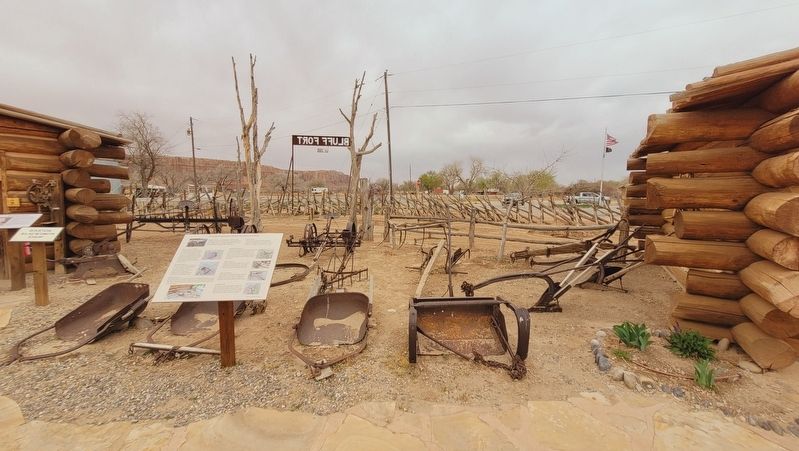
Photographed by James Hulse, March 28, 2025
2. Farming Implements Used by the Settlers of Bluff and Marker
Location. 37° 16.998′ N, 109° 33.198′ W. Marker is in Bluff, Utah, in San Juan County. It is at the intersection of Black Locust Avenue and 5th E Street on Black Locust Avenue. The marker is located at the Bluff Fort Historic Site. Touch for map. Marker is at or near this postal address: 550 Black Locust Ave, Bluff UT 84512, United States of America. Touch for directions.

Regionally, this marker is in the Navajo Nation and in Canyon Country. It is also in the American Mountain West, on the Colorado Plateau, and at the Four Corners. Globally, it is in North America, the Western Hemisphere, the Western World, and the Anglosphere. Historically, it finds itself in what was once New Spain, the territory of the Ancestral Puebloans, and Mexico’s Alta California.

Other nearby markers. At least 8 other markers are within walking distance of this marker: Amasa Barton's Blacksmith Shop (here, next to this marker); George Brigham Hobbs & Sisters (a few steps from this marker); The Barton's Well (a few steps from this marker); The Barton Cabin/West Wall of the Bluff Fort
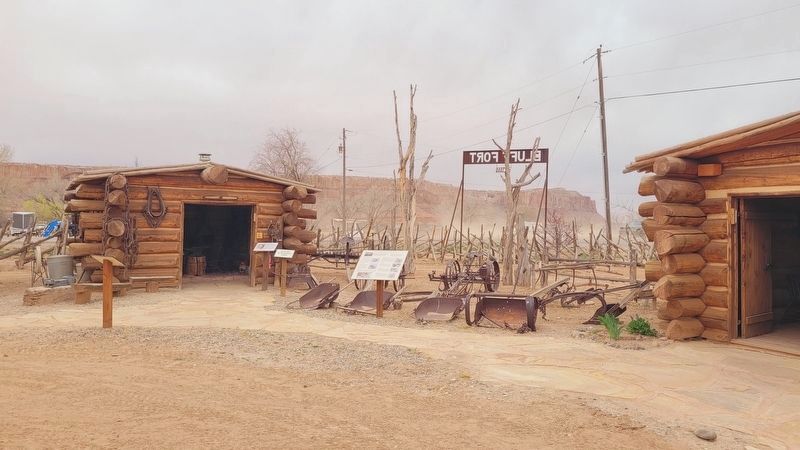
Photographed by James Hulse, March 28, 2025
3. The view of the marker from the walkway
Also see . . . Bluff Fort Visitor Center. Hole in the Rock Foundation website entry (Submitted on April 21, 2025, by James Hulse of Medina, Texas.)
Credits. This page was last revised on June 23, 2025. It was originally submitted on April 20, 2025, by James Hulse of Medina, Texas. This page has been viewed 112 times since then and 15 times this year. Photos: 1, 2, 3. submitted on April 22, 2025, by James Hulse of Medina, Texas.
