
Old Aristocracy Hill in Springfield in Sangamon County, Illinois — The American Midwest (Great Lakes)
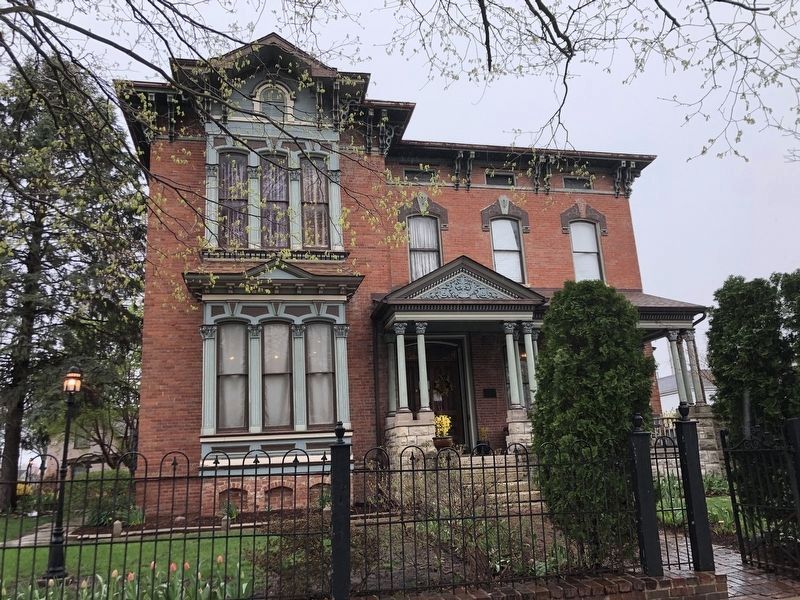
Howard K. Weber House

Photographed by Duane and Tracy Marsteller, April 4, 2025
1. Howard K. Weber House Marker
Topics and series. This historical marker is listed in this topic list: Architecture. In addition, it is included in the National Register of Historic Places (NRHP) series list. A significant historical year for this entry is 1878.
Location. 39° 47.514′ N, 89° 38.817′ W. Marker is in Springfield, Illinois, in Sangamon County. It is in Old Aristocracy Hill. It is at the intersection of South 7th Street and Clay Street, on the right when traveling south on South 7th Street. Seventh Street is one-way southbound on this block. Touch for map. Marker is at or near this postal address: 925 S 7th St, Springfield IL 62703, United States of America. Touch for directions.

Regionally, this marker is in Central Illinois. It is also in the American Midwest and in the Corn Belt. Globally, it is in North America, the Western Hemisphere, the Western World, and the Anglosphere. Historically, it finds itself in what was once the territory of the Mississippian Culture and also the Northwest Territory.
Other nearby markers. At
this page online
Regarding Howard K. Weber House. Excerpts from the National Register nomination:
Weber was born in Maryland and was attending Dickinson College in Pennsylvania when the Civil War broke out. He attempted to join the Confederate Army but was persuaded by his father to visit Springfield relatives. Here he became converted to the Northern cause and was appointed a Commissary Sergeant at the local prisoner-of-war camp — Camp Butler. In the post-Civil War era he became President of one of the town's largest banks, the First National Bank. Springfield profited heavily from the wartime economy and experienced tremendous growth in the late 19th century. Weber'scareer and house reflect those times perfectly.Photographed by Duane and Tracy Marsteller, April 5, 20252. Howard K. Weber House MarkerMarker is right of the front door.
He purchased this house in 1878 when it was still a simple two-story brick, broadside house. As he prospered he began a series of extensive alterations which make the house a composite of the taste and aspirations of local citizens during the years from the Civil War to World War I.
Also see . . .
1. Howard K. Weber House (PDF). National Register nomination for the house, which was listed in 1979. (Prepared by Nanchen Frank and Michael Scully; via National Archives) (Submitted on April 22, 2025, by Duane and Tracy Marsteller of Murfreesboro, Tennessee.)
2. Howard K. Weber House. The historic brick mansion was constructed around the 1840s and added onto in the 1870s or 1880s by a new owner, Howard K. Weber. The two-story, L-shaped house became an Italianate-style mansion for the local bank cashier and his family in the Aristocracy Hill neighborhood for nearly a century; he later became president of First National Bank. (Laurie Paonessa, Clio: Your Guide to History, Dec. 13, 2023) (Submitted on April 22, 2025, by Duane and Tracy Marsteller of Murfreesboro, Tennessee.)
Credits. This page was last revised on April 22, 2025. It was originally submitted on April 22, 2025, by Duane and Tracy Marsteller of Murfreesboro, Tennessee. This page has been viewed 171 times since then and 51 times this year. Photos: 1, 2. submitted on April 22, 2025, by Duane and Tracy Marsteller of Murfreesboro, Tennessee.
