Latin Quarter in Galway in County Galway, Connacht, Ireland — Irish West ((Éire) North Atlantic Ocean)
Lavender • Labhandar • Lavandula
Photographed by William Fischer, Jr., April 7, 2025
1. Lavender • Labhandar • Lavandula Marker
Inscription.
Lavender . . This historical marker was erected by Galway City Museum. It is in Latin Quarter in Galway in County Galway Connacht Ireland
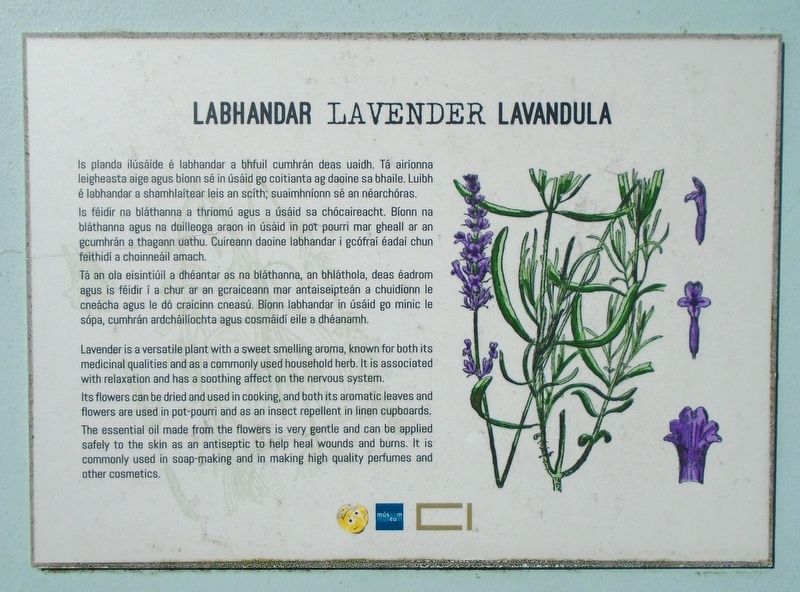
Labhandar . Is planda ilúsáide é labhandar a bhfuil cumhrán deas uaidh. Tá airíonna leigheasta aige agus bíonn sé in úsáid go coitianta ag daoine sa bhaile. Luibh é labhandar a shamhlaitear leis an scith; suaimhníonn sé an néarchóras., Is féidir na bláthanna a thriomú agus a úsáid sa chócaireacht. Bíonn na bláthanna agus na duilleoga araon in úsáid in pot pourri mar gheall ar an gcumhrán a thagann uathu. Cuireann daoine labhandar i gcófraí éadaí chun feithidí a choinneáil amach., Tá an ola eisintiúil a dhéantar as na bláthanna, an bhláthola, deas éadrom agus is féidir í a chur ar an gcraiceann mar antaiseipteán a chuidíonn le cneácha agus le dó craicinn cneasú. Bíonn labhandar in úsáid go minic le sópa, cumhrán ardcháilíochta agus cosmáidí eile a dhéanamh.
Lavandula. . , Lavender is a versatile plant with a sweet smelling aroma, known for both its medicinal qualities and as a commonly used household herb. It is associated with relaxation and has a soothing affect on the nervous system., Its flowers can be dried and used in cooking, and both its aromatic leaves and flowers are used in pot-pourri and as an insect repellent in linen cupboards., The essential oil made from the flowers is very gentle and can be applied safely to the skin as an antiseptic to help heal wounds and burns. It is commonly used in soap-making and in making high quality perfumes and other cosmetics. ,
, , , , , , , , , , , , , , .
Lavender is a versatile plant with a sweet smelling aroma, known for both its
medicinal qualities and as a commonly used household herb. It is associated
with relaxation and has a soothing affect on the nervous system.
Its flowers can be dried and used in cooking, and both its aromatic leaves and
flowers are used in pot-pourri and as an insect repellent in linen cupboards.
The essential oil made from the flowers is very gentle and can be applied
safely to the skin as an antiseptic to help heal wounds and burns. It is
commonly used in soap-making and in making high quality perfumes and
other cosmetics.
——————————————
Is planda ilúsáide é labhandar a bhfuil cumhrán deas uaidh. Tá airíonna
leigheasta aige agus bíonn sé in úsáid go coitianta ag daoine sa bhaile. Luibh
é labhandar a shamhlaitear leis an scith; suaimhníonn sé an néarchóras.
Is féidir na bláthanna a thriomú agus a úsáid sa chócaireacht. Bíonn na
bláthanna agus na duilleoga araon in úsáid in pot pourri mar gheall ar an
gcumhrán a thagann uathu. Cuireann daoine labhandar i gcófraí éadaí chun
feithidí a choinneáil amach.
Tá an ola eisintiúil
Click or scan to see this page online
a dhéantar as na bláthanna, an bhláthola, deas éadrom
agus is féidir í a chur ar an gcraiceann mar antaiseipteán a chuidíonn le
cneácha agus le dó craicinn cneasú. Bíonn labhandar in úsáid go minic le
sópa, cumhrán ardcháilíochta agus cosmáidí eile a dhéanamh.
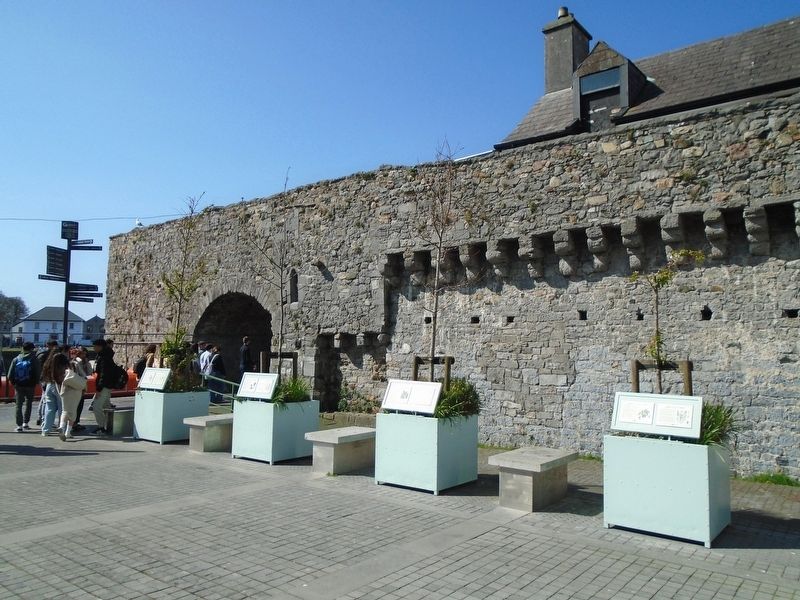
Location. 53° 16.188′ N, 9° 3.227′ W. Marker is in Galway, Connacht, in County Galway. It is in the Latin Quarter. It can be reached from The Long Walk. Marker is on the Spanish Parade plaza, between the Spanish Arch and City Museum. Touch for map. Marker is in this post office area: Galway, Connacht H91 CX5P, Ireland. Touch for directions.
Regionally, it is on the Atlantic Ocean, in the North Atlantic Region, on the Atlantic Arc, in Europe, on the Island of Ireland, on the Celtic Fringe, in the European Union, in Atlantic Europe, on one of the British Isles, in the Western World, and in the Anglosphere.
Other nearby markers. At least 8 other markers are
Photographed by William Fischer, Jr., April 7, 2025
Regarding Lavender • Labhandar • Lavandula. Although this marker has limited specific historical information, it highlights human use of the plant through history, and is part of a series of plants important in local history.
Credits. This page was last revised on December 3, 2025. It was originally submitted on April 23, 2025, by William Fischer, Jr. of Reynoldsburg, Ohio. This page has been viewed 94 times since then and 17 times this year. Photos:1, 2. submitted on April 23, 2025, by William Fischer, Jr. of Reynoldsburg, Ohio.