Montmartre in Paris in Département de Paris, Île-de-France, France — Western Europe
La Légende de saint Denis
⎯⎯⎯
The Legend of Saint Denis
| — | Histoire de Paris | — |
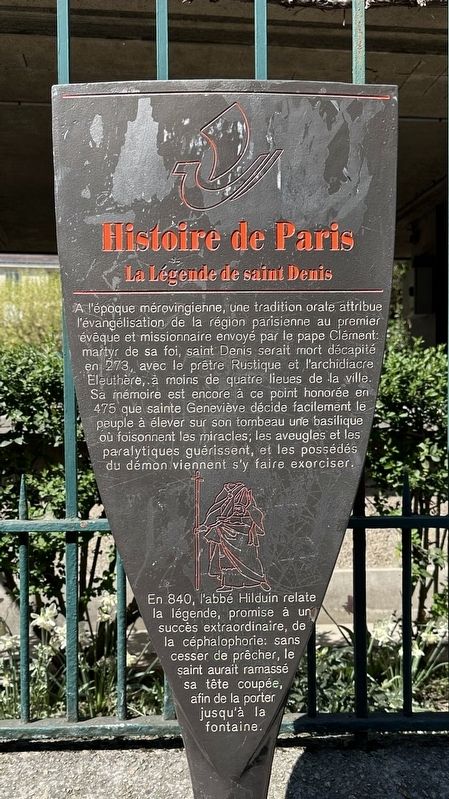
Photographed by Andrew Ruppenstein, April 11, 2025
1. La Légende de saint Denis / The Legend of Saint Denis Marker

A l'époque mérovingienne, une tradition orale attribue l'évangélisation de la région parisienne au premier évêque et missionnaire envoyé par le pape Clément: martyr de sa foi, saint Denis serait mort décapité en 273, avec le prêtre Rustique et l'archidiacre Eleuthère, à moins de quatre lieues de la ville. Sa mémoire est encore à ce point honorée en 475 que sainte Geneviève décide facilement le peuple à élever sur son tombeau une basilique où foisonnent les miracles; les aveugles et les paralytiques guérissent, et les possédés du démon viennent s'y faire exorciser. En 840, l'abbé Hilduin relate la légende, promise à un succès extraordinaire, de la céphalophorie: sans cesser de prêcher, le saint aurait ramassé sa tête coupée, afin de la porter jusqu'à la fontaine.
The Legend of Saint Denis
During the Merovingian era, an oral tradition attributes the evangelization of the Paris region to the first bishop and missionary sent by Pope Clement: a martyr for his faith, Saint Denis is said to have died beheaded in 273, along with the priest Rustique and the archdeacon Eleutherius, less than four leagues from the city. His memory was still so honored in 475 that Saint Genevieve easily persuaded the people to erect a basilica over his tomb, where miracles abounded; the blind and the paralytic were healed, and those possessed by the devil came to be exorcised. In 840, Abbot Hilduin recounted the legend of cephalophoria, which was destined for extraordinary success: without ceasing to preach, the saint is said to have picked up his severed head in order to carry it to the fountain.
Topics and series. This historical marker is listed in this topic list: Religion & Religious Structures. In addition, it is included in the Histoire de Paris series list. A significant day of the year for for this entry is October 9.
Location. 48° 53.286′ N, 2° 20.264′ E. Marker is in Paris, Île-de-France,
this page online

Regionally, it is in the North Atlantic Region, Europe, the European Union, Atlantic Europe, the Schengen Area, Western Europe, a coastal Mediterranean country, and the Western World. Historically, it finds itself in what was once a French colony and also the Roman Empire.
Other nearby markers. At least 8 other markers are within walking distance of this marker: Square Suzanne Buisson (1935) (here, next to this marker); Suzanne Buisson (here, next to this marker); Gen-Paul (within shouting distance of this marker); Le Passe-Muraille / The Man Who Could Walk Through Walls (within shouting distance of this marker); Marcel Aymé (within shouting distance of this marker); D.E. Inghelbrecht (within shouting distance of this marker); Le Château des Brouillards (within shouting distance of this marker in Ile-de-France); Jean-Pierre Aumont (within shouting distance of this marker). Touch for a list and map of all markers in Paris.
Also see . . . Denis of Paris (Wikipedia). Excerpt:
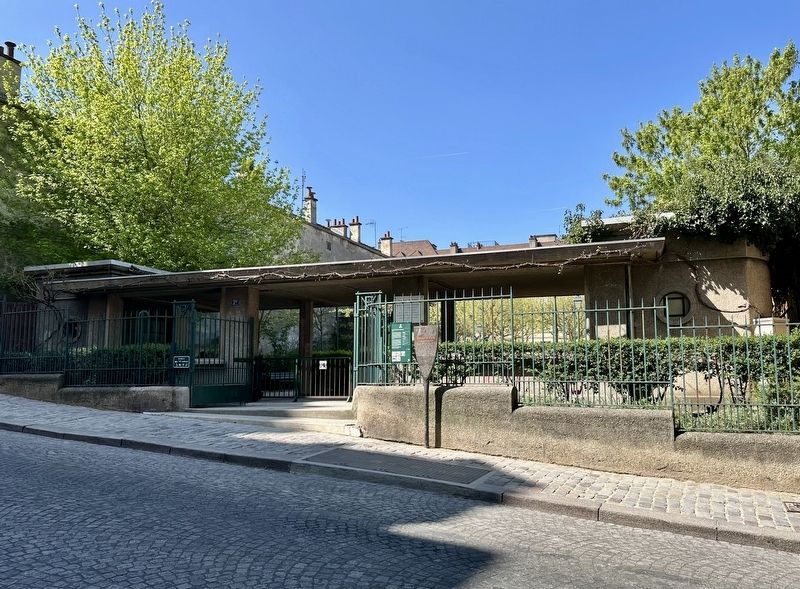
Denis of Paris (Latin:(Submitted on April 24, 2025.)Dionysius) was a 3rd-century Christian martyr and saint. According to his hagiographies, he was bishop of Paris (then Lutetia) in the third century and, together with his companions Rusticus and Eleutherius, was martyred for his faith by decapitation...Photographed by Andrew Ruppenstein, April 11, 20252. The Legend of Saint Denis Marker - wide viewThe marker is located just outside the south entrance to Square Suzanne-Buisson.
Denis is the most famous cephalophore in Christian history, with a popular story claiming that the decapitated bishop picked up his head and walked several miles while preaching a sermon on repentance. He is venerated in the Catholic Church as a patron saint of both France and Paris and is one of the Fourteen Holy Helpers. A chapel was raised at the site of his burial by a local Christian woman; it was later expanded into an abbey and basilica, around which grew up the French city of Saint-Denis, now a suburb of Paris.
Additional keywords. panneau
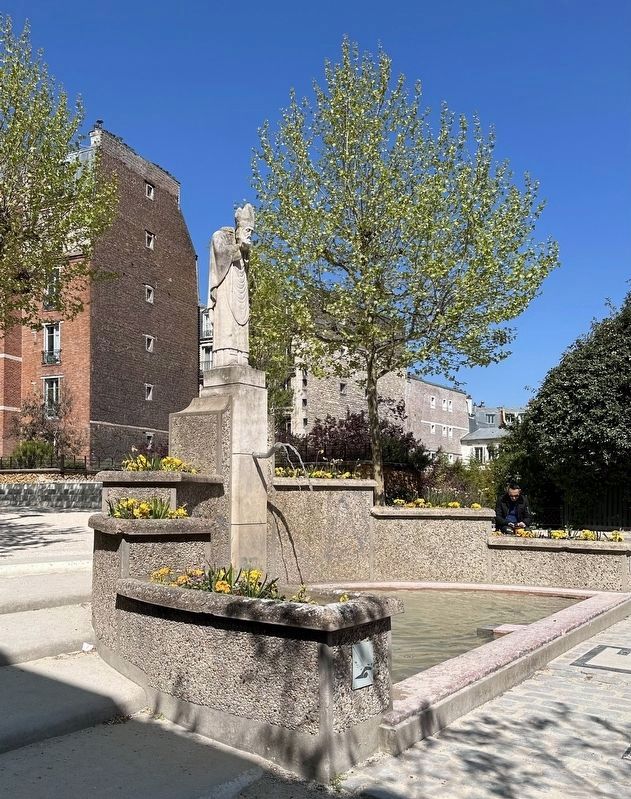
Photographed by Andrew Ruppenstein, April 11, 2025
3. Saint Denis statue and fountain
Just steps away from the marker, inside the park, is a statue of Saint Denis with fountain. This, according to legend, is about where he stopped to wash off his head, after being beheaded some 300 meters to the southeast. After washing it off, he is said to have continued on walking, preaching all the while.

Job (courtesy New York Public Library), 1896
4. Saint Denis
Saint Denis is the patron saint of France, and along with Saint Genevieve, the patron saint of Paris. His help, according to the “14 Holy Helpers” tradition, is also invoked for headaches and demonic possession.
It has been noted that artists face an odd challenge when depicting cephalophores (saints who walk around carrying their head after decapitation). That is, should the halo remain above the shoulders, where the head used to be, or should the halo accompany the head?
It has been noted that artists face an odd challenge when depicting cephalophores (saints who walk around carrying their head after decapitation). That is, should the halo remain above the shoulders, where the head used to be, or should the halo accompany the head?
Credits. This page was last revised on April 24, 2025. It was originally submitted on April 24, 2025, by Andrew Ruppenstein of Lamorinda, California. This page has been viewed 218 times since then and 72 times this year. Photos: 1, 2, 3, 4. submitted on April 24, 2025, by Andrew Ruppenstein of Lamorinda, California.
