Nelsonville in Athens County, Ohio — The American Midwest (Great Lakes)
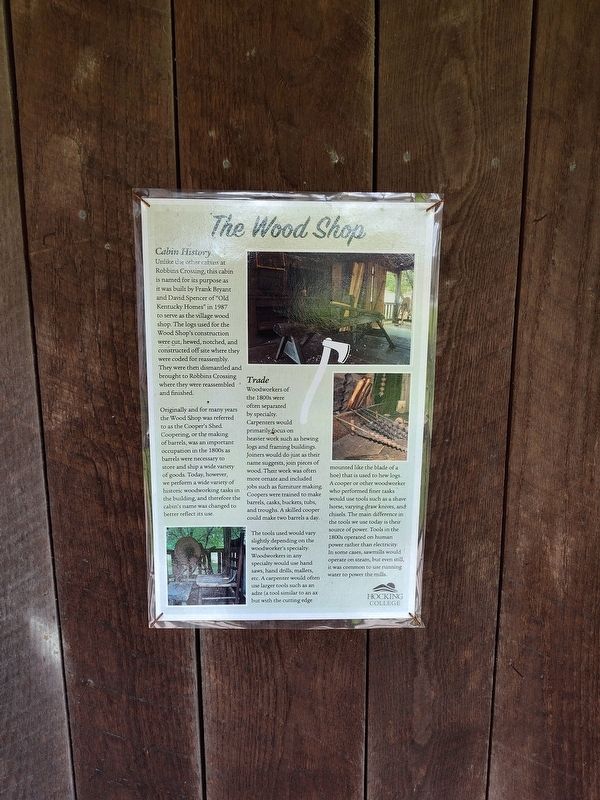
The Wood Shop
Photographed by Craig Doda, April 19, 2025
1. The Wood Shop Marker
Cabin History
Unlike the other cabins at Robbins Crossing, this cabin is named for its purpose as it was built by Frank Bryant and David Spencer of "Old Kentucky Homes" in 1987 to serve as the village wood shop. The logs used for the Wood Shop's construction were cut, hewed, notched, and constructed off site where they were coded for reassembly. They were then dismantled and brought to Robbins Crossing where they were reassembled and finished.
Originally and for many years the Wood Shop was referred to as the Cooper's Shed. Coopering, or the making of barrels, was an important occupation in the 1800s as barrels were necessary to store and ship a wide variety of goods. Today, however, we perform a wide variety of historic woodworking tasks in the building, and therefore the cabin's name was changed to better reflect its use.
Trade
Woodworkers of the 1800s were often separated by specialty. Carpenters would primarily focus on heavier work such as hewing logs and framing buildings. Joiners would do just as their name suggests, join pieces of wood. Their work was often more ornate and included jobs such as furniture making.
this page online
The tools used would vary slightly depending on the woodworker's specialty. Woodworkers in any specialty would use hand saws, hand drills, mallets, etc. A carpenter would often use larger tools such as an adze (a tool similar to an ax but with the cutting edge mounted like the blade of a hoe) that is used to hew logs. A cooper or other woodworker who performed finer tasks would use tools such as a shave horse, varying draw knives, and chisels. The main difference in the tools we use today is their source of power. Tools in the 1800s operated on human power rather than electricity. In some cases, sawmills would operate on steam, but even still, it was common to use running water to power the mills.
Erected by Hocking College.
Topics. This historical marker is listed in these topic lists: Architecture • Industry & Commerce. A significant historical year for this entry is 1987.
Location. 39° 26.395′ N, 82° 13.049′ W. Marker is in Nelsonville, Ohio, in Athens County. It is at the intersection of Hocking Parkway

Photographed by Craig Doda, April 19, 2025
2. The Wood Shop Marker

Regionally, this marker is in the Hocking Hills. It is also in the American Midwest, in the Ohio River Valley, in Appalachia, and specifically in Northern Appalachia. Globally, it is in North America, the Western Hemisphere, the Western World, and the Anglosphere. Historically, it finds itself in what was once the Haudenosaunee (Iroquois) Confederacy, the territory of the Mississippian Culture, and the Northwest Territory.
Other nearby markers. At least 8 other markers are within 2 miles of this marker, measured as the crow flies: Hocking Valley Railway (approx. 1.6 miles away); Nelsonville-York - Remember 9/11/01 (approx. 1.6 miles away); Veterans' Memorial (approx. 1.6 miles away); Stuart's Opera House (approx. 1.6 miles away); The Hocking Valley Coal Strike (approx. 1.6 miles away); Lockbourne Air Force Base Survival School (approx. 1.7 miles away); E. M. Poston (approx. 1.7 miles away); Daniel Nelson (approx. 1.7 miles away). Touch for a list and map of all markers in Nelsonville.
Credits. This page was last revised on May 11, 2025. It was originally submitted on April 24, 2025, by Craig Doda of Napoleon, Ohio. This page has been viewed 109 times since then and 18 times this year. Photos: 1, 2. submitted on April 24, 2025, by Craig Doda of Napoleon, Ohio. • Devry Becker Jones was the editor who published this page.
