New Rochelle in Westchester County, New York — The American Northeast (Mid-Atlantic)
Robert Sherwood
(1896 - 1955)
| — | New Rochelle Walk of Fame | — |
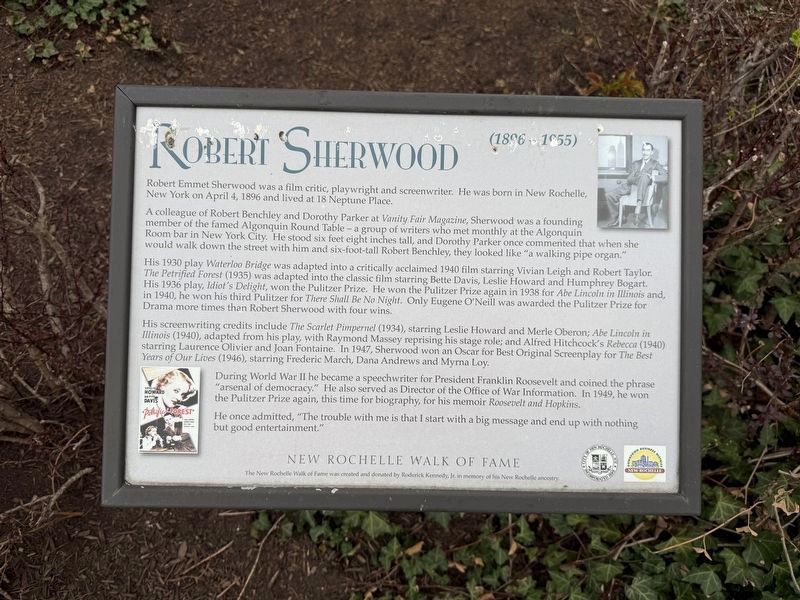
Robert Emmet Sherwood was a film critic, Playwright and screenwriter. He was born in New Rochelle, New York on April 4, 1896 and lived at 18 Neptune Place.
A colleague of Robert Benchley and Dorothy Parker at Vanity Fair Magazine, Sherwood was a founding member of the famed Algonquin Round Table — a group of writers who met monthly at the Algonquin Room bar in New York City. He stood six feet eight inches tall, and Dorothy Parker once commented that when she would walk down the street with him and six-foot-tall Robert Benchley, they looked like "a walking pipe organ."
His 1930 play Waterloo Bridge was adapted into a critically acclaimed 1940 film starring Vivian Leigh and Robert Taylor. The Petrified Forest (1935) was adapted into the classic film starring Bette Davis, Leslie Howard and Humphrey Bogart. His 1936 play, Idiot's Delight, won the Pulitzer Prize. He won the Pulitzer Prize again in 1938 for Abe Lincoln in Illinois and, in 1940, he won his third Pulitzer for There Shall Be No Night. Only Eugene O'Neill was awarded the Pulitzer Prize for Drama more times than Robert Sherwood with four wins.
His screenwriting
this page online
During World War II he became a speechwriter for President Franklin Roosevelt and coined the phrase "arsenal of democracy." He also served as Director of the Office of War Information. In 1949, he won the Pulitzer Prize again, this time for biography, for his memoir Roosevelt and Hopkins.
He once admitted, "The trouble with me is that I start with a big message and end up with nothing but good entertainment."
Erected by City of New Rochelle, NY; New Rochelle Downtown Business District.
Topics. This historical marker is listed in these topic lists: Arts, Letters, Music • Entertainment • Government & Politics • War, World II. A significant historical date for this entry is April 4, 1896.
Location. 40° 54.601′ N, 73° 46.992′ W.
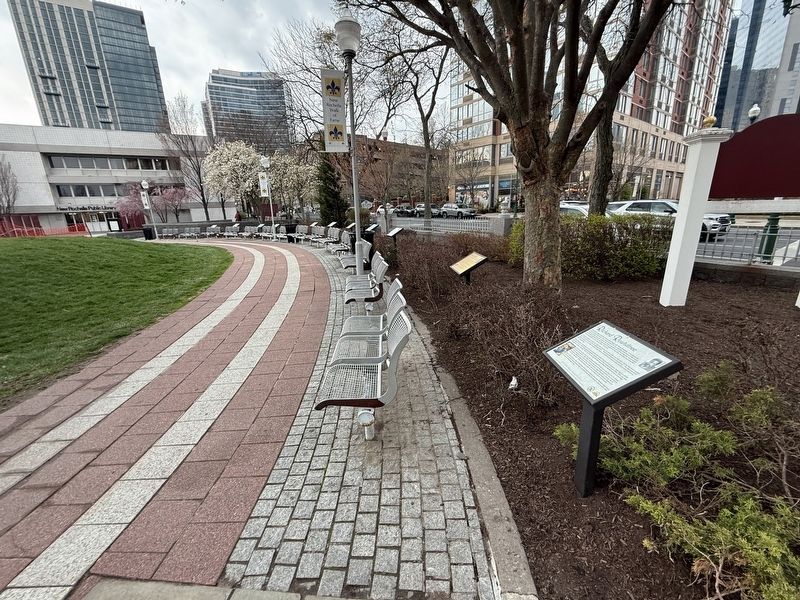

Regionally, this marker is in the Hudson Valley and in the New York City Metropolitan Area. It is also in the American Northeast, in the Mid-Atlantic, and on the Eastern Seaboard. Globally, it is in the North Atlantic Region, North America, the Western Hemisphere, the Western World, and the Anglosphere. Historically, it finds itself in what was once New Netherland and also one of the original Thirteen Colonies.
Other nearby markers. At least 8 other markers are within walking distance of this marker: Willie Mays (here, next to this marker); Alan Menken (here, next to this marker); Barry Gray (here, next to this marker); Edwin & Gertrude Thanhouser (here, next to this marker); Don McLean (here, next to this marker); Coots & Allen (a few steps from this marker); Monty Hall (a few steps from this marker); Frances Sternhagen (a few steps from this marker). Touch for a list and map of all markers in New Rochelle.
Credits. This page was last revised on April 24, 2025. It was originally submitted on April 24, 2025, by Devry Becker Jones of Washington, District of Columbia. This page has been viewed 133 times since then and 19 times this year. Photos: 1, 2. submitted on April 24, 2025, by Devry Becker Jones of Washington, District of Columbia.
