
Bellwood in Chesterfield County, Virginia — The American South (Mid-Atlantic)
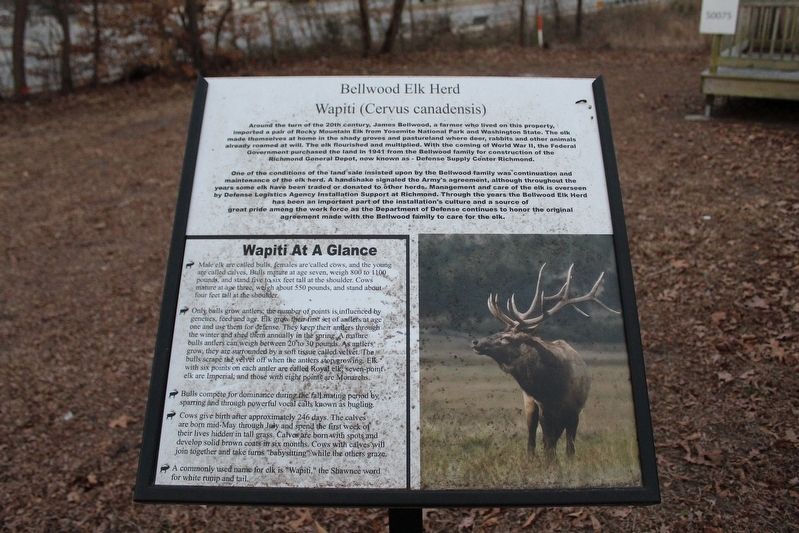
Bellwood Elk Herd
Wapiti (Cervus canadensis)
Photographed by Evan Dwyer, March 1, 2025
1. Bellwood Elk Herd Marker
One of the conditions of the land sale insisted upon by the Bellwood family was continuation and maintenance of the elk herd. A handshake signaled the Army's agreement, although throughout the years some elk have been traded or donated to other herds. Management and care of the elk is overseen by Defense Logistics Agency Installation Support at Richmond. Through the years the Bellwood Elk Herd has been an important part of the installation's culture and a source of great pride among the work force as the Department of Defense continues to honor the original agreement made with the Bellwood
this page online
Wapiti At A Glance
• Male elk are called bulls, females are called cows, and the young are called calves. Bulls mature at age seven, weigh 800 to 1100 pounds, and stand five to six feet tall at the shoulder. Cows mature at age three, weight about 550 pounds, and stand about four feet tall at the shoulder.
• Only bulls grow antlers; the number of points is influenced by genetics, feed and age. Elk grow their first set of antlers at age one and use them for defense. They keep their antlers through the winter and shed them annually in the spring. A mature bulls [SIC] antlers can weigh between 20 to 30 pounds. As antlers grow, they are surrounded by a soft tissue called velvet. The bulls scrape the velvet off when the antlers stop growing. Elk with six points on each antler are called Royal elk; seven-point elk are Imperial; and those with eight points are Monarchs.
• Bulls compete for dominance during the fall mating period by sparring and through powerful vocal calls known as bugling.
• Cows give birth after approximately 246 days. The calves are born mid-May through July and spend the first
Photographed by Evan Dwyer, March 1, 2025
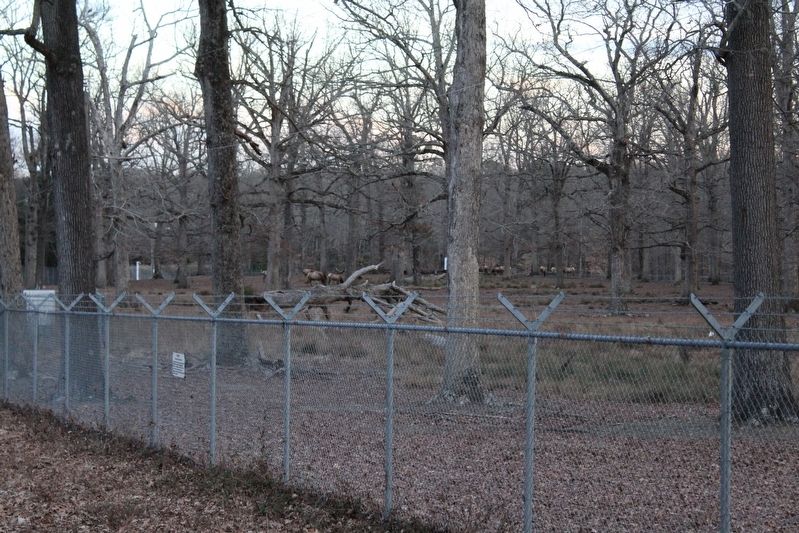
2. Bellwood Elk Herd
Seen from the wooden platform erected next to the marker.
• A commonly used name for elk is “Wapiti,” the Shawnee word for white rump and tail.
Erected by Defense Supply Center Richmond.
Topics. This historical marker is listed in these topic lists: Animals • War, World II. A significant historical year for this entry is 1941.
Location. 37° 24.798′ N, 77° 26.139′ W. Marker is in Bellwood, Virginia, in Chesterfield County. It is on U.S. 1 0.3 miles north of Chester Road, on the right when traveling south. Touch for map. Marker is at or near this postal address: 8000 Route 1, Richmond VA 23237, United States of America. Touch for directions.

Regionally, this marker is in Virginia’s Piedmont, in Central Virginia, and in the Richmond Metropolitan Area. It is also in the American South, specifically in the Upper South, and on the Eastern Seaboard. Globally, it is in the North Atlantic Region, North America, the Western Hemisphere, the Western World, and the Anglosphere.

circa November 2025
3. Bellwood Elk Herd - Cows
The Elk Herd is split, with the females (cows) in the fenced area nearest US Route 1. The males (bulls) are in an area interior to the post that is separated from the cows' yard by a bridge and not visible from the public overlook. The cows number at least 14 as of November 2025.
Other nearby markers. At least 8 other markers are within walking distance of this marker: F/A-18 Hornet (about 300 feet away, measured in a direct line); F-15 Eagle (about 700 feet away); F-14A Tomcat (about 700 feet away); Here Stood Quarters 1, Building 25 (approx. 0.2 miles away); The Gregory Burial Ground (approx. 0.2 miles away); AH-1 Cobra (approx. ¼ mile away); UH-1 Iroquois (approx. ¼ mile away); Bellwood Elk (approx. ¼ mile away). Touch for a list and map of all markers in Bellwood.
Another marker is no longer nearby. Bellwood Elk Herd (has been replaced with this marker).
Related marker. Click here for another marker that is related to this marker. Old Marker At This Location also titled "Bellwood Elk Herd"
Also see . . .
1. The Bellwood Elk Story. Defense Logistics Agency (Submitted on April 25, 2025.)
2. The Bellwood Elk brochure (pdf file). Defense Supply Center Richmond (Submitted on April 25, 2025.)

circa November 2025
4. Bellwood Elk Herd - Bulls
The males (bulls) are kept in a fenced area near west of the Community Center and south of Gregory Cemetery. This view is from the end post of a roadside guardrail; otherwise, the fence would obscure the view. There are at least seven bulls in the herd as of November 2025.
Credits. This page was last revised on December 1, 2025. It was originally submitted on April 25, 2025, by Evan Dwyer of Richmond, Virginia. This page has been viewed 157 times since then and 39 times this year. Photos: 1, 2. submitted on April 25, 2025, by Evan Dwyer of Richmond, Virginia. 3, 4. submitted on November 26, 2025. • Bernard Fisher was the editor who published this page.
