Quartier des Spectacles in Montréal, Québec — Central Canada (French-Canadian)
Le Collège Sainte-Marie
Photographed by Cosmos Mariner, May 22, 2024
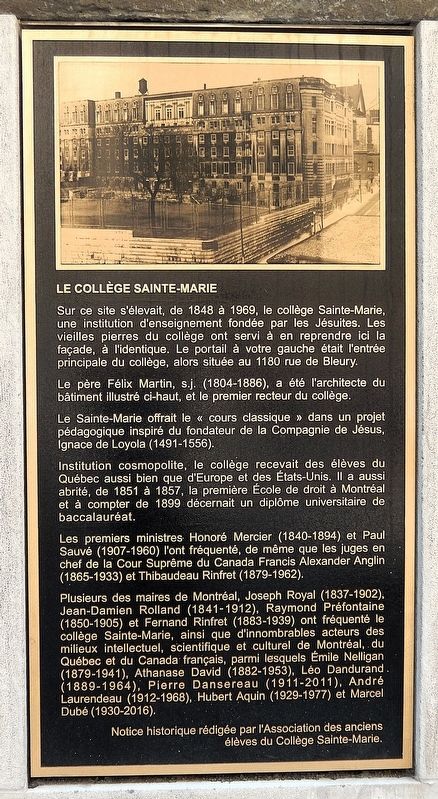
1. Le Collège Sainte-Marie Marker

Le père Félix Martin, s.j. (1804-1886), a été l’architecte du bâtiment illustré ci-haut, et le premier recteur du collège.
Le Sainte-Marie offrait le « cours classique » dans un projet pédagogique inspiré du fondateur de la Compagnie de Jésus Ignace de Loyola (1491-1556).
Institution cosmopolite, le collège recevait des élèves du Québec aussi bien que d'Europe et des États-Unis. Il a aussi abrité, de 1851 à 1857, la première École de droit à Montréal et à compter de 1899 décernait un diplôme universitaire de baccalauréat.
Les premiers ministres Honoré Mercier (1840-1894) et Paul Sauvé (1907-1960) l’ont fréquenté, de même que les juges chef de la Cour Suprême du Canada Francis Alexander Anglin (1865-1933) et Thibaudeau Rinfret (1879-1962).
Plusieurs des maires de Montréal, Joseph Royal (1837-1902), Jean-Damien Rolland (1841-1912), Raymond Préfontaine (1850-1905) et Fernand Rinfret (1883-1939) ont fréquenté le collège Sainte-Marie, ainsi que d'innombrables acteurs des milieux intellectuel, scientifique et culturel de Montréal, du Québec et du Canada français, parmi lesquels Émile Nelligan (1879-1941), Athanase David (1882-1953), Léo Dandurand (1889-1964), Pierre Dansereau (1911-2011), André Laurendeau (1912-1968), Hubert Aquin (1929-1977) et Marcel Dubé (1930-2016).
Notice historique rédigée par l'Association des anciens élèves du Collège Sainte-Marie.
this page online
Father Félix Martin, SJ (1804-1886), was the architect of the building illustrated above, and the first rector of the college.
The Sainte-Marie College offered the "classical course" in an educational project inspired by the founder of the Society of Jesus, Ignatius of Loyola (1491-1556).
A cosmopolitan institution, the college welcomed students from Quebec as well as from Europe and the United States. From 1851 to 1857, it also housed the first law school in Montreal and, starting in 1899, awarded a bachelor's degree.
Prime Ministers Honoré Mercier (1840-1894) and Paul Sauvé (1907-1960) attended it, as did Chief Justices of the Supreme Court of Canada Francis Alexander Anglin (1865-1933) and Thibaudeau Rinfret (1879-1962).
Several mayors of Montreal, Joseph Royal (1837-1902), Jean-Damien Rolland (1841-1912), Raymond Préfontaine (1850-1905) and Fernand Rinfret (1883-1939) attended Sainte-Marie College, as did countless figures from the intellectual, scientific
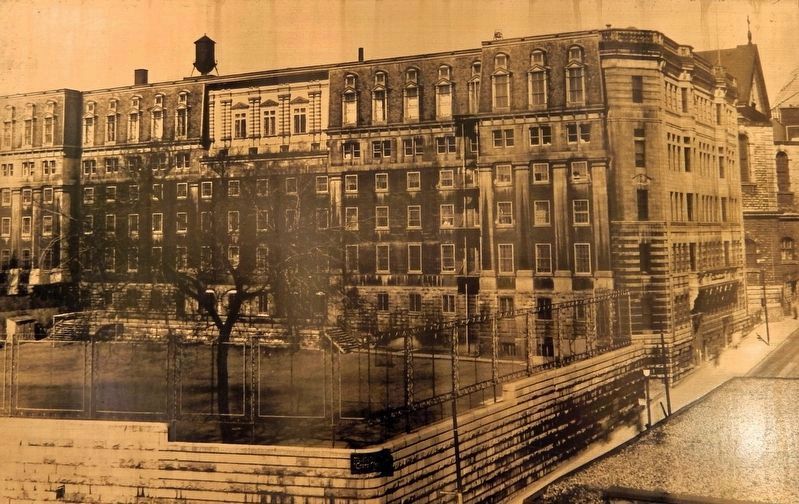
2. Marker detail: Saint-Marie College
Le Collège Sainte-Marie
Historical notice written by the Sainte-Marie College Alumni Association.
Erected by Association des anciens élèves du Collège Sainte-Marie / Sainte-Marie College Alumni Association.
Topics. This historical marker is listed in these topic lists: Architecture • Education • Religion & Religious Structures. A significant historical year for this entry is 1848.
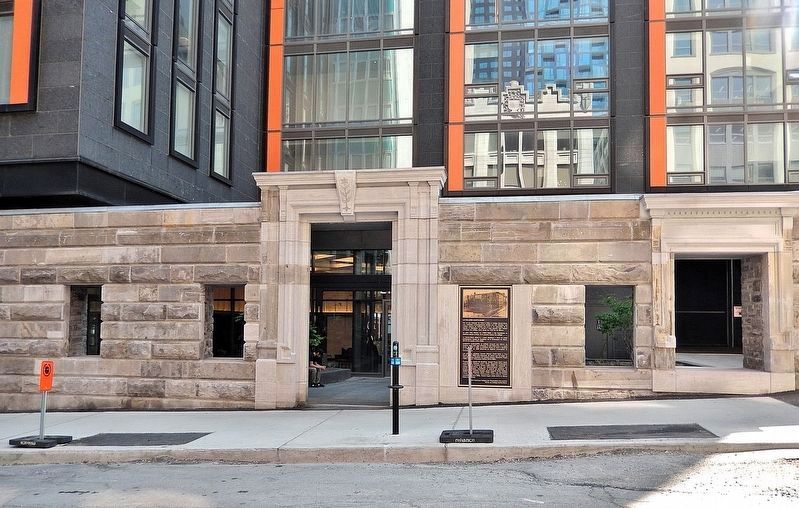
Location. 45° 30.331′ N, 73° 33.929′ W. Marker is in Montréal, Québec. It is in Quartier des Spectacles. It is on Rue de Bleury just west of René-Lévesque Boulevard West, on the right when traveling east. The marker is mounted at eye-level on the stonework facade at this location. Touch for map. Marker is at or near this postal address: 1180 Rue de Bleury, Montréal QC H3B 0H2, Canada. Touch for directions.

Regionally, this marker is in Central Canada. Globally, it is in North America, the Western
Photographed by Cosmos Mariner, May 22, 2024
3. Le Collège Sainte-Marie Marker
The marker is mounted on the replicated Sainte-Marie College stonework facade at this location, on the right side of the former main entrance.
Other nearby markers. At least 8 other markers are within walking distance of this marker: La terre concédée le 24 octobre 1654 (about 150 meters away, measured in a direct line); La Basilique Saint-Patrick / Saint Patrick's Basilica (about 210 meters away); L'église St. James United / St. James United Church (about 210 meters away); The Olympic Symbol (about 240 meters away); Frère André (approx. 0.3 kilometers away); The Canada Cement Company Building / L'édifice de la compagnie Canada Cement (approx. 0.3 kilometers away); La Cathédrale Christ Church / Christ Church Cathedral (approx. 0.4 kilometers away); Raoul Wallenberg (approx. 0.4 kilometers away). Touch for a list and map of all markers in Montréal.
Also see . . . Collège Sainte-Marie de Montréal (Wikipedia).
Excerpt : Collège Sainte-Marie was a college in Montreal, Quebec, Canada. It ceased to exist in 1969, when it was merged into UQAM (Université du Québec à Montréal). Collège Ste-Marie was founded by Jesuits in 1848. It had an English sector, which called the school St. Mary's College but later became separate in 1896 as Loyola College. Ste-Marie never issued degrees. It relied on its affiliation with chartered universities to grant degrees but had full curriculum control. Ste-Marie was originally affiliated with Université Laval until 1920, when it was affiliated with Université de Montréal. The college originally offered secondary education as well as collegial studies.(Submitted on May 1, 2025, by Cosmos Mariner of Cape Canaveral, Florida.)
Credits. This page was last revised on May 1, 2025. It was originally submitted on April 28, 2025, by Cosmos Mariner of Cape Canaveral, Florida. This page has been viewed 106 times since then and 15 times this year. Photos: 1, 2, 3. submitted on May 1, 2025, by Cosmos Mariner of Cape Canaveral, Florida.
