Chichester in West Sussex, England, United Kingdom — Northwestern Europe (the British Isles)
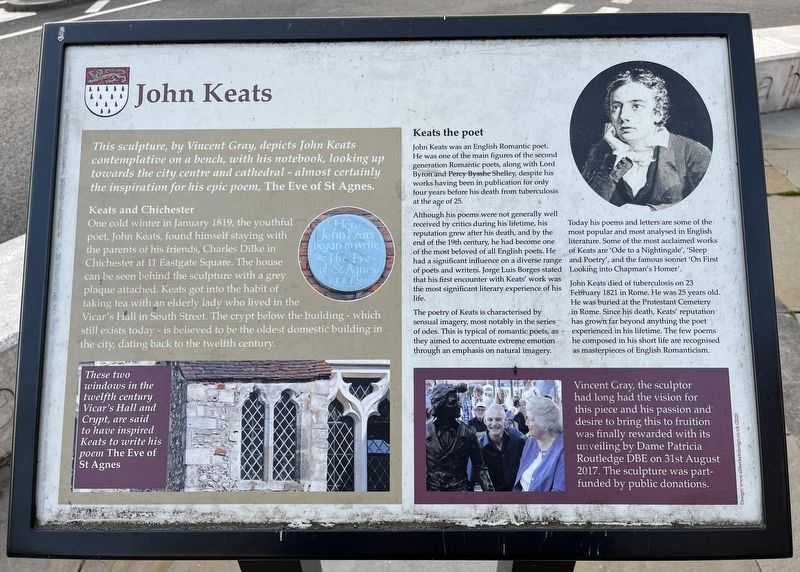
John Keats
Photographed by Ray Gurganus, April 4, 2025
1. John Keats Marker
Keats and Chichester
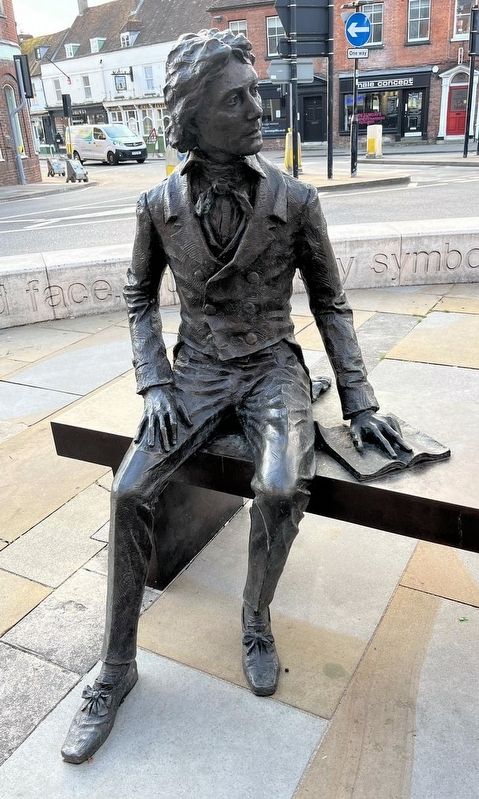
One cold winter in January 1819, the youthful poet, John Keats, found himself staying with the parents of his friends, Charles Dilke in Chichester at 11 Eastgate Square. The house can be seen behind the sculpture with a grey plaque attached. Keats got into the habit of taking tea with an elderly lady who lived in the Vicar's Hall in South Street. The crypt below the building - which still exists today is believed to be the oldest domestic building in the city, dating back to the twelfth century.
Keats the poet
John Keats was an English Romantic poet. He was one of the main figures of the second generation Romantic poets, along with Lord Byron and Percy Bysshe Shelley, despite his works having been in publication for only four years before his death from tuberculosis at the age of 25.
Although his poems were not generally well received by critics during his lifetime, his reputation
this page online
The poetry of Keats is characterised by sensual imagery, most notably in the series of odes. This is typical of romantic poets, as they aimed to accentuate extreme emotion through an emphasis on natural imagery.
Today his poems and letters are some of the most popular and most analysed in English literature. Some of the most acclaimed works. of Keats are 'Ode to a Nightingale', 'Sleep and Poetry, and the famous sonnet 'On First Looking into Chapman's Homer'.
John Keats died of tuberculosis on 23 February 1821 in Rome. He was 25 years old. He was buried at the Protestant Cemetery in Rome. Since his death, Keats' reputation has grown far beyond anything the poet experienced in his lifetime. The few poems he composed in his short life are recognised as masterpieces of English Romanticism.
Vincent Gray, the sculptor
Photographed by Ray Gurganus, April 4, 2025
2. John Keats Statue
Topics. This historical marker is listed in this topic list: Arts, Letters, Music.
Location. 50° 50.172′ N, 0° 46.419′ W. Marker is in Chichester, England, in West Sussex. It is on Eastgate Square, on the left when traveling north. Touch for map. Marker is at or near this postal address: 5 Eastgate Square, Chichester, England PO19 7BD, United Kingdom. Touch for directions.

Regionally, this marker is in the Greater South East. Globally, it is on the Atlantic Ocean, in the North Atlantic Region, in Europe, in Atlantic Europe, on one of the British Isles, in the Western World, and in the Anglosphere. Historically, it finds itself in what was once the Roman Empire.
Other nearby markers. At least 8 other markers are within walking distance of this marker: 1642 - Cannons fire into the city (within shouting distance of this marker); Litten Gardens (about 150 meters away, measured in a direct line); Chichester War Memorial (about 180 meters away); Garden of Reflection and Reconciliation (about 210 meters away); Lance Corporal Maurice Patten (about 240 meters away); 1800s - A new use for the walls (approx. 0.2 kilometers away); AD 280 - The Emperor's seal of approval (approx. 0.4 kilometers away); Ethel Margaret 'Madge' Turner (approx. 0.4 kilometers away). Touch for a list and map of all markers in Chichester.
Credits. This page was last revised on April 29, 2025. It was originally submitted on April 28, 2025, by Ray Gurganus of Washington, District of Columbia. This page has been viewed 124 times since then and 18 times this year. Photos: 1, 2. submitted on April 28, 2025, by Ray Gurganus of Washington, District of Columbia. • Andrew Ruppenstein was the editor who published this page.
