Ashford in Kent, England, United Kingdom — Northwestern Europe (the British Isles)
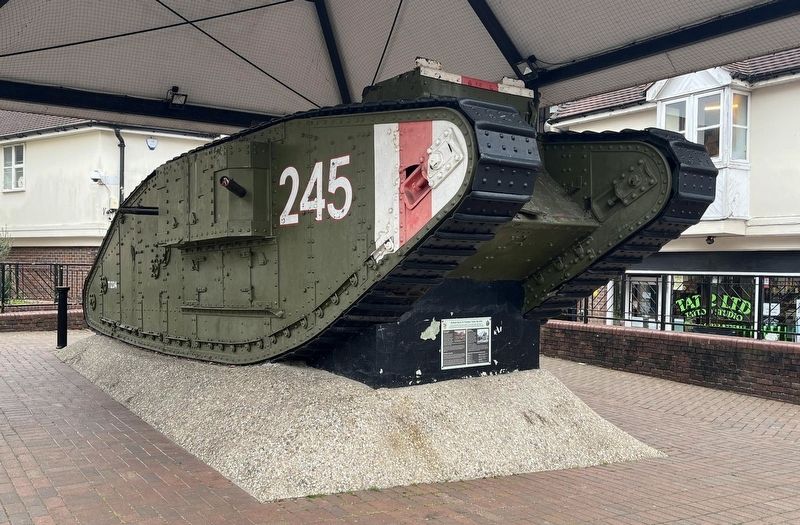
British Mark IV Female Tank, No 245

Photographed by Ray Gurganus, March 25, 2025
1. British Mark IV Female Tank, No 245 Marker
The Invention of the Tank
At the outbreak of the First World War, Europe faced a conflict that was unlike any experienced before. The technological advances of the early 20th century resulted in heavier artillery, better weaponry and more gruelling fighting. Faced with these prospects, the British War Office required a new type of weapon to overcome these odds. The result was the 'Tank', a code name given to disguise these new armoured vehicles as humble water tanks. They were used for the first time at the Battle of Flers-Courcellette with minimal success, with many breaking down or being immobilised by artillery fire.
The Battle of Cambrai
Undeterred the British Army commissioned more tanks and between 1916 and 1918 various new models or 'marks' rolled off the production line. The Mark IV being the most popular
this page online
Ashford's Mark IV Tank
The Mark IV also played an important role on the home front. Many of the training vehicles from Bovington toured the UK to encourage purchases from the National War Savings appeal. After the war 265 of the Mark IVS were gifted to the towns that had raised the most. Ashford was one of those towns and on 1 August 1919, No '245' was delivered by rail and met by a Tank Corps Crew who drove it to St. George's Square, where it has remained ever since. She was de-activated by the removal of her rear drive sprockets and in 1929 her engine was removed to allow an electricity substation to be installed, which was in use until 1972.
Specification of the Mark IV Female Variant:
Weight: 26 tons
Length: 26ft 5in
Width:
Photographed by Ray Gurganus, March 25, 2025
2. British Mark IV Female Tank Marker
Height: 8ft 10in
Road Speed: 3.7 mph
Fuel Capacity: 70 gallons
Engine: 105 bhp Daimler-Foster 6 cylinder Sleeve Valve
Crew: 8 (Commander, Driver, 2 Gearsmen, 4 Gunners)
Armament: 5.303 Lewis Machine Guns
Radius of Action: 35 Miles
Topics. This memorial is listed in this topic list: War, World I. A significant historical year for this entry is 1919.
Location. 51° 9.015′ N, 0° 52.233′ E. Memorial is in Ashford, England, in Kent. It is at the intersection of New Street and St Georges Square, on the left when traveling east on New Street. Touch for map. Memorial is at or near this postal address: New Street, Ashford, England TN24 8TB, United Kingdom. Touch for directions.

Regionally, this memorial is in the Greater South East. Globally, it is on the Atlantic Ocean, in the North Atlantic Region, in Europe, in Atlantic Europe, on one of the British Isles, in the Western World, and in the Anglosphere. Historically, it finds itself in what was once the Roman Empire.
Other nearby markers. At least 8 other markers are within walking distance of this marker: Grammar School (about 210 meters away, measured in a direct line); The Oldest Parts of this Building... (about 240 meters away); TS Churchill, Ashford Sea & Royal Marine Cadets (approx. 0.4 kilometers away); HMS Albacore and 'Warship Week' (approx. 0.4 kilometers away); The Borough Arms (approx. half a kilometer away); Anne Frank's Tree (approx. half a kilometer away); The Hubert Fountain (approx. 0.7 kilometers away); Mystery of the Stags (approx. 0.7 kilometers away). Touch for a list and map of all markers in Ashford.
Also see . . . Hidden History Local Histories - The British Female Mark IV Tank 245, Ashford, Kent. YouTube, 3:18 (Submitted on May 1, 2025.)
Credits. This page was last revised on May 1, 2025. It was originally submitted on May 1, 2025, by Ray Gurganus of Washington, District of Columbia. This page has been viewed 313 times since then and 91 times this year. Photos: 1, 2. submitted on May 1, 2025, by Ray Gurganus of Washington, District of Columbia. • Andrew Ruppenstein was the editor who published this page.
