Strood in Medway, England, United Kingdom — Northwestern Europe (the British Isles)
St Nicholas Church
Photographed by Ray Gurganus, March 26, 2025
1. St Nicholas Church Marker
St Nicholas Church
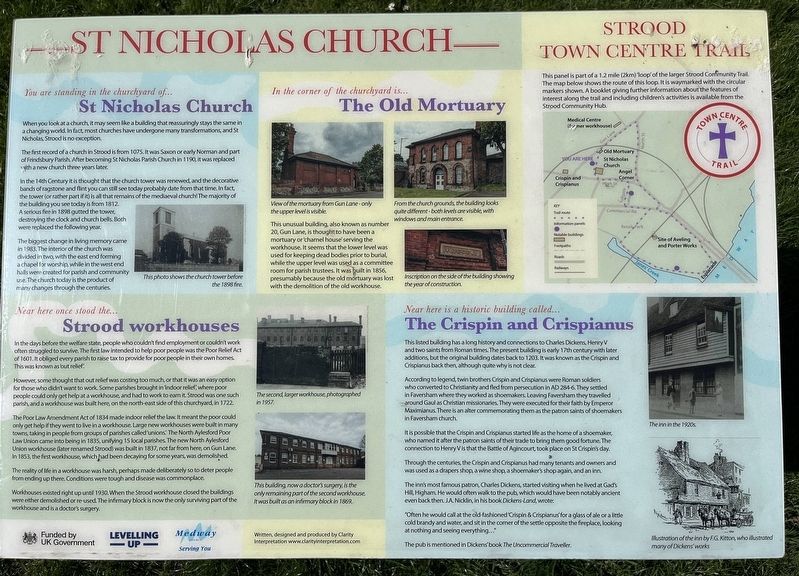
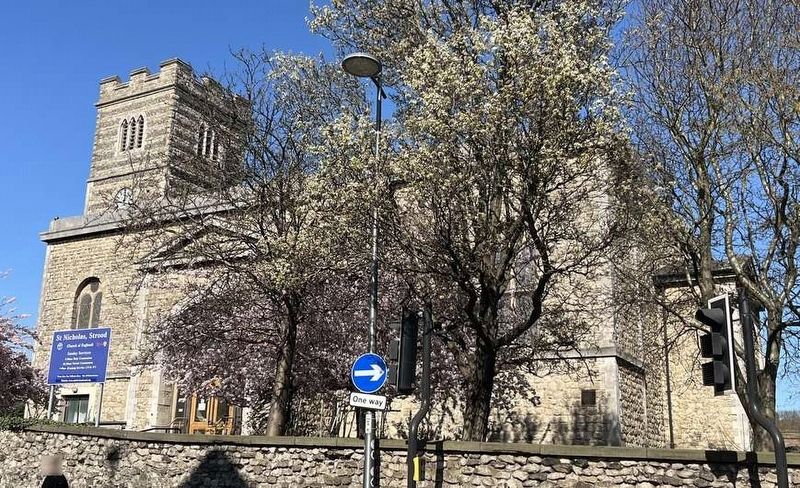
When you look at a church, it may seem like a building that reassuringly stays the same in a changing world in fact, most churches have undergone many transformations and St Nicholas Strood is no exception.
The first record of a church in Strood is from 1075. It was Saxon or early Norman and part of Finsbury Parish After becoming St Nicholas Parish Church in 1190 it was replaced with a new church three years later.
In the 14th Century it is thought that the church tower was renewed and the decorative bands of ragstone and flint you can still see today probably date from that time. In fact the tower (or rather part of it) is all that remains of the medieval church. The majority of the building you see today from 1812. A serious fire in 1898 gutted the tower destroying the clock and church bells. Both were replaced the following year.
The biggest change in living memory came in 1983. The interior of the church was divided in two, with the east end forming a chapel for worship while in the west end halls were created for parish and community use. The church
this page online
In the corner of the churchyard is...
The Old Mortuary
This unusual building, also known as number windows and main entrance 20, Gun Lane, is thought to have been a mortuary or charnel house serving the workhouse. It seems that the lower level was used for keeping dead bodies prior to burial while the upper level was used as a committee room for parish trustees. It was built in 1856 presumably because the old mortuary was lost with the demolition of the old workhouse.
Near here once stood the....
Strood workhouses
In the days before the welfare state, people who couldn't find employment or couldn't work often struggled to survive. The first law intended to help poor people was the Poor Relief Act of 1601. It obliged every parish to raise tax to provide for poor people in their own homes. This was known as 'out relief'.
However, some thought that out relief was costing too much, or that it was an easy option for those who didn't want to work. Some parishes brought in indoor relief, where poor people could only get help at a workhouse, and had to work to earn it.
Photographed by Ray Gurganus, March 26, 2025
2. St Nicholas Church
The Poor Law Amendment Act of 1834 made indoor relief the law. It meant the poor could only get help if they went to live in a workhouse. Large new workhouses were built in many towns, taking in people from groups of parishes called unions. The North Aylesford Poor Law Union came into being in 1835, unifying 15 local parishes. The new North Aylesford Union workhouse (later renamed Strood) was built in 1837, not far from here on Gun Lane. In 1853, the first workhouse, which had been decaying for some years, was demolished.
The reality of life in a workhouse was harsh, perhaps made deliberately so to deter people from ending up there. Conditions were tough and disease was commonplace. Workhouses existed right up until 1930. When the Strood workhouse closed the buildings were other demolished or re-used. The infirmary block is now the only surviving part of the workhouse and is a doctor's surgery.
Near here is a historic building called...
The Crispin and Crispianus
This listed building has a long history and connections to Charles Dickens, Henry V and two saints from Roman times. The present building is early 17th century with later additions, but the original building dates back to 1203. It was known as the Crispin and Crispianus back then, although quite why is not clear.
According to legend, twin brothers Crispin and Crispianus were Roman soldiers who converted to Christianity and fled from persecution in AD 2846. They settled in Faversham where they worked as shoemakers. Leaving Faversham they travelled around Gaul as Christian missionaries. They were executed for their faith by Emperor Maximianus. There is an alter commemorating them as the patron saints of shoemakers in Faversham church.
It is possible that the Crispin and Crispianus started life as the home of a shoemaker who named it after the patron saints of their trade to bring them good fortune. The connection to Henry V is that the Battle of Agincourt, took place on St Crispin's day.
Through the centuries the Crispin and Crispianus had many tenants and owners and was used as a drapers shop a wine shop, a shoemaker's shop again, and an inn.
The inn's most famous patron, Charles Dickens, started visiting when he lived at Gads Hill, Higham. He would often walk to the pub, which would have been notably ancient even back then. J.A. Nicklin, in his book Dickens-Land, wrote:
"Often he would call at the old fashioned Crispin & Crispianus for a glass of ale or a little cold brandy and water, and sit in the comer of the settle opposite the fireplace, looking at nothing and seeing everything..."
The pub is mentioned in Dickens book The Uncommercial Traveller.
Erected by Clarity Interpretation.
Topics. This historical marker is listed in these topic lists: Architecture • Charity & Public Work • Religion & Religious Structures.
Location. 51° 23.791′ N, 0° 29.586′ E. Marker is in Strood, England, in Medway. It can be reached from Gun Lane. In the St Nicholas Churchyard. Touch for map. Marker is at or near this postal address: 14 Gun Lane, Strood, England ME2 4TJ, United Kingdom. Touch for directions.

Regionally, this marker is in the Greater South East. Globally, it is on the Atlantic Ocean, in the North Atlantic Region, in Europe, in Atlantic Europe, on one of the British Isles, in the Western World, and in the Anglosphere. Historically, it finds itself in what was once the Roman Empire.
Other nearby markers. At least 8 other markers are within walking distance of this marker: The Thames and Medway Canal (approx. 0.7 kilometers away); Royal Crown (approx. 0.8 kilometers away); The River Crossing (approx. 0.8 kilometers away); Welcome to Rochester Esplanade Gardens and Churchfields Park (approx. 0.8 kilometers away); The Battlements (approx. 0.9 kilometers away); Percy Henry Gordon (approx. 0.9 kilometers away); The Bull Hotel (approx. 0.9 kilometers away); Guildhall (approx. 0.9 kilometers away).
Credits. This page was last revised on May 2, 2025. It was originally submitted on May 2, 2025, by Ray Gurganus of Washington, District of Columbia. This page has been viewed 174 times since then and 65 times this year. Photos: 1, 2. submitted on May 2, 2025, by Ray Gurganus of Washington, District of Columbia. • Andrew Ruppenstein was the editor who published this page.
